Dollar weaponization is accelerating the push away from the Dollar [Video]
![Dollar weaponization is accelerating the push away from the Dollar [Video]](https://editorial.fxsstatic.com/images/i/Discover-77.png)
The U.S. dollar remains the world’s dominant reserve currency, but countries around the globe are looking for ways to reduce their exposure to it.
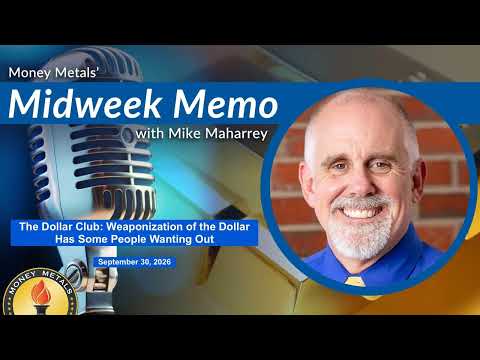
According to Money Metals Midweek Memo host Mike Maharrey, this gradual de-dollarization trend is being fueled not only by America’s fiscal problems, but also by Washington’s increasing willingness to use the dollar-based financial system as a weapon.
The warning signs are already visible in the bond market.
Last week, the 10-year Treasury yield surged to 5.23 percent, its highest level since 2007. Rising yields reflect falling bond prices and signal that investors are becoming increasingly reluctant to lend money to the U.S. government.
That is a serious problem for a country carrying roughly $40 trillion in debt, particularly when there is little political appetite for cutting borrowing or spending. The federal government is already paying more than $1 trillion annually in interest expense. Interest costs now exceed spending on national defense and Medicare. Only Social Security costs more.
The Treasury Department has even been buying back long-term bonds in an effort to support the market and push yields lower. But the effort has not meaningfully reversed the underlying pressure.
A close ally questions Dollar dominance
Canadian Prime Minister Mark Carney recently gave the world another reason to take the de-dollarization trend seriously.
Canada has traditionally been one of America’s closest allies and trading partners. Yet Carney has openly argued that the world should seek alternatives to the dollar, or at least reduce the dollar’s role as the dominant reserve currency.
In a speech before the European Parliament, Carney warned that “financial mechanisms are being used for coercive purposes.” He suggested that Canada and Europe should work more closely to develop payment systems that bypass those controlled by the United States.
In a New York Times interview, Carney went further. He said the world should move toward a “multi-polar system” using several reserve currencies rather than relying so heavily on the dollar.
This does not mean the dollar is about to vanish from international commerce. The dollar remains deeply embedded in global trade and finance, supported by the size, sophistication, liquidity, and depth of U.S. financial markets. As Maharrey put it, the dollar is still the “cleanest dirty shirt in the laundry.”
But the fact that the leader of the world’s 11th-largest economy is publicly discussing ways to minimize dollar dependence matters. It matters even more because Carney’s comments reflect a growing global consensus.
The debt black hole
One force behind the so-called debasement trade is America’s enormous debt burden.
The debasement trade refers to a strategy of holding tangible assets such as gold, silver, and other commodities to protect against the declining purchasing power of fiat currencies. Investors and governments are looking at escalating debt, persistent deficits, and monetary expansion and concluding that holding paper currencies carries greater risk.
Maharrey described the national debt using a phrase coined by analyst Greg Weldon, a “debt black hole.”
Like an astrophysical black hole, the debt burden warps everything around it. It affects monetary policy, fiscal policy, bond markets, government spending, and the broader economy. The higher the debt climbs, the harder it becomes for policymakers to tolerate higher interest rates because every increase in yields makes borrowing more expensive.
The Globe and Mail recently observed that dollar preeminence rests in part on the perception that U.S. Treasuries remain the world’s safest asset. But that assumption is increasingly being questioned as federal debt surpasses $40 trillion and the United States continues to run massive budget deficits.
The world has long needed dollars and dollar-denominated assets. That demand has allowed the U.S. government to borrow and spend far more than would otherwise be possible. Global demand for dollars helps absorb Federal Reserve money creation and supports the dollar despite years of inflationary policy.
If foreign demand for dollars and Treasuries weakens, the United States faces a painful adjustment. Less demand means higher borrowing costs, greater downward pressure on the dollar, and more inflationary consequences at home.
Sanctions create an incentive to escape the Dollar system
The second major driver of de-dollarization is the weaponization of the dollar.
The United States can impose powerful financial pressure because so much global commerce is conducted through dollar-based networks. Washington can freeze assets under U.S. jurisdiction, restrict dealings with American companies, limit foreign banks’ access to U.S. accounts, and use secondary sanctions to punish firms that do business with sanctioned governments or entities.
This power became especially visible after Russia invaded Ukraine and the U.S. and its Western allies aggressively sanctioned Moscow. Russia was effectively locked out of major parts of the global financial system.
More recently, Treasury Secretary Scott Bessent reportedly threatened to target Iranian commercial airlines as part of broader pressure on Iran. He warned that companies or countries supporting those airlines could be “knocked out of the dollar system.”
The message was blunt. Businesses that provide fuel, landing services, or tickets to Iranian airlines could risk losing access to the financial infrastructure that supports international trade.
The U.S. can also work with allies to cut sanctioned entities off from SWIFT, the Society for Worldwide Interbank Financial Telecommunication. SWIFT serves as a global financial messaging network facilitating cross-border payments. Because the dollar remains central to world commerce, cutting off access to these systems can be economically devastating.
Sanctions can be an effective foreign-policy tool. They give governments, banks, and companies a strong incentive to avoid doing business with targeted countries such as Iran or Russia.
But they also create a powerful incentive for other countries to build alternatives.
If governments fear that their access to dollars, U.S. banks, or payment networks can be restricted in the future, they have a reason to diversify away before they become a target. They can reduce dollar reserves, sell Treasury securities, accumulate gold, develop alternative payment networks, and conduct more trade in other currencies.
That is the blowback from dollar weaponization.
Gold buying reflects the global shift
Central bank gold buying has surged in recent years, particularly after the aggressive sanctions on Russia. Countries have recognized that gold is not someone else’s liability. It cannot be frozen by a foreign government, blocked from a payment system, or printed into existence by a central bank.
At the same time, foreign holdings of U.S. Treasuries have declined. China’s Treasury holdings recently fell to their lowest level in decades.
Gold and silver are increasingly attractive in an environment where governments fear the political and financial risks of holding too many dollar assets. A country holding its reserves in gold is far less exposed to sanctions than one holding reserves in Treasuries or dollars parked in foreign banks.
Carney summarized the logic with a simple “fool me once, fool me twice” observation. Once countries see how financial mechanisms can be used coercively, they begin asking how they can diversify away from the system.
That process does not require a sudden collapse in dollar dominance to create problems for the United States. Even modest de-dollarization can matter because America depends on robust global demand for dollars and Treasury debt.
If more unwanted dollars flow back into the U.S. economy, the result could be a dollar glut. That would further weaken the currency and push prices higher, reducing Americans’ purchasing power. In an extreme scenario, a sharp decline in global dollar demand could contribute to a currency crisis.
Roman Silver and the durability of real money
Maharrey closed the episode by contrasting modern fiat money with a recent Roman silver discovery in Germany.
Amateur archaeologist Oliver Riedel found a trove of 934 Roman denarii in a field after his metal detector continued to signal that more coins were buried beneath the ground. Experts later determined that the coins dated to the reign of Emperor Hadrian.
The hoard weighed about 6.8 pounds, or roughly 99 troy ounces. Archaeologists estimated the denarii were approximately 80 percent silver, meaning the find contained more than 79.2 ounces of silver.
At a silver price of $65.47 per ounce, the melt value of the metal was approximately $5,185. The collection also represented a considerable fortune in Roman times. A Roman soldier earned around 300 denarii annually, with about half withheld for food and equipment. The hoard equaled roughly six years of take-home pay for an average soldier.
The lesson is durability.
A Roman denarius buried for nearly 2,000 years may have tarnished, but its silver content still has value. It can be exchanged for goods or currency because silver remains widely recognized as money and a store of value.
By contrast, paper dollars buried today would likely deteriorate over time. Even if the physical notes survived, their purchasing power would be uncertain. Maharrey noted that $5,000 buried 50 years ago would purchase only about $859.75 worth of goods and services today.
Gold and silver cannot be printed into oblivion. Governments can debase coinage by reducing metal purity, as Roman emperors eventually did when the denarius fell as low as 50 percent silver, but they cannot create precious metals with a keystroke.
As nations diversify away from the dollar system and concerns about debt, inflation, and sanctions grow, the enduring characteristics of gold and silver remain relevant. They do not mold, rust, or depend on the promises of any government.
To receive free commentary and analysis on the gold and silver markets, click here to be added to the Money Metals news service.
Author

Joshua D. Glawson
Money Metals Exchange
Joshua D. Glawson is a writer on such topics as philosophy, politics, economics, finance, and personal development. He graduated with a Bachelor in Political Science from the University of California Irvine. His website is JoshuaDGlawson.com.