|

NZDUSD: Price tests 0.5600 for the first time since November 2025

  • Sellers take control of the NZDUSD pair after a brief struggle with buyers 
  • Price tests 0.5600 for the first time since November 2025  
  • 0.5500 now in sight for sellers if 0.5600 support is breached 

NZDUSD broke below 0.5650 on Tuesday, a level that was keenly contested by both buyers  and sellers, with sellers finally able to push through the level. NZDUSD has continued to  move lower, with price testing lows around 0.5600 in the session this afternoon. 

The move comes against the backdrop of moves lower across the major FX pairs, with  EURUSD, GBPUSD and AUDUSD all lower in the session today as higher yields continue to  support the US Dollar broadly across the market. 

NZD has been pressured not only by a slightly dovish macro environment but also by  heightened geopolitical pressure in the Middle East. Iran sent a cease-fire proposal to the US  if certain terms were agreed to, but that has not been accepted by the United States. 

There are now reports that the US is planning another round of attacks on Iran, oil prices are  now back above $91 per barrel. 
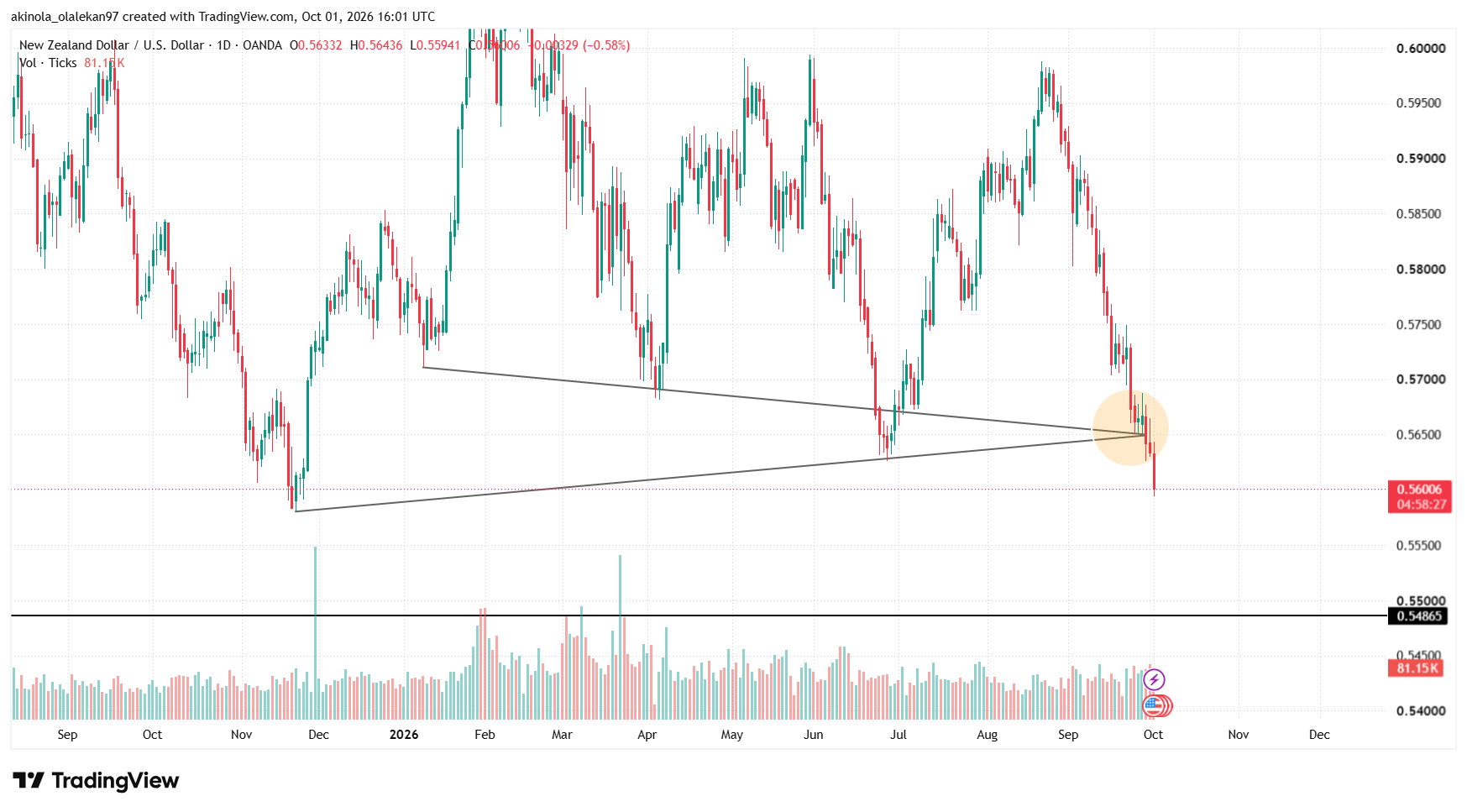
The sharp decline in price today has taken NZDUSD back to lows from November 2025, with  sellers now threatening a break below 0.5600 and setting their sights on extending the move  lower towards 0.5500 in the medium term.

The base case in the market suggests that this move is quite feasible, as the NZD side of the  equation remains slightly disadvantaged compared with the US Dollar side of the equation,  backed not only by higher yields but also by a hawkish Fed. 

The NFP report tomorrow will be key. It could be the next catalyst for a break below 0.5600  and a push towards 0.5500, or it could at least trigger a temporary recovery in price before  sellers resume the onslaught we have seen in recent times. 

In conclusion, it is not looking particularly good for buyers on the NZDUSD pair. Sellers are  constructively in control.

Author

Olalekan Akinola

Olalekan Akinola

Independent Analyst

Olalekan Akinola is a financial-markets analyst and writer with five years of experience covering forex, commodities, and global macroeconomic developments.


More from Olalekan Akinola
Share:

Editor's Picks

AUD/USD stays vulnerable below 0.6800 after weak China data

AUD/USD kicks off the week subdued, consolidating recent heavy losses to its lowest level since January. The pair stays defensive below 0.6800 after China’s October Retail Sales and Industrial Production disappointed, keeping the Chinese proxy, the Australian Dollar, undermined amid a broadly bullish US Dollar and fresh US-Iran tensions.

USD/JPY drifts toward 159.50 despite dismal Japan Q3 GDP

USD/JPY faces headwinds and drifts lower toward 159.50 at the start of the new week on Monday, shrugging off dismal data showing that Japan’s economy unexpectedly shrank by 0.1% in Q3. Japanese Yen draws support from looming intervention risks. Meanwhile, the US Dollar sits near a 19-month high amid certainty of a Fed rate hike and geopolitical risks, supporting the pair.


Gold consolidates before the next leg down

Gold enters bearish consolidation, aiming for October 2025 lows near $3,820 early Monday. US Dollar sits at 19-month highs amid fresh Iranian aggression and hawkish Fedspeak. Gold’s daily technical setup suggests a ‘sell-the-bounce’ strategy for traders.

Bitcoin: ETF outflows hit $1.07 billion as BTC struggles to recover from oversold levels

Bitcoin struggles to regain ground, trading below $65,200 on Monday after extending its decline to a low of $62,006 last week, levels not seen since mid-July. Persistent institutional selling is adding pressure, with spot BTC Exchange Traded Funds recording their second straight week of billion-dollar outflows.

Nvidia earnings and surging yields: Is the market setting a trap?

Stocks finished last week looking surprisingly healthy. But underneath the indexes, three major signals broke at the same time: Treasury yields posted their sharpest weekly jump in more than two years, Nvidia suffered its worst week since the April 2025 tariff selloff, and that Gold closed at its lowest level in more than a year.

Gold hit its lowest level of 2026 near $3,850
Gold (XAU/USD) attempts to stabilize around $3,890 on Friday after falling to $3,852 on Thursday, its lowest level since October 2025. The precious metal has lost more than 4% this week, as investors increasingly anticipate further monetary tightening from the Federal Reserve (Fed). The latest decline reflects a sharp change in market expectations.