Dollar stumbles as Fed cut bets surge – Gold and Oil rebound, risk sentiment recovers


Market overview
Risk assets start the week on a firmer footing, as a sharp US jobs disappointment forces markets to radically rethink the Fed’s next move.
Asian and European equity futures bounce in early trade sessions on Monday, helped by a wave of buy-the-dip flows and the near-certainty of lower US rates by autumn. The US Dollar Index (DXY) trades below 99, giving up all gains from the post-tariff rally, while US yields tumble after Friday’s historic payroll shock. Meanwhile, Brent crude and gold both rebound, and FX volatility returns as US political drama and OPEC+ supply shifts inject fresh uncertainty. Global liquidity and central bank credibility are front and center as traders parse weaker US data, Fed leadership turbulence, and the real-world impact of trade policy on inflation.
Macro and sentiment drivers
US NFP shock: July payrolls rose just 73,000, missing consensus by a wide margin; prior months revised lower by 258,000. Markets now price a 63bps Fed rate cut by year-end; September is nearly fully priced.
Political overhang: President Trump’s firing of BLS Commissioner McEntarfer raises questions over data integrity and the Fed’s future independence, as he is expected to soon fill a vacant Fed governorship.
OPEC+ output: Brent crude reverses early losses as the group confirms a 547,000 bpd output hike for September. Focus shifts to Russian supply risks and US secondary sanctions.
FX flows: The dollar weakens versus pro-cyclical currencies (GBP, AUD, NZD) but is more resilient versus the euro and yen. BoE is 87% priced for a rate cut this week. Sterling remains capped.
Equity sentiment: US and EU futures rally as lower global yields support risk, even as underlying US growth momentum continues to moderate.
Technical and instrument analysis
Brent Crude Oil (Brent) – Hourly chart
-
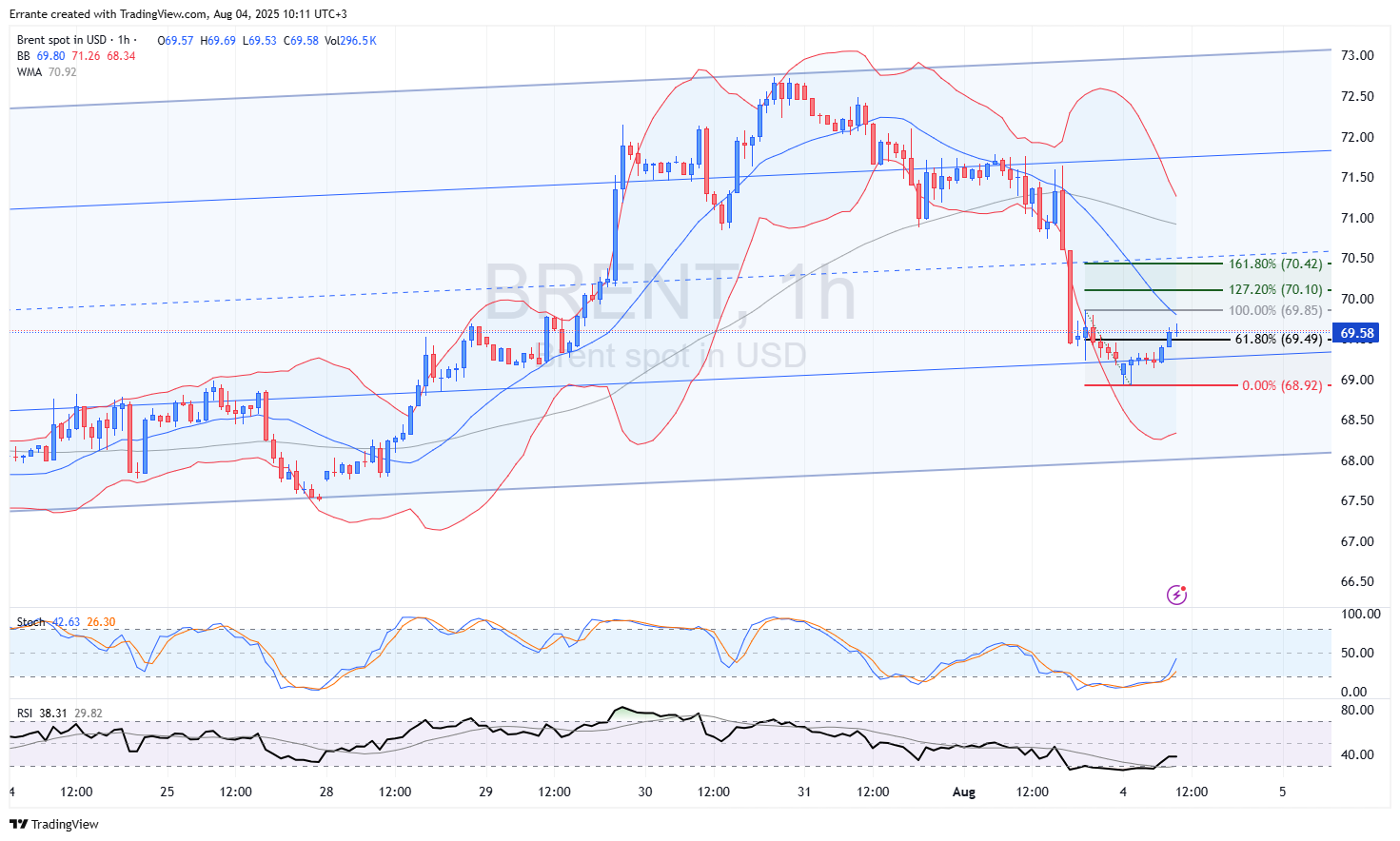
Price action: Brent rebounds above $69.50, recovering from a steep slide that found support at the lower channel boundary and 61.8% Fibonacci retracement ($69.49).
-
Indicators: Stochastics turn up from oversold. RSI is still subdued near 38, signaling recovery but not full bullish momentum. WMA (~$70.92) is a key dynamic resistance.
-
Scenario: As OPEC+ output hike is absorbed and markets watch for secondary sanctions fallout, Brent’s immediate resistance lies at $69.85 (Last top), then $70.10/70.42 (127%/161% extensions). If the dollar remains weak and geopolitical risk returns, a break above $70.50 could trigger a quick move toward the upper channel ($71.25+). Downside risk remains to $68.92 if risk appetite fades.
-
Outlook: Recovery underway but fragile; supply policy and US sanctions are in focus.
Gold Spot (XAU/USD) – Four-hour chart
-
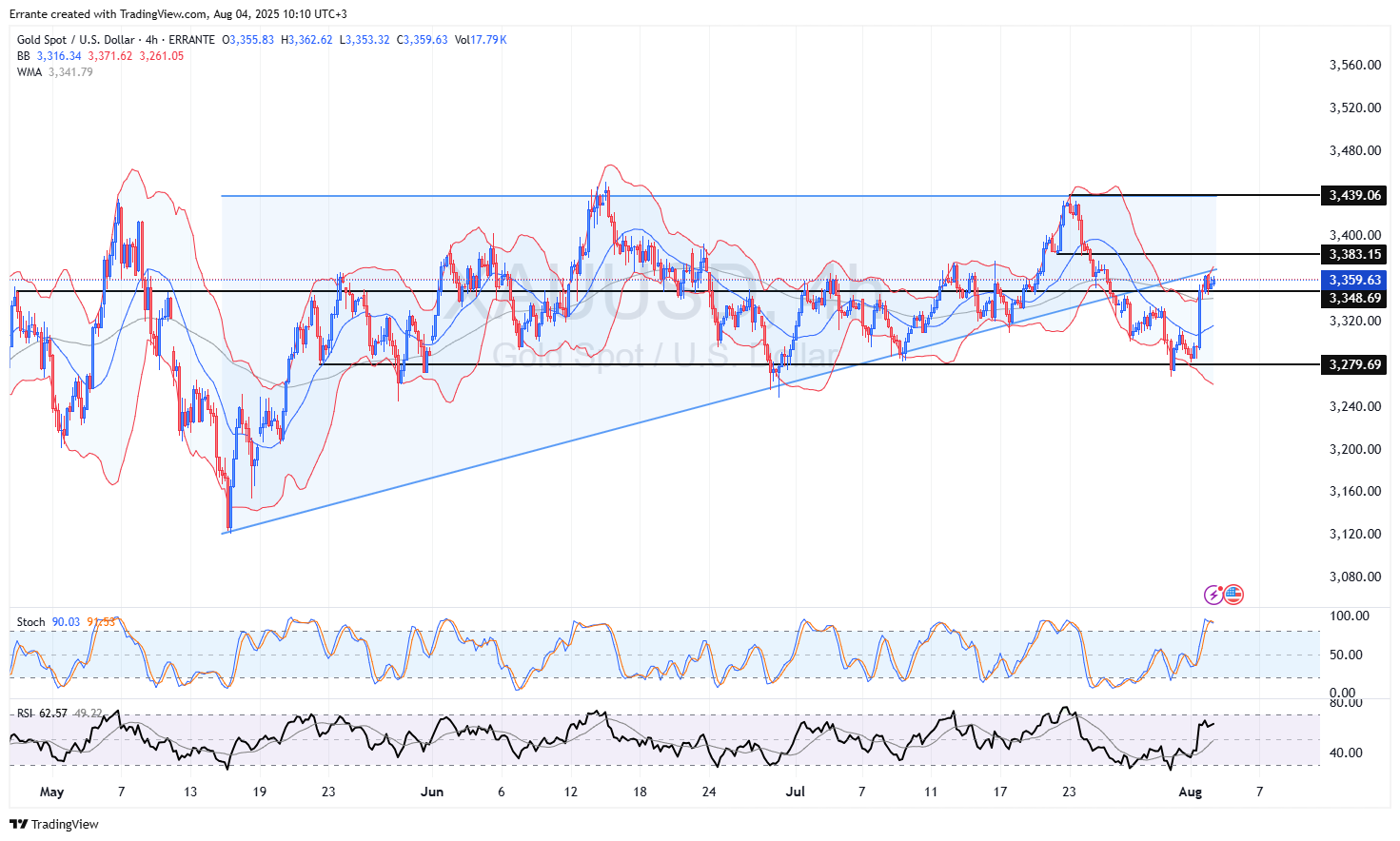
Price action: Gold rallies toward $3,360 after rebounding from the $3,280s, contained within a broad horizontal range ($3,279–$3,439) and now testing the mid-range and Bollinger band resistance.
-
Indicators: Stochastics are in overbought, signaling some risk of short-term exhaustion. RSI is near 62—bullish but not stretched.
-
Scenario: With the Fed credibility under scrutiny and lower US rates now the base case, gold’s safe-haven bid could extend. Bulls eye $3,383 then $3,439 as resistance; above there, momentum could accelerate. On pullbacks, $3,348 is initial support; major range floor at $3,279.
-
Outlook: Bias remains constructive on policy and credibility uncertainty, but overbought conditions argue for tactical caution near resistance.
USD/CAD – Hourly chart
-
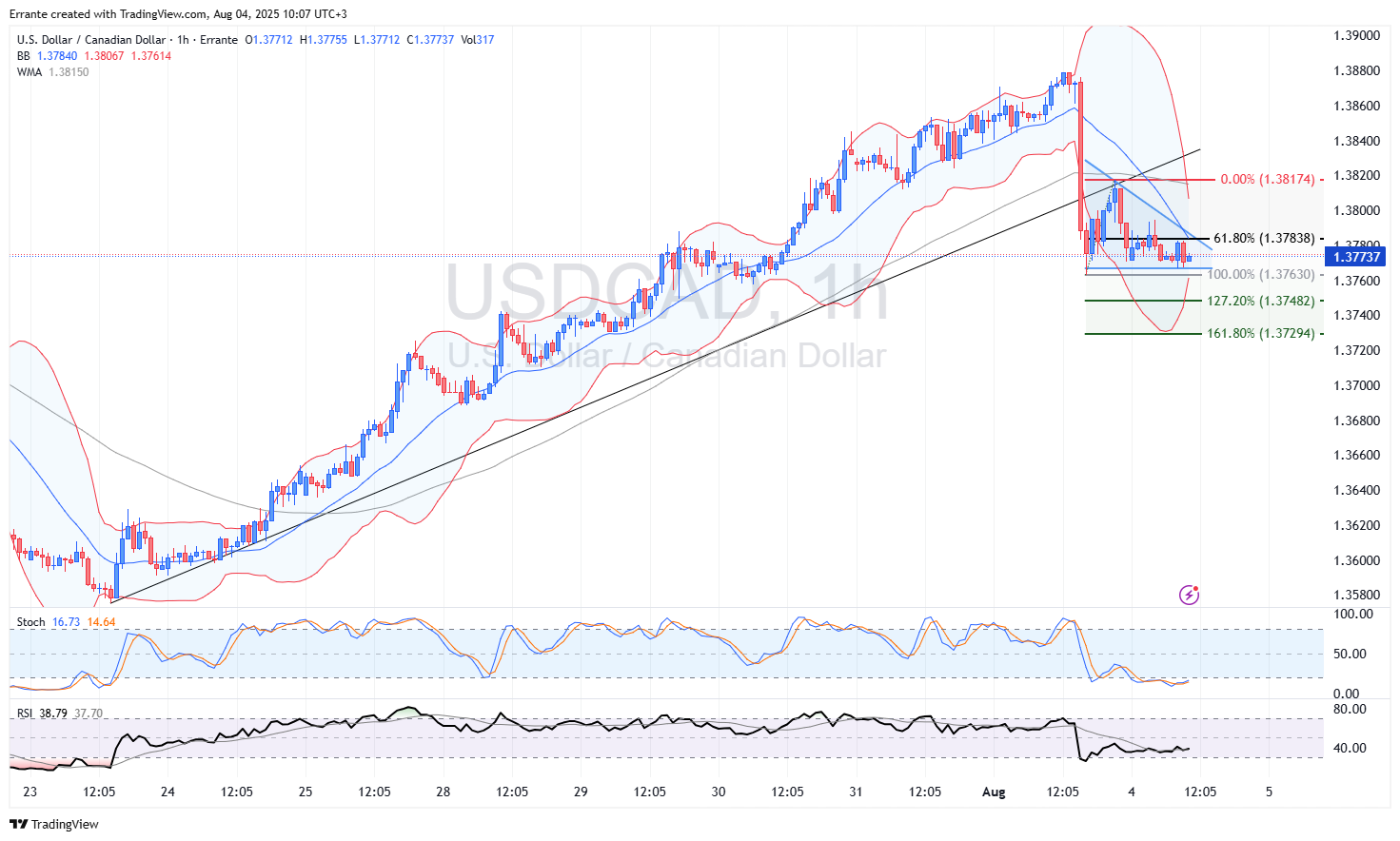
Price action: USD/CAD has broken short-term trend support and now consolidates near $1.3773 after a failed retest of $1.3817. Below WMA, Bollinger bands flatten.
-
Indicators: Stochastics and RSI both signal oversold (RSI ~39). Price is holding above minor support at $1.3763 (Fibo 100%), with room for a technical bounce.
-
Scenario: Downside risks persist as soft US data, a weaker dollar, and stable oil all support CAD. If $1.3763 fails, watch for $1.3748/1.3729 (127%/161% extensions). Resistance stands at $1.3784, then $1.3817.
-
Outlook: Short-term momentum favors CAD as oil recovers and USD weakens; risk of a corrective bounce if US data surprises positively.
CHF/JPY – Hourly chart
-
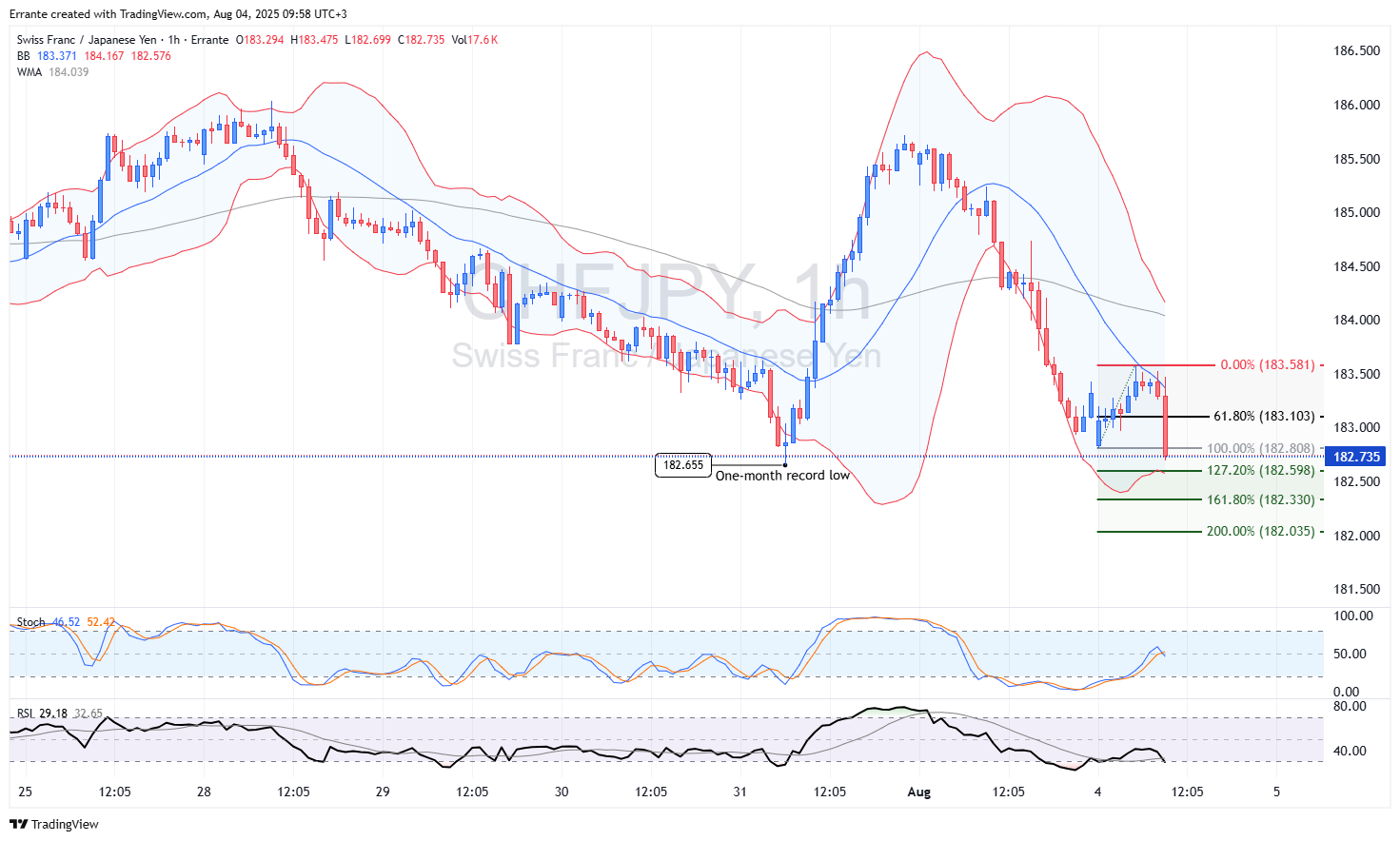
Price action: CHF/JPY hits a one-month low at 182.65, following a steep correction from recent highs. Price trades below both WMA and lower Bollinger band.
-
Indicators: RSI deeply oversold (29), Stochastics still negative.
-
Scenario: Swiss franc remains under pressure after recent SNB dovishness, while the yen recovers on global rate cut bets and a softer USD. Immediate support at 182.65, then 182.60 (127% Fibo), with deeper risk to 182.03 (200%). Resistance at 183.10 and 183.58.
-
Outlook: Trend remains bearish, but oversold levels signal risk of near-term stabilization or short squeeze.
Macro calendar implications
Key data: Little top-tier data today outside US factory orders (expected -4.9% m/m, watch for downside risks), CB Employment Trends, and bill auctions. The market focus remains firmly on Fed communication and US labor market trajectory.
BoE preview: Sterling remains capped as markets anticipate Thursday’s Bank of England cut. Divergence with Fed pricing will be key for GBP/USD direction.
Broader context: With holidays in the UK and Canada, expect lighter liquidity and heightened sensitivity to US political headlines and secondary data surprises.
Actionable themes for traders
-
Dollar volatility and downside risk: Short-term bias remains negative for USD, especially against commodity and risk-sensitive currencies. Watch for tactical reversals on profit-taking.
-
Gold as a hedge: Ongoing Fed credibility questions, political interference, and weaker real rates favor continued gold inflows on dips.
-
Commodities rebound: Oil’s technical recovery may extend if sanctions risks escalate, but OPEC+ output hike limits upside for now.
-
CHF/JPY and haven pairs: Expect volatility as traders rebalance safe-haven exposures in the face of shifting central bank signals.
Conclusion
The market is at a crossroads where political drama, macro data disappointment, and policy uncertainty have converged to force a re-pricing of global rates and risk. As the dust settles from Friday’s jobs shock, traders must balance near-term oversold technicals with the potential for a deeper re-alignment of global capital flows. Maintain a nimble, data-driven approach as central bank signals and US political moves will drive cross-asset volatility in the days ahead.
Author
Ali Mortazavi
Errante
BEc, CMSA, Member of IFTA - International Federation of Technical Analysis, Associate Member of STA - Society of Technical Analysis (UK).