|

Dollar rally may endure beyond weak PCE

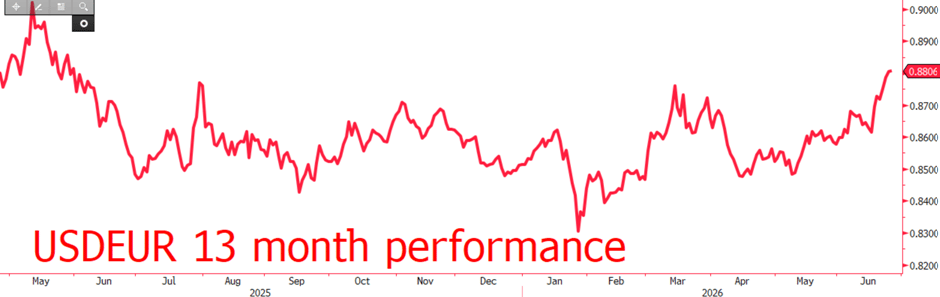
The white-hot and lightning-fast Dollar rally of June, which has swept USDEUR to its strongest since May of last year and propelled the broad DXY back above the 100 indexed level, below which it has lingered for most of the last 12 months, may yet have legs. Certainly, the Fed meeting of June 17th has acted as the firm catalyst for the most recent movement in the Dollar, but in many ways, the Fed may be forced to act regardless of whether it would like to or not.
Chart

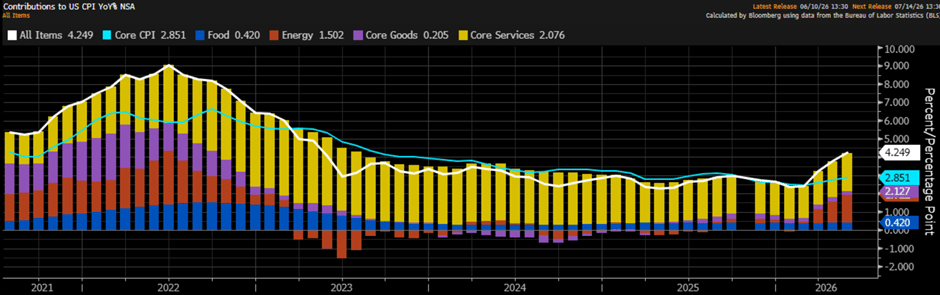
Now that the conflict and the blockade are, for the most part, concluded it makes sense that a routine 2nd-tier data point such as Personal Consumption Expenditure suddenly gains this level of intrigue and interest. The Fed’s benchmark is CPI, which has been above the 2% target for 64 consecutive months and currently sits at 4.2%, whether PCE is 3.5% or 3.6% is pale ale compared to this kind of extended performance.

Whether Warsh sees himself as the man to end this rueful run or whether he is simply the man left with the job, the Fed cannot endure such a period without damage to credibility. Certainly, the worst of the energy shock-induced inflation will, and possibly already has, evaporated, but the issue of high US CPI is more a story of services than goods.
Chart

The above chart shows the constituents of US CPI month by month, with services in yellow and energy in brown. Even a cursory glance tells the tale that US inflation is a services problem at its heart. Oil may steal a few months headlines, but the increasing cost of labour has proven a much more enduring problem for the Fed.

Warsh, the man who ‘does not believe in forward guidance’ gave plenty of it last week, even with what he didn’t say. Other FOMC members also seem to be taking a firm tone with regard to rates. The situation now is that the ECB started the talk before the Fed but soon lost its appetite once the Strait reopened, the BoE never started and the Fed’s just getting going.

Author

David Stritch

Working as an FX Analyst at London-based payments provider Caxton since 2022, David has deftly guided clients through the immediate post-Liz Truss volatility, the 2020 and 2024 US elections and innumerable other crises and events.


More from David Stritch
Share:

Editor's Picks

GBP/USD recovers above 1.3200 as USD loses traction

GBP/USD is rebounding toward 1.3250 in the European session on Monday. The pair recovers ground as the US Dollar uptrend falters and traders resort to profit-taking ahead of Tuesday's US-Iran peace talks and Fed Chair Kevin Warsh's appearance on Wednesday at the ECB Forum.

EUR/USD hold gains around 1.1400 amid US Dollar weakness

EUR/USD is attempting a tepid bounce above 1.1400 in European trading on Monday, helped by a broadly weaker US Dollar. Traders continue to assess the developments surrounding talks to end the US war with Iran. The European Central Bank's annual forum and the US June employment data will be the highlights later this week.

Gold stays in red near $4,050 as US-Iran clash revives inflation fears

Gold price remains in the negative territory around $4,050 in Monday's European trading. The bullion struggles as military clashes between the United States and Iran in the strategic Strait of Hormuz have revived inflation concerns, bolstering Fed rate hike expectations. However, a broad US Dollar retreat is helping limit Gold's downside.

Bitcoin four-year cycle: BTC risks 75% drawdown with four months of bear market still ahead

Bitcoin price continues to trend downward below the $60,000 support zone after losing over 50% of its value since the $126,199 high in October. Bitcoin’s four-year cycle, measured from cycle tops to bottoms, suggests that four months of a bear market are still ahead.

How Kevin Warsh upended the game plan for Gold
Something is breaking inside the Federal Reserve's new strategy, signaling a massive regime change for macro markets. Under the leadership of newly appointed Fed Chair Kevin Warsh, the traditional framework of forward guidance and predictable rate paths could be dismantled soon.
Regime change: Inside Kevin Warsh's first move to make the Fed unreadable on purpose

The rate did not move. That was the least interesting thing about Kevin Warsh's first meeting in charge of the Fed. The FOMC held its benchmark at 3.50%-3.75% for the fourth straight meeting, exactly as priced, and then the new chair used his first press conference to dismantle the machinery the market has leaned on for a decade.