|

USD Index – Limited correction to precede fresh push higher
USD Index

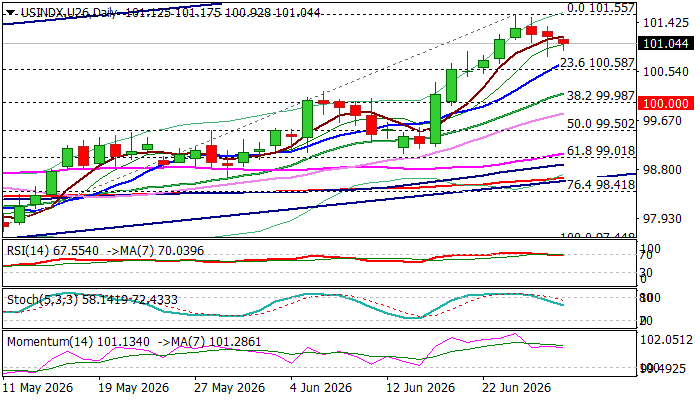
The Dollar extends its gradual easing from new one-year high, with dips being so far limited (Friday’s long-tailed daily candle signals still strong bids).

End of month / quarter prompts some profit-taking as Dollar rallied for two consecutive months and on track for the biggest monthly gain (June) in eleven months.

However, traders may refrain from stronger action ahead of release US May labor data (due later this week) which is expected to add more details to overall picture of the US economy amid growing bets for rate hike in September, as inflation continues to rise and maintains pressure on the central bank.

With larger uptrend being intact, technical correction is expected to provide better buying levels for dollar’s fresh advance.

Initial supports lay at 100.70/60 (10DMA / Fibo 23.6% of 97.44/101.55 upleg), with psychological 100 level, reinforced by Fibo 38.2% retracement, to ideally contain correction and keep broader bulls intact for renewed attack at 101.55 (new 2026 peak) and open way for 102+ acceleration.

Res: 101.55; 102.00; 102.40; 102.67.
Sup: 100.81; 100.60; 100.38; 100.00.
Chart

Author

Slobodan Drvenica

Slobodan Drvenica

Windsor Brokers

Industry veteran with over 22 years’ experience, Slobodan Drvenica joined Windsor Brokers in 1995 when he was an active trader for more than 10 years, managing the trading desk and own account departments.


More from Slobodan Drvenica
Share:

Editor's Picks

AUD/USD bulls seem hesitant near 0.6950

AUD/USD attracts some buyers for the second straight day, though it remains confined within Friday's broader range amid mixed cues. The US PCE data and the US NFP report released last week tempered October Fed hike bets, dragging US bond yields away from multi-year highs and keeping US Dollar bulls on the back foot. However, geopolitical uncertainty is a tailwind for the safe-haven buck, while the RBA's cautious outlook caps the Aussie.

USD/JPY remains confined in a range below 158.00

USD/JPY holds steady around 157.75 during the Asian session on Monday, trading within a one-week-old range. Against the backdrop of soft US PCE data, the US NFP report, released on Friday, tempers October Fed rate-hike bets and drags US bond yields away from multi-year highs. Furthermore, hawkish BoJ expectations amid looming intervention risks support the Japanese Yen, capping the pair. However, geopolitical uncertainty acts as a tailwind for the safe-haven buck and limits the downside.

Gold trades with positive bias around $4,150; upside seems capped

Gold attracts some dip-buyers at the start of a new week, though it remains confined in a familiar range held over the past week or so. Against the backdrop of soft US PCE data, Friday's weak US NFP report tempered bets of an October Fed rate hike. This, in turn, drags US bond yields away from multi-year highs and benefits the non-yielding bullion. The US Dollar, however, draws support from geopolitical uncertainties and could act as a headwind for the precious metal.

Week ahead: Fed minutes in the spotlight amid bond market rout
The first full week of October and the final quarter of the year get underway with little fanfare in terms of the economic agenda. But far from being short on excitement, the coming week will test market nerves, as government bond yields continue to soar on growing worries that the energy crisis will only get worse, fuelling inflation.
CFTC Report: Speculators turn more defensive as Oil exposure falls
The week in one sentence: During the week leading up to September 29, long positions in crude oil were significantly reduced, while short positions in the Canadian Dollar went up. In addition, the positioning of the Australian Dollar and the Japanese Yen declined, while Coffee buying stood out against a more general background of defensiveness.
The Euro is near a one-year low: Inflation could trigger its rebound, not its fall

EUR/USD has fallen to its lowest level since May 2025. The pair hit 1.1312 on Wednesday and trades well below the January peak of 1.2082. The decline reflects a powerful combination of US Dollar strength, geopolitical uncertainty and renewed concerns about Europe's exposure to higher energy prices.