Dollar Index dips to level not seen since early 2022


The U.S. dollar ended the second quarter of 2025 notably weaker, with the Wall Street Journal reporting a decline of over 5% from its starting level in April. According to internal data from ActivTrades, the greenback has been under sustained pressure since mid-February, registering a total loss of approximately 12% against a basket of major global currencies. This downtrend appears to be continuing into the third quarter, with the U.S. Dollar Index down by 0.36% at the time of writing, marking a soft start to July.
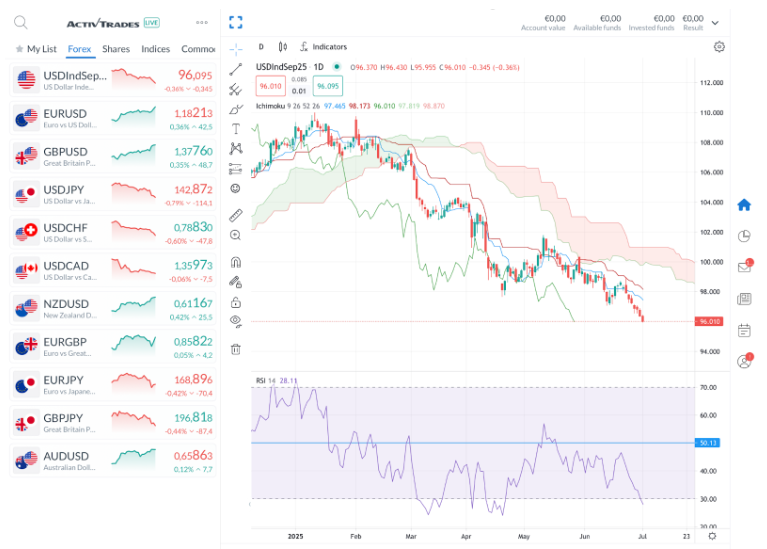
US Dollar Index Daily Chart - Source: ActivTrader
From a technical standpoint, the bearish momentum has been firmly in place for several months. In mid-February, the index broke decisively below the Ichimoku cloud, a widely followed Japanese trend indicator, and has since remained beneath all key technical thresholds. This persistent weakness is reinforced by the behavior of the Relative Strength Index (RSI), which has hovered below the neutral 50 level for most of the period and has now slipped into oversold territory, falling below 30—typically interpreted as a signal of sustained downward pressure.
What is driving the dollar’s decline, and what could the coming months hold for the currency? In the analysis that follows, we explore the macroeconomic forces, market sentiment, and policy outlook that are shaping the trajectory of the U.S. dollar—and what investors should watch as the second half of 2025 unfolds.
The US Dollar’s decline: Context, causes, and outlook
The immediate catalyst for the dollar’s downturn stems largely from evolving expectations around U.S. monetary policy. Market participants have become increasingly convinced that the Federal Reserve will begin easing interest rates later this year. According to the CME FedWatch tool, the probability of three rate cuts in 2025 has risen to 49%, up from just 29% a month ago. The probability of a rate cut to the 4.00–4.25% range in July stands at 21%, while September sees a 75% chance, driven by a softening labor market, cooling inflation data, and signs of slowing economic momentum.
This week could be volatile for the greenback. On Thursday, the June Nonfarm Payrolls report is expected to offer new insights into the health of the U.S. labor market. Any upside or downside surprises in job creation or wage growth may recalibrate expectations for monetary policy in the second half of the year. In parallel, markets are also watching for any shift in tone from Federal Reserve Chair Jerome Powell, who is scheduled to speak at the European Central Bank’s annual Sintra forum. A change in rhetoric—especially concerning inflation risks or the timing of rate cuts—could meaningfully influence the dollar’s near-term direction.
Despite some episodes of temporary support—such as a brief flight to safety amid Middle East tensions and the Fed’s initial reluctance to cut rates—the dollar has remained under pressure. The April announcement of sweeping tariffs introduced by President Trump served as a critical turning point, injecting additional policy uncertainty and triggering capital outflows. While the imposition of an average 13% tariff—down from the 20% initially threatened—has tempered fears of runaway inflation, the looming expiration of the current 90-day tariff pause on July 9 has revived investor unease. The outcome of this deadline could significantly impact dollar sentiment.
The Fed’s internal divide has added to the uncertainty. Chair Jerome Powell has maintained a cautious stance, emphasizing a "wait-and-see" approach in light of evolving policy risks, particularly those tied to tariffs. He reiterated in his June 24 testimony before the Senate that monetary decisions are not influenced by political pressure, a statement that comes amid escalating attacks from President Trump. Trump has publicly and repeatedly criticized Powell and the Federal Reserve Board, calling for aggressive rate cuts to support economic growth. This political pressure has introduced an unusual degree of tension and speculation around the Fed’s independence.
Investment banks are beginning to revise their forecasts accordingly. Goldman Sachs now expects three 25-basis-point cuts in 2025—in September, October, and December—citing muted inflationary impact from tariffs and persistent labor market fragility. Citigroup, Wells Fargo, and UBS Global Research have issued similar projections, with UBS going further by forecasting 100 basis points of easing before year-end. For 2026, Goldman Sachs expects two additional cuts, bringing its projected terminal rate down to 3.00%–3.25%.
Beyond monetary policy, the dollar’s decline also reflects a broader rebalancing of global capital flows. The long-standing narrative of U.S. exceptionalism—grounded in strong fundamentals, deep capital markets, and dominant technology firms—is now being reassessed. Growing concerns about fiscal sustainability, political instability, and protectionist trade policies have led many international investors to begin rotating capital away from U.S. assets.
Recent months have seen increased allocations to European and Japanese markets, where relative valuations, policy clarity, and macroeconomic stabilization offer compelling alternatives. The euro, in particular, has benefited, climbing to its highest level against the dollar in nearly four years. Investors are beginning to price in potential upside surprises in European growth, especially in 2026, in contrast to a moderating U.S. outlook.
That said, U.S. assets remain dominant in global portfolios. According to Fidelity International, U.S. large-cap equities still represent over 20% of global equity market capitalization, and the country remains a core destination for global capital thanks to its innovation capacity, demographic resilience, and liquidity depth. However, Bertrand Puiffe, portfolio manager at Fidelity, has cautioned against excessive concentration in U.S. equities, encouraging diversification as geopolitical and policy risks mount. Beyond Europe, he sees promising opportunities in emerging markets such as India and Indonesia.
While the current weakness may appear overstretched in the short term, structural headwinds suggest the U.S. dollar may remain under downward pressure this year and into 2026—unless policy clarity, macroeconomic momentum, and investor confidence in the Fed’s independence improve meaningfully.
Stay up to date with what's moving and shaking on the world's markets and never miss another important headline again! Check ActivTrades daily news and analyses here.
Stay up to date with what's moving and shaking on the world's markets and never miss another important headline again! Check ActivTrades daily news and analyses here.
Author
Carolane de Palmas
ActivTrades
Carolane graduated with a Masters in Corporate Finance & Financial Markets and got the AMF Certification (Financial Markets Regulator in France). Afterward, she became an independent trader, investing mostly in European and American stocks/indices.