Despite the heat, the animal spirits are cooling off

Summary
-
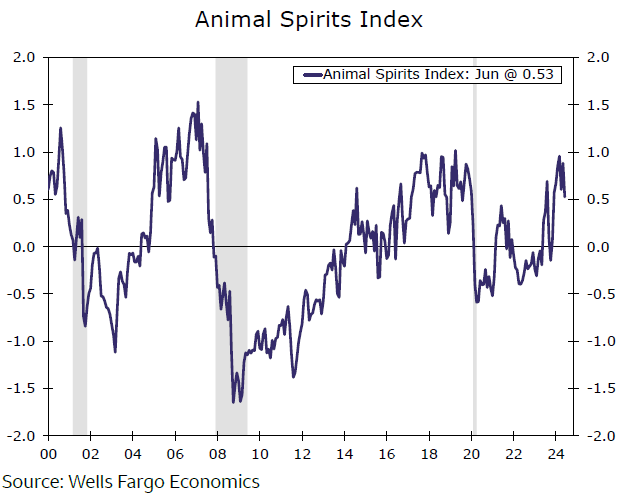
Our Animal Spirits Index (ASI) fell in June to 0.53 from 0.88 in May but has remained positive in all six months of 2024.
-
Most components were subtractive in June, with the only strength tied to indicators reflecting the stock market.
-
Though a positive reading, it sits below the year-to-date average of 0.75 and is the lowest index value seen since November of last year, reflecting the recent deceleration seen in the U.S economy.
Stormy spirits ahead?
Our Animal Spirits Index (ASI) fell in June to 0.53 from 0.88 in May but has remained positive in all six months of 2024 (chart). Previous reports detail the index's methodology, but on a basic level, an index value above zero indicates optimism and a value below zero suggests pessimism.1 Though June's reading remains positive, it sits below the year-to-date average of 0.75 and is the lowest index value seen since November of last year.
The ASI consists of five indicators: the S&P 500 Index, the Conference Board’s Consumer Confidence Index, the yield curve (the spread between the 10-year and three-month Treasury yields), the VIX Index and the Economic Policy Uncertainty Index. The policy uncertainty and VIX indices inversely affect the ASI. In other words, a rise in uncertainty or volatility decreases the index, while a fall increases the index, all else equal.
Most components were subtractive in June, with the only strength tied to the indicators reflecting the stock market. The S&P 500 Index reached another record high, and rose roughly 183 points over the month. Year-to-date, the index is up 13% and has contributed positively to the ASI for five out of the six months of 2024. Stock market volatility remained roughly the same from May to June, falling slightly to 12.44 from 12.92 previously. In the bond market, the yield spread on the 10-year and 3- month Treasuries widened to -94 bps from -77 bps in May. The yield curve has been inverted since November 2022 and continues to weigh heavily on the ASI.
Author
Wells Fargo Research Team
Wells Fargo

















