|

Despite headwinds, a record pace of service sector expansion in July

Summary

The service sector continued to expand full-throttle in July, with the services ISM hitting a new record high of 64.1. While stronger hiring suggests labor constraints eased at least slightly, supply problems extend well beyond the manufacturing sector. With supplies and labor both in short supply, input costs are rising further with the prices paid measure hitting its highest level in more than 15 years.

Services Activity On Fire in July, but Will it Last?

Amid hand-wringing about the peak of growth having passed and worries about the reopening of the service economy, the ISM Services index for July set a new record high. With the exception of inventory measures, all other components are in expansion territory and most moved higher in July.

Business activity is humming, with the subindex adding 6.6 points to 67.0, just a few notches below the 69.4 print in March when stimulus checks burned a hole in consumers' pockets and drove this component to an all-time high.

The biggest change of any component was a 15.1 point leap for new export orders. While this does not factor into the headline, it does signal a rebound for service exports which could eventually help narrow the trade deficit and add to growth.

In a sense, there are two seemingly contradictory problems occurring at the same time. The first is that demand for services has come back online faster than the ability of firms to staff-up and source needed parts and materials. The second is the slow realization that COVID has gone from something people thought was largely behind us to the problem that just won't go away. Rising case counts and the particularly virulent Delta variant are threatening to disrupt the recreation renaissance we have been counting on to drive a services spending boom this summer. Through July at least, the service sector is still cranking at full throttle.
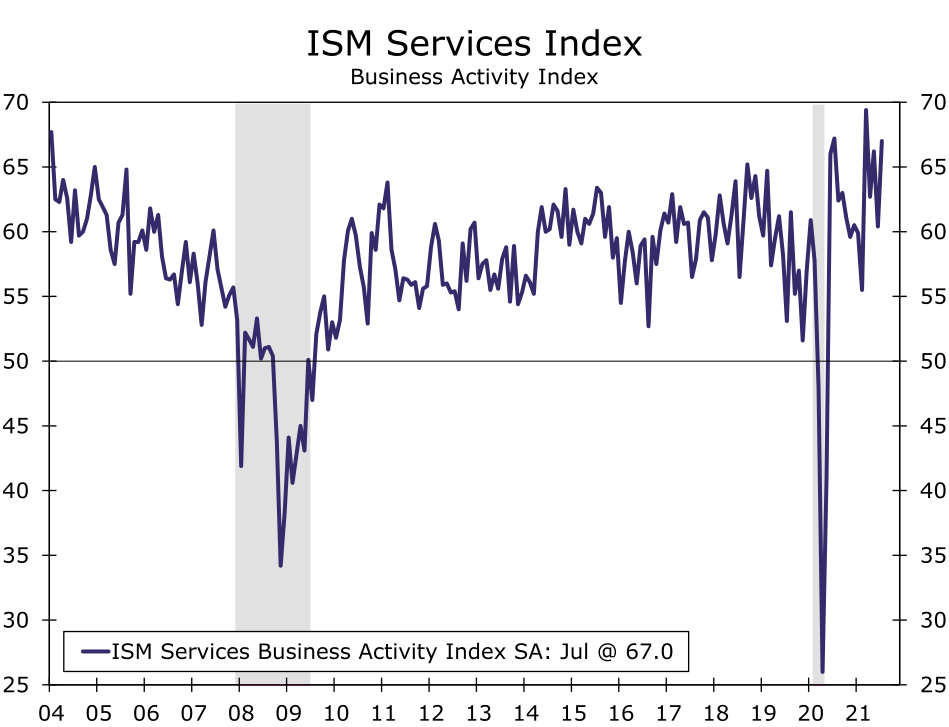
Source: Institute for Supply Management and Wells Fargo Securities

Download the full report

Author

More from Wells Fargo Research Team
Share:

Editor's Picks

EUR/USD flirts with daily highs, retargets 1.1900

EUR/USD regains upside traction, returning to the 1.1880 zone and refocusing its attention to the key 1.1900 barrier. The pair’s slight gains comes against the backdrop of a humble decline in the US Dollar as investors continue to assess the latest US CPI readings and the potential Fed’s rate path.

GBP/USD remains well bid around 1.3650

GBP/USD maintains its upside momentum in place, hovering around daily highs near 1.3650 and setting aside part of the recent three-day drop. Cable’s improved sentiment comes on the back of the Greenback’s  irresolute price action, while recent hawkish comments from the BoE’s Pill also collaborate with the uptick.

Gold clings to gains just above $5,000/oz

Gold is reclaiming part of the ground lost on Wednesday’s marked decline, as bargain-hunters keep piling up and lifting prices past the key $5,000 per troy ounce. The precious metal’s move higher is also underpinned by the slight pullback in the US Dollar and declining US Treasury yields across the curve.

Crypto Today: Bitcoin, Ethereum, XRP in choppy price action, weighed down by falling institutional interest 

Bitcoin's upside remains largely constrained amid weak technicals and declining institutional interest. Ethereum trades sideways above $1,900 support with the upside capped below $2,000 amid ETF outflows.

Week ahead – Data blitz, Fed Minutes and RBNZ decision in the spotlight

US GDP and PCE inflation are main highlights, plus the Fed minutes. UK and Japan have busy calendars too with focus on CPI. Flash PMIs for February will also be doing the rounds. RBNZ meets, is unlikely to follow RBA’s hawkish path.

Ripple Price Forecast: XRP potential bottom could be in sight

Ripple edges up above the intraday low of $1.35 at the time of writing on Friday amid mixed price actions across the crypto market. The remittance token failed to hold support at $1.40 the previous day, reflecting risk-off sentiment amid a decline in retail and institutional sentiment.














