Currency market: USD interest and exchange rates

Canada’s two main interest rates are CORRA or Canada Overnight Repo Rate Average and OMMFR or Overnight Money Market Finance Rate.
The proper position is OMMFR trades below CORRA in order to borrow low and sell high. OMMFR is the protection rate so CORRA never trades to zero or negative. And also so the exchange rate doesn’t trade out of control.
Many central banks offer a protection interest rate. The BOJ for example uses the Overnight Call rate Vs the Interest rate applied to Deposit Facility as protection rates. Both now trade at 0.979 Vs Deposit Facility at 0.90.
From the BOJ. However, with the completion of the deregulation of interest rates in 1994, the direct link between the official discount rate and deposit rates disappeared. In its place, various interest rates are now determined by arbitrage activities in financial markets. In such a situation, the previously adopted official discount rate is now called the basic loan rate — the loan rate applied to the Complementary Lending Facility — and acts as a ceiling on the uncollateralized overnight call rate.
A Floor and ceiling and where is found the exchange rate
Call rates trade above the deposit facility rate just as OMMFR trades above CORRA. These are misalignments as OMMFR must trade below CORRA and explains USD/CAD shorts. Japanese Call rates must trade below the Deposit Facility and explains USD/JPY shorts.
From CORRA and OMMFR comes next short term yields and the same for Japan and the BOJ.
Switzerland London, Libor 3
CHF CHF USD JPY GBP EUR
SARON M 1 Call money rate (Tomorrow next) M Money market debt register claims of the Swiss Confederat… 3-month M 2 1-month M 3-month M 6-month M 12-month M 3-month M 3-month M 3-month M 3-month M
2019-12 -0.659 -1.000 -0.751 -0.781 -0.688 -0.622 -0.481 1.908 -0.047 0.792 -0.414
2020-01 -0.702 -0.850 -0.762 -0.773 -0.690 -0.641 -0.506 1.751 -0.057 0.765 -0.416
2020-02 -0.707 -0.800 -0.762 -0.825 -0.735 -0.707 -0.602 1.463 -0.076 0.673 -0.471
2020-03 -0.666 -1.250 -0.750 -0.780 -0.655 -0.571 -0.452 1.451 -0.049 0.596 -0.255
2020-04 -0.659 -0.850 -0.719 -0.722 -0.583 -0.560 -0.441 0.556 -0.003 0.594 -0.185
2020-05 -0.660 -0.850 -0.734 -0.761 -0.651 -0.597 -0.478 0.344 -0.041 0.228 -0.347
2020-06 -0.662 -0.900 -0.734 -0.767 -0.676 -0.626 -0.472 0.302 -0.047 0.141 -0.422
2020-07 -0.704 -0.850 -0.738 -0.788 -0.705 -0.656 -0.528 0.249 -0.055 0.084 -0.445
2020-08 -0.706 -0.830 -0.746 -0.789 -0.720 -0.668 -0.525 0.241 -0.058 0.064 -0.509
2020-09 -0.714 -0.850 -0.746 -0.805 -0.781 -0.726 -0.598 0.234 -0.104 0.061 -0.520
2020-10 -0.718 -0.830 -0.790 -0.805 -0.767 -0.733 -0.625 0.216 -0.103 0.045 -0.530
2020-11 -0.721 -0.830 -0.805 -0.842 -0.784 -0.732 -0.612 0.228 -0.117 0.045 -0.552
2020-12 -0.726 -0.850 -0.782 -0.813 -0.764 -0.725 -0.610 0.238 -0.083 0.026 -0.566
Above is CHF and the SNB. The CALL Money Rate at 0.341 trades above Debt Register Claims at 0.249 and is misaligned. Explains USD/CHF shorts.
V39050: Overnight Money Market Financing Rate
V39050: Overnight Money Market Financing Rate
Low 2021-01-14 0.1973
Average 2021-01-11 — 2021-01-14 0.2010
High 2021-01-13 0.2047
Date V39050
2021-01-11 0.2005
2021-01-12 0.2015
2021-01-13 0.2047
2021-01-14 0.1973
Canadian Overnight Repo Rate Average (CORRA) (%): Canadian Overnight Repo Rate Average (CORRA) (%)
Canadian Overnight Repo Rate Average (CORRA) (%): Canadian Overnight Repo Rate Average (CORRA) (%)
Low 2021-01-15 0.1500
Average 2021-01-11 — 2021-01-15 0.1880
High 2021-01-13 0.2000
Date Canadian Overnight Repo Rate Average (CORRA) (%)
2021-01-11 0.2000
2021-01-12 0.2000
2021-01-13 0.2000
2021-01-14 0.1900
2021-01-15 0.1500
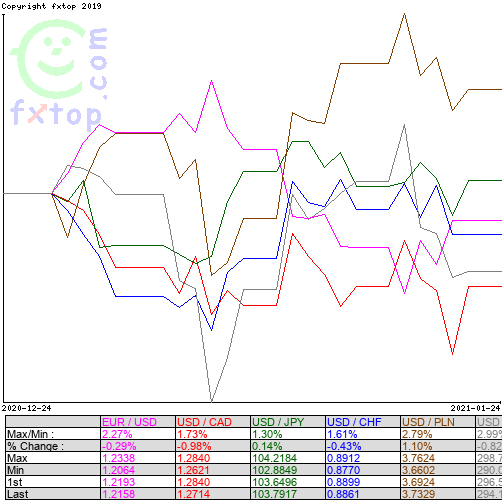
Above is Canada and shown is OMMFR trades above CORRA and is misaligned. If one central bank has a problem then all have problems. Deeply affects the exchange rates. If OMMFR drops below CORRA then long USD/CAD. Debt Register Claims drops below Call Money rate then long USD/CHF. If Call rates drop below the Deposit facility then Long USD/JPY.
USD/JPY desperately requires an expansion of its interest rate range so USD/JPY will move. Until that happens, stay clear USD/JPY.
USD Vs EM
As CAD, JPY and CHF contains misalignments to its main interest rates so does EM currencies arranged as USD/Other currency.
USD/PLN
From NBP or the Polish Central bank.
Reference rate (minimum money market intervention rate) 1) 0.10 2020-05-29
Lombard rate 0.50 2020-05-29
NBP deposit rate 0.00 2020-05-29
Rediscount rate 0.11 2020-05-29
Discount rate 0.12 2020-05-29
The Discounts rates are barely hanging on. The Lombard Rate dropped from 2.50 since May 2020 while the Deposit rate dropped from 0.50 and headline sits at 0.10. Polish interest rates are misaligned as all USD currency pairs and explains shorts. May 2020, USD/PLN traded 4.24 and today 3.72.
Run through all central banks and what is found is misaligned interest rates and a problem for USD/Other Currency Pair
Author
Brian Twomey
Brian's Investment
Brian Twomey is an independent trader and a prolific writer on trading, having authored over sixty articles in Technical Analysis of Stocks & Commodities and Investopedia.