Crude investors weigh geopolitical risks against US supply, demand concerns

After a positive start to the new week overnight, oil prices turned negative this morning before rebounding off their as we approached the end of European session. Concerns over potential supply disruptions amid raised geopolitical uncertainty in the Middle East had initially boosted prices. After last week’s attack on two oil tankers in the Gulf of Oman, which the US blamed on Iran, tensions between the two nations increased further after Tehran warned that it will breach limits — set by the historic nuclear accord it signed with world powers in 2015 — of its uranium stockpile within 10 days. Nevertheless, oil prices could not hold onto those gains due, in part, to ongoing concerns over rising non-OPEC supplies and weak demand outlook amid soft global economic activity.
Demand concerns linger
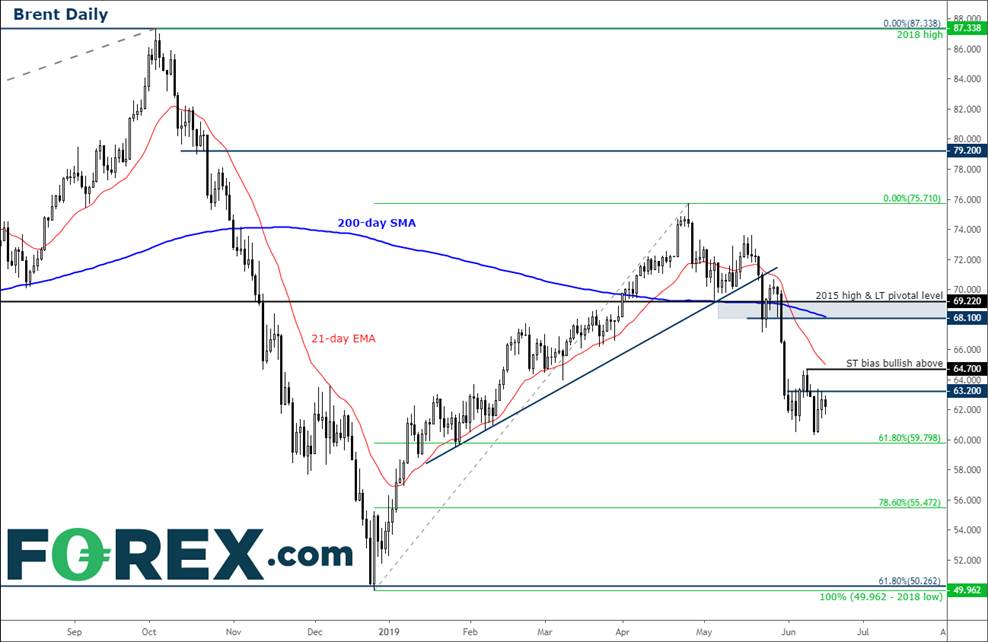
After a two-day rebound, it is hardly surprising that crude prices have struggled to sustain the rally given that both oil contracts have been stuck in a downward trend since they peaked in October of last year. Although crude staged one of its biggest rallies ever in the first quarter of this year, we have seen renewed weakness in prices since the latter parts of April. During this period, global macro pointers have remained on the whole weak, even if Eurozone data improved a little bit (from very a low base). The latest such indication came today in the form of a poor showing from the US Empire Manufacturing Index, which unexpectedly suffered its biggest fall on record to its lowest level since October 2016 (to -8.6 from 17.8 in May).
EM currency falls hurt oil demand
Thanks to the US-China trade spat, we have also seen fresh 2019 lows for the Chinese yuan recently, making dollar-denominated crude oil dearer for one of the world’s largest consumer nations. Other emerging market currencies such as the Turkish Lira and Indian Rupee have also weakened again, weighing on demand from these large consumers.
US oil inventories on the rise
Meanwhile, US oil inventories have mostly surprised to the upside again. As a result, American crude stockpiles have risen and according to the Energy Information Administration they are now 8% above the five-year average for this time of the year. While stocks of crude oil may have risen in anticipation of a pickup in gasoline demand ahead of the driving season, which is now well underway, this only helps explain part of the inventory build-up. So, it could be an indication of lower demand and/or excessive supply. We expect inventories to build further owing to the past increases in the rig counts.
IEA forecasts upsurge in non-OPEC supply
Indeed, more crude is being pumped than needed, judging by the latest International Energy Agency’s forecasts. The IEA envisages an upsurge of 2.3 million barrel per day in output in 2020, more than offsetting the growth in demand. As well as the ongoing boom in US shale production, new fields in places such as Brazil, Canada and Norway are likely to add to the supply.
OPEC+ to the rescue?
Still, the downside could be limited as prices have already fallen significantly. It would not come as major surprise if crude oil finds support from the prospects of fresh output cuts from the OPEC+ group of countries. The cartel’s next meeting was initially pencilled in for the end of this month, but that has now been pushed back to early July. Saudi’s oil minister will certainly be pushing for output cuts at that meeting. “We are hoping that we will reach consensus to extend our agreement when we meet in two weeks’ time in Vienna” Khalid Al-Falih told reporters on Sunday. The OPEC will probably meet “the first week of July and that will secure the rebalancing the market as we strive for it.”
Geopolitical tensions: USA vs. Iran
Meanwhile prices are likely to find tailwind support from ongoing geopolitical tensions in the Middle East. Last week saw prices spike higher after the attack on two oil tankers in the Gulf of Oman— which the US blames on Iran, with Tehran profoundly rejecting the accusation — stoked concerns about supply disruptions in the region. Tensions between Iran and the US remain perilous. If Iran goes ahead with its warning and the nuclear deal collapses entirely, then we could see more sanctions being imposed on Iran, resulting in a potential supply shortage – especially in light of Saudi Arabia’s desire to reduce output from the OPEC+ group.
Figure 1:
Author
Fawad Razaqzada
TradingCandles.com
Experience Fawad is an experienced analyst and economist having been involved in the financial markets since 2010 working for leading global FX, CFD and Spread Betting brokerages, most recently at FOREX.com and City Index.

















