Course d’autruches: The French ostrich race could turn EUR/CHF

France
The FX market is taking the widening in French spreads in stride so far. The flip in JPY sentiment over the past month has created heavy CHF supply as the franc becomes the hot new funding currency. But if France keeps deteriorating, all those CHF funding positions could suddenly become vulnerable. Here’s the Germany vs. France 10-year spread.
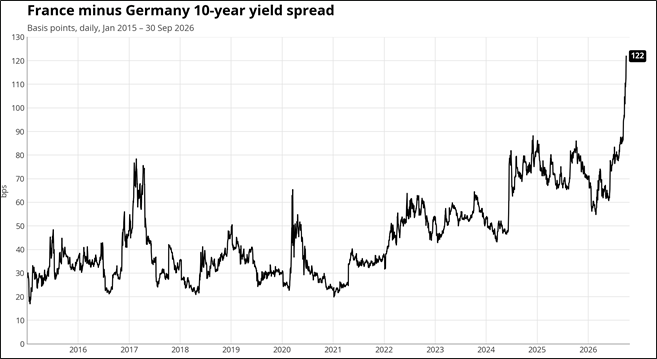
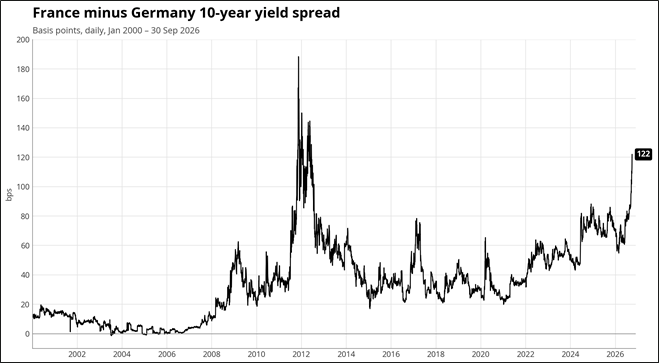
This is not just a matter of global bonds selling off. Spain, Portugal, and Italy are barely wider. For the full perspective on French yields, here is the same chart back to the year 2000, so you can see the Eurozone crisis in there as well. Recall that in 2011/2012, there was serious concern that the euro would not survive as a currency and we were going back to DEMFRF and DEMITL and DEMGRD. And here we are moving almost as much in French bonds today.
And as I mentioned, short CHF has become enormously popular as specs and CTAs have exited JPY shorts as the primary funder and replaced them with CHF
Once upon a time, a multi-SD widening of French sovereign spreads would be an occasion to sell EURCHF, but in the current environment, the market is ignoring France and focusing on the ever-juicier carry. The carnage in USDMXN shows you what can happen when the market changes its mind on a carry trade. EURCHF has been following German/Swiss rate differentials up, up, and away—my bet is that we see a turn soon as French fears intensify and CHF funding trades unwind.
Steph Targui (Spectra FX Singapore) has sent a few recent articles to give a sense of the French vibe.
Re French budget, the key dates are now quite close:
- Tomorrow 1-Oct, 8:30 a.m. Paris time: the government will present the 2027 State Budget (PLF) and the 2027 Social Security Budget (PLFSS)
- 1-Oct, 4:45 p.m.: Finance Minister Roland Lescure and Public Accounts Minister David Amiel are scheduled to appear before the National Assembly Finance Committee on the 2027 budget.
- 12 to 19-Oct: National Assembly debate on the first part of the budget (mainly revenue/tax measures), with a formal vote scheduled for 20-Oct
- From 27-Oct: debate on the second part, covering government spending and individual ministry budgets. The overall National Assembly vote is scheduled for 17-Nov (potentially 18-Nov if debate runs over).
- The parliamentary process then continues, including the Senate. Under the normal procedure, Parliament has 70 days to examine the budget, and the Finance Act must ultimately be promulgated by 31-Dec.
Below is a translated excerpt from the French business newspaper Les Echos 29-Sep 2026… Note the article refers to this report by France Positive. Ironically, the report by France Positive is quite negative.
“The watchword of the presidential campaign is a total denial of reality”: Candidates’ worrying silence on reducing France’s debt
Whoever becomes the next occupant of the Élysée Palace will have to restore public finances that are in dire straits. The required fiscal adjustment is estimated at around €126 billion over five years. At this stage, however, none of the candidates’ programmes explains in detail how this would be achieved.
So far, the 2027 presidential election looks rather like… an ostrich race. When it comes to public finances, all the candidates have their heads buried in the sand.
“No programme currently sets out a fully costed path all the way to bringing the deficit back below the 3% threshold required under European treaties,” according to a summary report published by France Positive, a think tank founded by writer and essayist Jacques Attali, who is also a columnist for Les Echos.
“Denial of reality”
The report reviews, party by party, the main measures already being discussed, as well as whether or not each party has set out a target for the trajectory of the public finances. Its conclusion is stark.
“Across all parties, there are only vague and imprecise guidelines that do not extend beyond one or two years. None sets out significant spending cuts,” Jacques Attali says.
“The watchword of the campaign is a total denial of reality,” concludes the former adviser to François Mitterrand.
On the left, restoring the public finances relies primarily on tax increases. But the uncertain revenue expected from some measures, such as the Zucman tax — estimated by economists to raise between €5 billion and €25 billion — makes these programmes fragile, in addition to being insufficient relative to the scale of the adjustment required, according to the report.
In the centre and on the right, by contrast, there is an explicit desire to cut spending. However, the lack of detail surrounding these measures undermines the credibility of the targets. At the same time, the tax cuts being promised to stimulate economic growth have not been funded.
Philippe Juvin, the Les Républicains (LR) general rapporteur of the National Assembly’s Finance Committee, has so far received no response to the letter he sent to all declared presidential candidates asking them to provide detailed, quantified information about their budgetary ambitions for the five-year presidential term.
“I don’t see any recognition of the seriousness of the situation,” the MP says. “Some underestimate it, but more often they are afraid of frightening voters with the sheer scale of the measures that would have to be taken,” he continues.
With many potential catalysts in October, I like buying 1-month 0.9420s in EURCHF for around 36bps off 0.9468 spot. You can also seek to thread the needle here as we are right at resistance in spot. Selling EURCHF here (0.9468) with a stop loss at 0.9536 could also work. I like both trades about equally but slightly prefer the extra leverage that could come from the option and so the option is in the sidebar.
Alternative ways to play an acceleration of French fears would be to buy 1-month 1.1200s in EURUSD as the break of 1.1270/1.1330 should trigger a trend move lower. Or, you could do EURJPY but that is my least favorite as it’s crowded and the JPY side looks like a complete mess to me as everyone is waiting for GPIF and they might not be around until 160.00.
Author

Brent Donnelly
Spectra Markets
Brent Donnelly is the President of Spectra Markets. He has been trading currencies since 1995 and writing about macro since 2004. Brent is the author of “Alpha Trader” (2021) and “The Art of Currency Trading” (Wiley, 2019).
















