The commodity Dollar crash: Geopolitics and hawkish rates
- Commodity currencies hit multi-month lows against greenback.
- Middle East tensions fuel strong safe-haven demand.
- Hawkish Federal Reserve stance broadens policy divergence.
- High Oil prices fail to boost Canadian dollar.

During September, commodity-linked currencies have faced significant downside pressure against the greenback. Geopolitical risk aversion emanating from escalation in the Middle East, coupled with widening central bank policy divergence, has generated strong safe-haven demand for the US dollar. This dynamic has left the Australian dollar (AUD), New Zealand dollar (NZD), and Canadian dollar (CAD) vulnerable to broader risk-off liquidations despite elevated crude oil prices.
Price movements over recent days
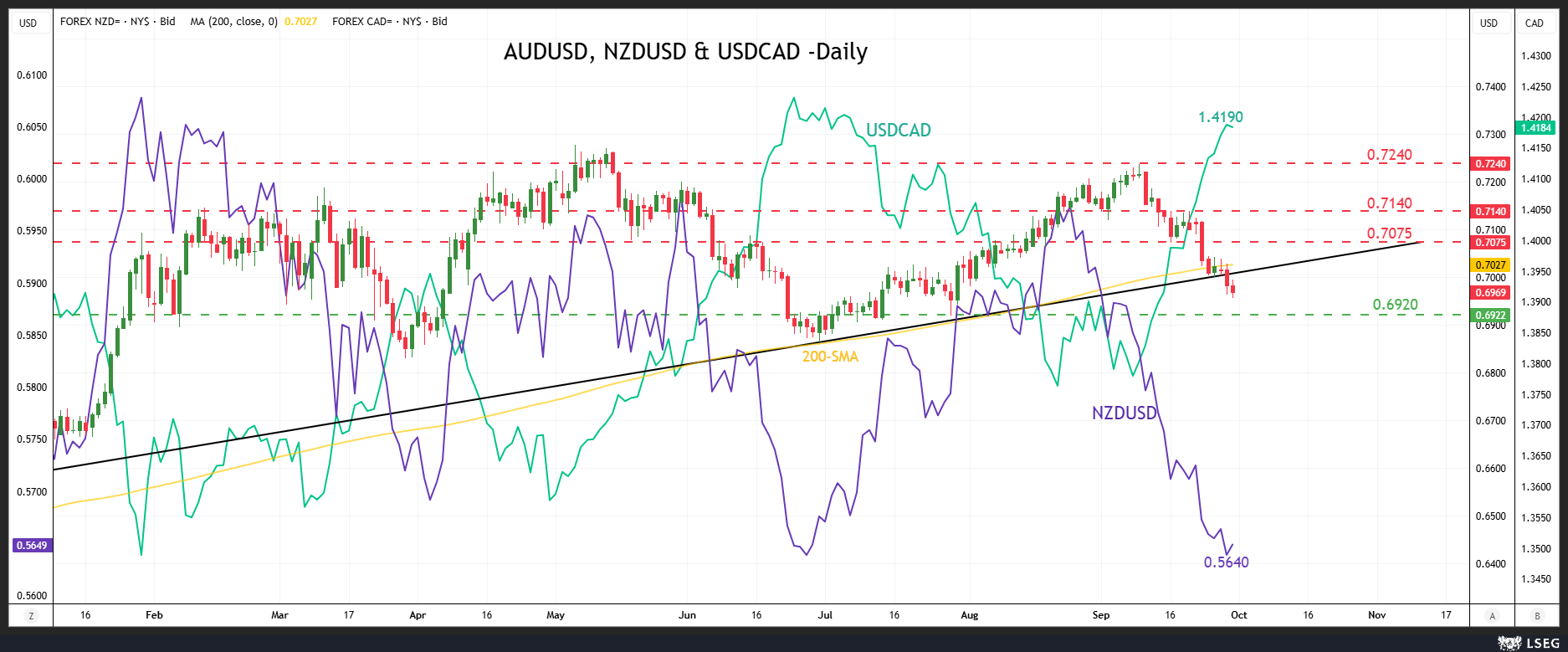
The Australian Dollar has experienced a persistent drop, sliding from September highs near 0.7240 down toward critical technical support around 0.7000, posting a fresh two-month low. Softening industrial demand signals from Australia’s key Asian trade partners alongside broader risk aversion have kept the aussie heavily defense-oriented.
The New Zealand Dollar mirrored this downside trend, dropping toward 0.5625 before slightly stabilizing around 0.5670. As the kiwi is highly sensitive to broad market risk sentiment and global trade volumes, global growth anxieties weighed directly on kiwi valuation.
The US dollar has gained steady momentum against the Canadian dollar, driving dollar/loonie up from the 1.3730 level from the end-August to peak near 1.4200. Although rising oil prices traditionally provide a tailwind for the energy-exporting Canadian economy, those gains were offset by widespread dollar strength and concerns over domestic economic slowing.
Middle East conflict and risk sentiment
Escalation in the Middle East has served as a catalyst for global foreign exchange re-positioning. During periods of geopolitical uncertainty, market participants systematically reduce exposure to growth-linked assets like the AUD and NZD in favor of traditional safe havens such as the US Dollar and Swiss Franc.
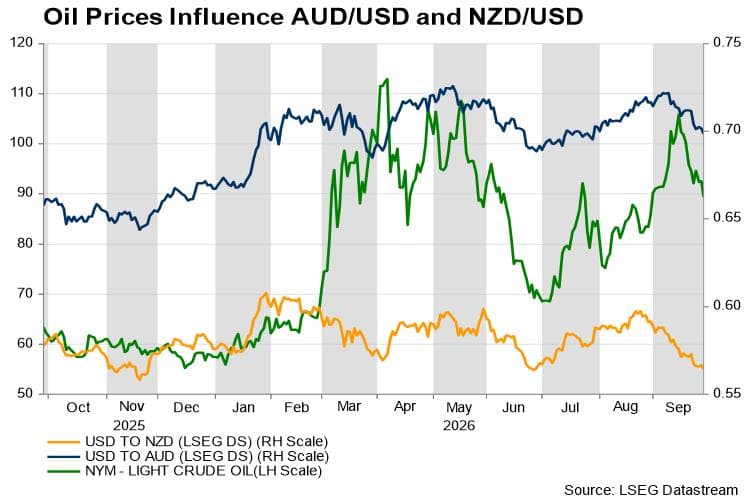
Energy markets have reacted sharply to Middle East supply anxieties, driving crude prices upward. For the Canadian Dollar, this price surge usually creates positive terms-of-trade momentum. However, high energy prices also spark global inflation fears and raise input costs for importing nations. The resulting anxiety over prolonged restrictive global monetary policy has neutralized much of the Canadian dollar's usual commodity advantage, allowing the greenback’s strength to dominate the currency pair.
Central Bank dynamics and Federal Reserve transmission
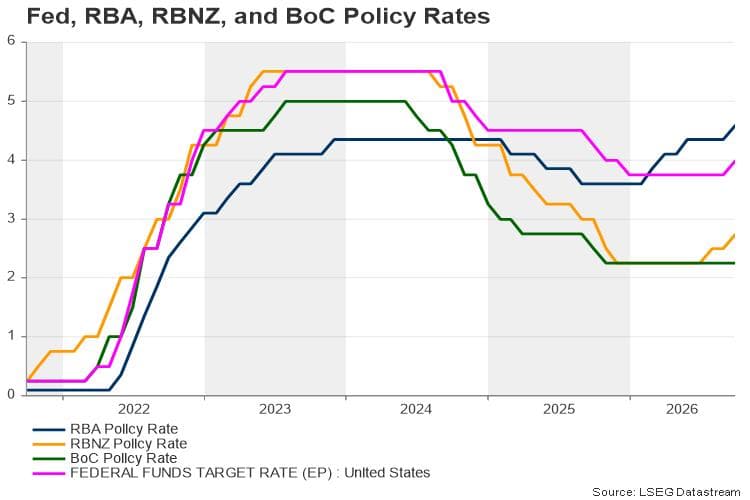
The monetary policy stance across major economies remains a dominant driver of currency market dynamics. As the benchmark anchor of global liquidity, the Federal Reserve’s decisions exert substantial influence over peer central banks, including the Reserve Bank of Australia (RBA), Reserve Bank of New Zealand (RBNZ), and Bank of Canada (BoC).
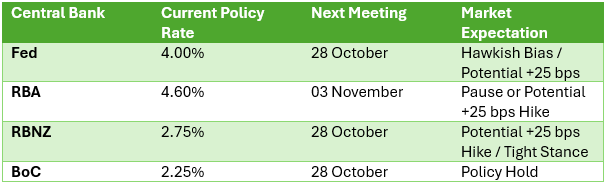
At its September 16 meeting, the Federal Reserve raised its target range by 25 basis points to 3.75%–4.00%, marking an active shift to combat stubborn headline inflation driven by elevated energy prices. The Fed's updated dot plot signals at least one additional 25 basis point rate increase before the end of 2026, establishing a hawkish baseline for global monetary policy.
This Federal Reserve posture directly constrains the maneuverability of foreign central banks. If peer central banks lag behind or ease rates while the Fed continues to tighten, their domestic currencies suffer sharp depreciation against the dollar, effectively importing foreign inflation via higher import costs. Consequently, the RBA, RBNZ, and BoC must continuously calibrate their policy paths against the Fed to prevent widening interest rate differentials from severely weakening their currencies.
The Reserve Bank of Australia has faced intense inflation pressure tied to elevated global energy costs. In response, the RBA raised its cash rate target by 25 basis points to 4.60% at its September 29 meeting. Looking ahead to its next policy announcement, money market pricing leans toward another potential 25 basis point hike or a prolonged hold at high levels if domestic services inflation fails to decelerate rapidly.
The Reserve Bank of New Zealand similarly tightened policy on September 2, raising its Official cash rate to 2.75% following elevated consumer price readings. Ahead of the RBNZ’s upcoming October 28 meeting, markets anticipate that the Monetary policy committee will either deliver a follow-up 25 basis point hike or maintain a strictly restrictive stance, directly reflecting persistent cost pressures stemming from global energy disruptions.
The Bank of Canada continues to experience a tricky trade-off. The BoC has kept its policy rate steady at 2.25% as domestic growth indicators reflect softening consumer expenditure and labor capacity. Looking ahead to the BoC’s October announcement, money markets lean toward another policy rate hold, given Canada's cooling domestic demand. However, this pause set against a Fed that is actively hiking rates broadens the US-Canada yield gap, capping any potential strength the Canadian Dollar that would have otherwise been derived from elevated oil prices.
Summary
Near-term performance for commodity currencies hinges on geopolitical stability in the Middle East and upcoming economic data releases. Until broad risk sentiment stabilizes or global interest rate expectations converge with the Fed, AUD, NZD, and CAD are likely to encounter ongoing headwinds against the US Dollar.
Author

Melina joined Trading Point in December 2017 as a Market Analyst. She can clearly communicate market action, particularly technical and chart pattern setups.