Conflict, Oil and sticky prices


Frankly, price action has been bruising this week, and understandably so. The US-Israeli military campaign against Iran – now entering its fifth day – has shifted from a weekend of strikes on Iran that killed the Supreme Leader Ayatollah Ali Khamenei into a broader conflict.
Energy markets in focus
With retaliatory drone and missile strikes from Tehran hitting key infrastructure across the Gulf, markets are, it is fair to say, still catching their breath, with energy prices at the forefront.
Oil prices ended a third consecutive session in the green yesterday, with WTI Oil and Brent Crude clocking highs of US$78.00 and US$85.00, respectively. WTD, both markets are up by around 15%, with near-40% gains YTD. The real issue right now, of course, remains the Strait of Hormuz, which accounts for about 20% of global Oil flows, and has seen most maritime traffic come to a halt.
As far as I understand, the Strait is not ‘officially’ closed; it is more a case of shipping companies avoiding the waterway for obvious reasons, and insurance companies either pausing coverage in the region or, for those still offering insurance, raising premiums to unaffordable levels. President Donald Trump has announced that the US will provide coverage and insurance guarantees for tankers navigating the Strait, which offered some relief. But it is still early days, and until tankers are moving again, I expect Oil prices to continue higher.
Yields, Fed speak, currencies, and Gold
US Treasury yields bear flattened on Tuesday, rising for a second consecutive session. The 10-year yield settled at around 4.06%, the 2-year at 3.51%, and the 30-year at 4.71%, as traders continue to pare back expectations for a Fed rate cut. As of writing, money markets are fully pricing in a 25-bp rate reduction in September, though July still has around an 80% probability.
Fed speak made the airwaves yesterday, with a cautious message, stressing data dependence and signalling that rate cuts are unlikely in the near term, which is clearly reflected in money markets right now.
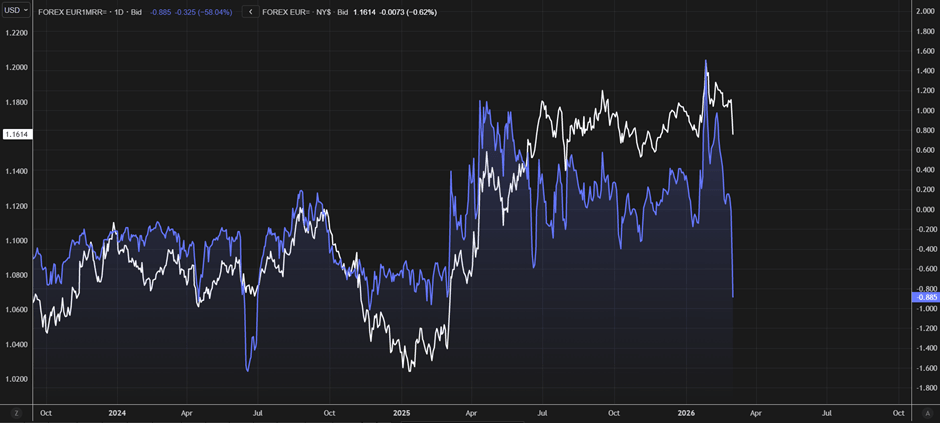
In the FX space, the USD continued to welcome fresh bids, benefitting from its safe-haven status, with the USD index adding 0.5%. Even as some investors believed that Trump’s policies would diminish the currency’s global importance, the USD remains king and a standout in times of market turmoil. Interestingly, EUR/USD risk reversals have recently cratered, showing that EUR puts are more expensive than calls in implied vol terms. As shown in the chart below, the market is paying a higher premium to hedge the downside risk in EUR/USD right now.
Notably absent from the usual safe-haven rally was Spot Gold. The yellow metal tumbled 4.3% to just under US$5,100, weighed by the stronger USD and a flight to pure liquidity – cash, in other words – rather than traditional stores of value.
Macro front: Eurozone inflation rises more than expected
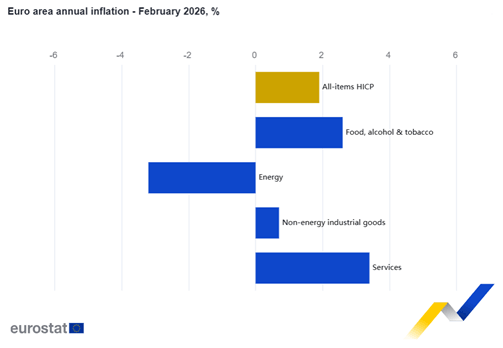
While macro data has certainly taken a back seat for now, it is worth noting that the YY eurozone February CPI inflation surprised to the upside, rising by 1.9%, rebounding from 1.7% in January, per Eurostat's flash estimate. According to LSEG data, analysts’ median forecast was for the rate to remain unchanged. Importantly, excluding energy and food, YY core inflation climbed to 2.4% from 2.2%, and also came in above expectations, suggesting that underlying price pressures are sticky. Notably, these data were also collected prior to the Middle East escalation, which began feeding through to energy markets.
In terms of the drivers behind the uptick, services remained the largest contributor to inflation, rising by 3.4% from 3.2%. This shows modest acceleration and matches December’s reading. Food, alcohol and tobacco were not far behind, rising by 2.6%, while energy fell by 3.2%, albeit its deflationary impact was somewhat less, at 4.0% last month.
While there is certainly a pickup in price pressures – particularly in core data – it has done little to ECB policy expectations for now. The central bank is still expected to remain on hold for the foreseeable future, but it is in a challenging position. The key focus will now be on what happens next considering European Gas prices have jumped more than 70% this week. I think the ECB’s Chief Economist summed it up perfectly, acknowledging the upside inflation risk while stressing that the outcome depends on the conflict's breadth and duration.
Today’s calendar
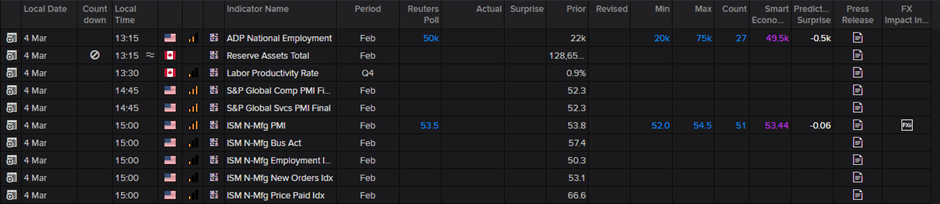
Again, while the Middle East war will remain in focus for markets, we have the US February ADP employment report at 1:15 pm GMT, and the US February ISM services PMI out at 3:00 pm. The focus in the latter’s report will be on the following sub-indices: prices paid, employment, and new orders.
Author
Aaron Hill
FP Markets
After completing his Bachelor’s degree in English and Creative Writing in the UK, and subsequently spending a handful of years teaching English as a foreign language teacher around Asia, Aaron was introduced to financial trading,