China's Watch: Subdued Inflation Facilitates PBOC's Monetary Policy

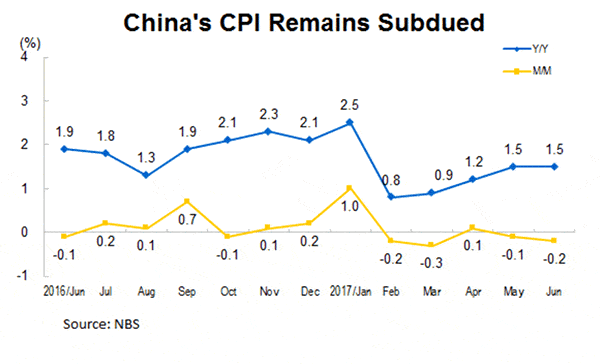
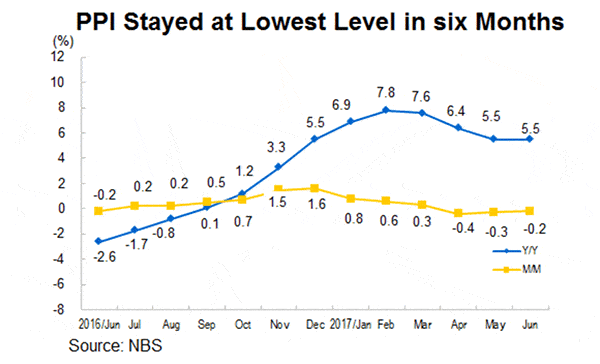
The set of June data released so far has pointed to a steady growth trend in China, the world's second largest economy. Released earlier in the week, headline CPI stayed unchanged at +1.5% y/y in June, shy of consensus of +1.6%. Persistently soft food price (on deflation) continued to put downward pressure on the headline reading. For instance, pork plummeted -16.7 and egg price fell -9.3%.PPI, upstream price levels, steadied at +5.5% in June, in line with expectations. Subdued inflation offers the government room to maintain its targeted tightening measures, focusing on cracking down overheating asset prices. Yet, soft PPI suggested that growth in industrial profits would be limited.
FX Reserve:
China's FX reserve increased for the 5th consecutive, by +US$ 3.22B, to US$ 3.056 trillion in June. This marks the highest level since October 2016. Yet, after adjusting for currency valuation effect, there comes a net drop of US$ 8 to US$ 13B. We are not at all surprised by the rise in FX reserve, as suggested in the headline reading. The massive selloff of renminbi in 2015 has passed, following the government aggressive capital control measures, imposing barriers on the transfer of foreign currency abroad by companies and individuals. It also tried containing renminbi's decline by dumping of foreign currencies (and buying renminbi). FX reserve fell by around one-quarter between the peak in June 2014 and January 2017. Meanwhile, China raised the rates for its open market and lending facilities by 10-35 bps to retain capitals. Undoubtedly, the recent change in the renminbi fixing mechanism, by adding ''counter-cyclical factor'', is another initiative to intervene the currency market. In the first half of this year, renminbi has risen about +2.4% against US dollar, contrary to the -6.5% depreciation in 2016.
In the near- to medium- tern, we expect renminbi to continue recovery against US dollar. Barring the abovementioned measures, diminished expectations over US' growth momentum, and over Fed funds rate hike schedule next year, have limited the greenback's strength. Indeed, the recent hawkish shift by several major central banks (including ECB and BOC) has weighed on the US dollar. This phenomenon should be supportive of renminbi.
PMIs
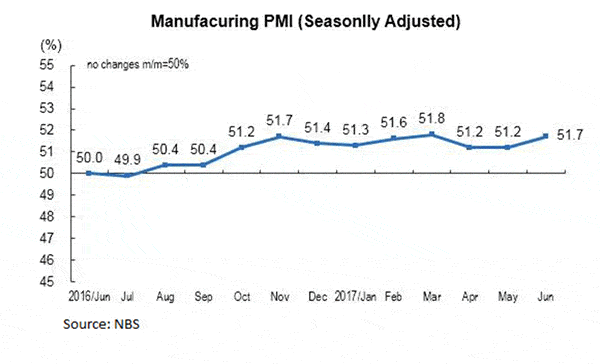
On the last day of June, the National Bureau of Statistics reported that China's manufacturing PMI rose +0.5 point to 51 in June. This marked the second straight month of increase. The size of the increase signaled acceleration of the manufacturing sector. Looking into the details, the ''production'' index gained +1 point to 54.4 while the ''new orders'' index added +0.8 point to 53.1. However, the ''employed person index'' slipped -0.4 point to 49 and the ''supplier delivery'' time index dropped -0.3 point to 49.9 for the month.
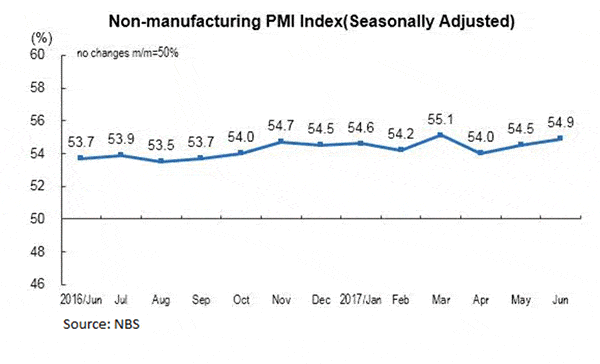
The non-manufacturing PMI gained +0.4 points to 54.9 in June. Of which, the services index gained +0.3 point to 53.8 while the construction index rose +1 point to 61.4. Looking into the details, the ''new orders'' index added +0.5 point to 51.4, the ''input price'' index was climbed +0.1 point higher to 51.2, while the ''sales price index gained +0.5 point to 49.3 for the month. Meanwhile, the ''employment'' index gained +0.6 point to 49.6 and the ''business activities expectation'' index jumped +0.9 point to 61.1. The government judged the report confirms the ''expansion trend of a steady rise'' in the non-manufacturing sector.
The set of data compiled by Caixin, focusing on SMEs, showed a more mixed trend. The manufacturing PMI rose +0.8 points to 50.4 in June with indices such as ''output'', ''new orders'', ''input prices'' and ''output prices'' on the rise. By contrast, the services PMI dropped -1.2 points to 51.6, sending the composite output index -0.4 point lower to 51, the slowest rate of expansion in a year, for the month.
Author
Agnes Tse
ActionForex.com
Agnes Tse, CFA, is adept at analyzing the impacts of politics on global financial markets.

















