China’s trade growth rebounds after tariff de-escalation, offering a boost to first-half growth

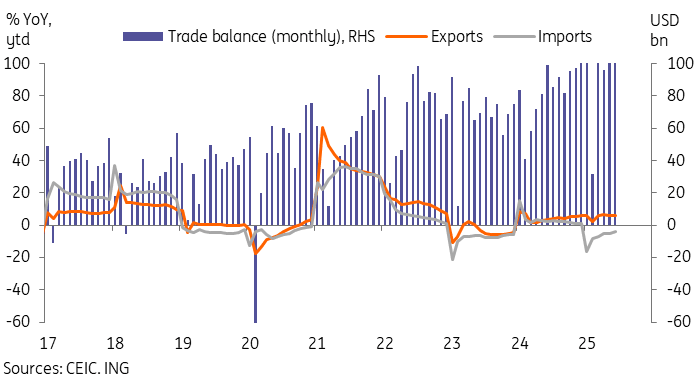
External demand continues to support Chinese economic growth, as the first-half trade surplus surged to a new high of $586bn amid resilient export growth and a year-on-year contraction of imports. While tariffs continue to drag on exports to the US, June data showed a smaller contraction after the tariff de-escalation in May.
Exports rebounded modestly in June
China's June export growth rebounded to 5.8% year on year from 4.8% in May. The growth was a little stronger than consensus, but broadly in line with our forecasts, and we saw a smaller tariff shock in June in the first full month of data after the tariff de-escalation in May. Through the first half of 2025, exports grew by 5.9% YoY, which is in line with the full year export growth from 2024.
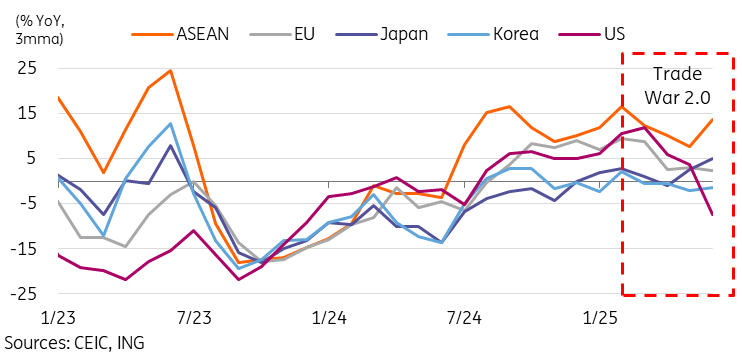
China's exports to the US remained in negative territory at -16.1% YoY in June, though this decline was notably shallower compared to the -34.5% YoY decline seen in May. Despite the de-escalation, US tariffs on China remain very high, with the additional 30% of tariffs this year added on top of existing tariffs to boost the overall rate to 51-55%. These tariffs continue to cause a clear drag on trade. Through the first half of the year, exports to the US have dropped -9.7% YoY.
Fortunately, exports to other destinations helped pick up the slack. In June, exports to ASEAN (16.8%) and Japan (6.6%) both accelerated. In 1H25, exports have been primarily supported by strong growth to ASEAN (12.2%), in particular Vietnam (18.8%) and Thailand (20.9%), as well as India (15.1%), Africa (18.9%), Latin America (9.4%), and Germany (12.3%).
By product, exports of semiconductors (18.9%), ships (18.6%), and autos (8.2%) continued to outpace the headline growth. The broader machinery and electrical products category also outperformed the headline figure at 8.2% YoY.
However, exports of mobile phones (-8.5%) and household appliances (0.2%) lagged, though these categories have been supported through the trade-in policies boosting domestic demand. Additionally, we can see the impact of tariffs hit lower value-added categories such as furniture (-6.8%), apparel (-0.2%), shoes (-7.2%), and toys (-2.1% YoY).
Overall, exports have held up better than most forecasters expected through the first half of the year, and contributed to first half GDP comfortably beating very downbeat forecasts from the start of the year.
Trade balance continued to rise in 1H25
Exports to other markets have helped offset the slowdown from the US
Imports continued to be dragged by weak commodities demand
On the flip side, we see imports have remained quite soft. China's June imports rose 1.1% YoY, up from -3.4% YoY in May, which was a little stronger than consensus forecasts and a little weaker than our forecasts. While lacklustre, this was the first positive growth since February. Through 1H25, imports registered a -3.9% YoY year-to-date growth.
The bulk of the sluggish import demand can be seen in commodities. In the first half of the year, China's agricultural imports (-10.1%) were dragged down by a sharp drop in grain (-27.0%) imports, including a drop in soybeans (-12.4%). Energy imports were mostly down across the board, with drops in coal (-32.1%), crude oil (-12.0%), and natural gas (-15.0%). The continued sluggishness of the property market also led to declines in steel (-14.6%) and lumber (15.3%) imports.
As China's domestic auto companies continued to gain competitiveness and market share, auto imports fell sharply, down -37.9% YoY ytd.
The bright spots remain in the tech categories. Hi-tech imports rose 9.8% YoY, with imports of automatic data processing equipment (55.2%), semiconductors (7.0%), and airplanes (71.2%) all seeing faster than headline import growth in the first half of the year.
Trade balance continues to beat expectations
On net, the continued resilience of exports and sluggish imports resulted in China's trade surplus continuing to widen, rising to $586.0bn in 1H25. This $150.8bn higher than the comparable period in 2024, good for 34.6% YoY growth. Tomorrow's GDP data will likely show that net exports have been a solid contributor to growth in the first half of the year despite tariff flare-ups.
Whether or not this can continue in the second half of the year will depend on several factors.
- First, how the tariff negotiations between China and the US progress will obviously be a big wildcard. It remains unclear if the 12 Aug deadline for the negotiation window between China and the US remains in place, or if this has been pushed back indefinitely after the agreements made in the past couple of months.
- Second, the nature of other countries' deals (or lack thereof) with the US will also have a ripple effect on China. The reports of Vietnam's deal with the US garnered a lot of attention in previous weeks, with the higher tariff rate on transshipments in particular seen as potentially affecting China's re-exports. Whether more countries sign similar deals, how transshipments are ultimately defined, and the extent to which these measures are enforced could all play roles in how China's exports to other regions develop. Additionally, if we do see a higher tariff environment globally, this could reduce the attractiveness of substitution products and, in turn, actually boost the competitiveness of China's exports to the US.
- Third, how China's trade relations with other countries develop is also worth monitoring. After slow progress in trade talks with the EU, China went ahead with retaliatory measures in the past month, raising tariffs on brandy and medical equipment. We could see economies strengthen trade ties as a response to higher tariffs from the US.
Considering 1H25 data also benefited from a wave of trade frontloading in the first quarter of the year, we tend to err on the side of caution when looking at 2H25. But even a low single-digit annual growth for exports will translate to a smaller drag on 2025 growth than what the market feared at the start of the year.
Read the original analysis: China’s trade growth rebounds after tariff de-escalation, offering a boost to first-half growth
Author
ING Global Economics Team
ING Economic and Financial Analysis
From Trump to trade, FX to Brexit, ING’s global economists have it covered. Go to ING.com/THINK to stay a step ahead.