China’s quiet return to US soybeans: Trade thaw or climate diplomacy?

A subtle gesture before a major summit
After months of silence in the grain corridor, Beijing has quietly resumed purchases of American soybeans.
Three cargoes, roughly 180 000 tonnes, were booked by state trader COFCO last week, marking the first U.S. sales of the 2025–26 season.
The timing is deliberate: the move comes just days ahead of the Trump–Xi summit, and its meaning goes far beyond agriculture.
For a commodity that once symbolised the U.S.–China trade war, soybeans have once again become the stage for a quiet power game.
This is not about volume; it’s about symbolism.
By dipping back into the American market, China is signalling both strategic flexibility and climate pragmatism.
In a year dominated by talk of sanctions, tariffs, and technology bans, a few grain ships may be the most eloquent diplomatic message yet.
Soybeans as strategy
China’s reliance on imported soybeans is a structural fact of its economy.
Each year, the country buys over 90 million tonnes, representing nearly two-thirds of global trade, vital for its livestock industry and food-security chain.
For much of the past two years, Brazil and Argentina have supplied most of that demand.
But weather disruptions, logistical bottlenecks, and fluctuating protein content have exposed the risks of single-source dependence.
When quality and punctuality matter, the United States still remains the most reliable supplier.
At the same time, Washington has encouraged agricultural diplomacy as a low-risk bridge to Beijing.
Unlike semiconductors or rare earths, soybeans are politically neutral, economically useful, and symbolically potent.
They allow both sides to show goodwill without formal concessions, a form of détente conducted through cargo manifests instead of communiqués.
Climate realism meets trade pragmatism
Beyond geopolitics, the climate dimension may be the true driver.
Drought patterns across South America, intensified by a lingering El Niño, have tightened supplies of high-protein soybeans.
China’s pivot back toward U.S. origins may therefore reflect more than diplomacy: it is also a climate-risk hedge.
Beijing’s planners have long feared that climate shocks could undermine food security faster than trade disputes.
Diversifying supply is therefore not only a diplomatic signal but a defensive adaptation strategy.
It fits into a broader recognition that climate volatility is now an economic variable, shaping trade routes, pricing, and even alliances.
Market reaction and sentiment shift
The commodity market immediately noticed.
Chicago soybean futures (ZSX25) firmed to 11 100 ¢/bushel, reversing a month-long slide and marking their highest level since late September 2024.
The move is small in tonnage terms but large in psychology: it hints that the world’s biggest buyer may be back in play just as global inventories are swelling.
For traders, the significance lies in timing.
Seasonal supply pressure typically weighs on soybeans in Q4, but the prospect of renewed Chinese demand is already altering price expectations into early 2026.
It also reconnects the U.S. grain complex to geopolitical headlines, something largely absent since 2022.
From energy diplomacy to grain diplomacy
Agriculture has become the quiet language of geopolitics.
Where oil once dominated statecraft, food now acts as its subtler counterpart.
For the United States, soybeans represent both a commercial and diplomatic asset.
For China, they are a tool to manage inflation, feed stability, and foreign relations simultaneously.
This new “grain diplomacy” mirrors the logic of 1970s oil diplomacy: control the flows, and you influence the tempo of the global economy.
In today’s world, supply chains, not armies, determine leverage.
That is why a seemingly modest transaction can resonate from the Gulf of Mexico to the South China Sea.
The sustainability angle
Another layer of the story is environmental.
The carbon intensity of soybean production varies sharply between regions.
Brazil’s expansion continues to raise deforestation concerns, while U.S. producers, operating under stricter environmental regulations, have improved their sustainability metrics.
If future trade policy integrates carbon-border adjustments or environmental scoring, China’s sourcing choices could naturally shift toward lower-emission suppliers.
In that context, this purchase may signal climate alignment through trade, even before formal agreements take shape.
The same cargoes that restock Chinese feed mills also remind investors that global commerce still depends on physical ecosystems, rainfall, soil, and shipping routes, which cannot be separated from geopolitics.
Historical echoes and policy parallels
Sceptics may argue that three cargoes do not make a trend, and they are right.
Yet small gestures often precede structural shifts.
Back in 2017, the first incremental Chinese orders from Brazil were dismissed as “routine”; within a year, they had redrawn global trade flows and reshaped the soy market entirely.
History could repeat in reverse if China gradually normalises U.S. imports over the next quarters.
Such a move would also fit Beijing’s current pattern of diversification rather than confrontation, a strategic softening that allows tactical flexibility ahead of potential climate shocks or supply crunches.
In parallel, Washington sees agricultural exports as one of the few policy areas where cooperation remains politically viable, especially as energy trade stays constrained by sanctions and technology restrictions.
Technical view: Soybeans (Nov 2025 CBOT)
On the Renko chart of soybean futures (Nov 2025 contract), the breakout is clearly defined.
Prices have surpassed the September 2024 high near 11 100 ¢, confirming renewed upward momentum.
This breakout follows a disciplined series of higher lows that began near 9 800 ¢ in early 2025.
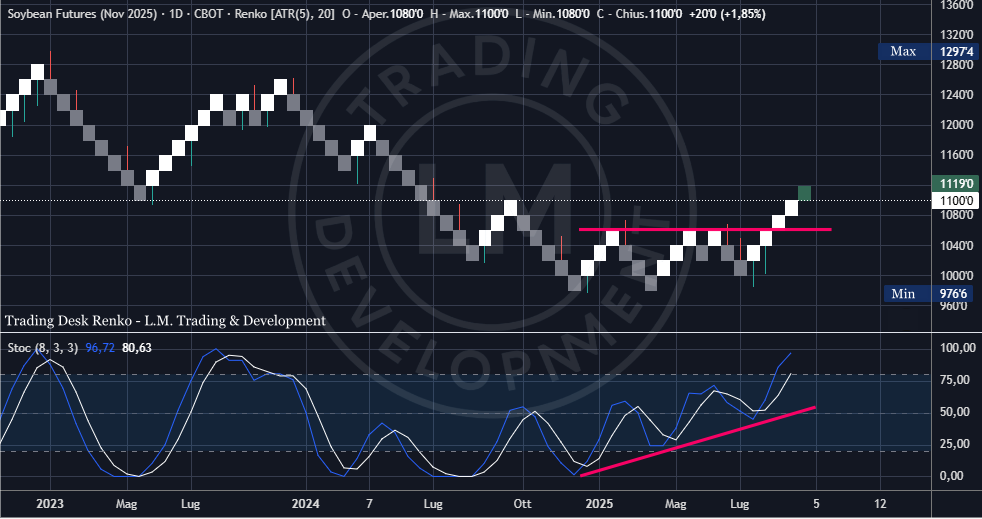
Soybean futures (Nov 2025) Renko chart: breakout above the September 2024 high near 11 100 ¢ confirms renewed upward momentum as China resumes U.S. purchases
The stochastic oscillator maintains a constructive bias, rising above 80 while preserving a bullish slope, indicating strong momentum but not yet over-extension.
Support is now established at 10 800 ¢, the former resistance area, while the next key objective lies around 11 200–11 300 ¢.
Technically, the Renko pattern illustrates what fundamentals are hinting:
measured, persistent buying rather than speculation, reflecting institutional hedging and re-pricing of climate and trade risk.
Outlook: Diplomacy through demand
Looking ahead, this development underscores the intersection of food, climate, and policy in commodity markets.
If Chinese demand expands even modestly, soybeans could stabilise above 11 000 ¢ and trigger a gradual rotation in speculative positioning.
Funds that had cut exposure during the summer could re-enter as liquidity and volatility pick up.
The broader implication is that commodities are regaining their strategic dimension.
Investors are learning that geopolitics and environmental adaptation now drive supply chains as much as traditional market cycles.
From oil to copper to soybeans, trade no longer moves only on prices but also on principles.
Bottom line
China’s return to U.S. soybeans may look small on paper, but symbolically it’s immense.
It represents a subtle, calculated message: global interdependence still matters, and even rivals can cooperate through the logic of necessity.
For traders, it’s also a reminder that volatility now stems as much from policy as from production.
A warmer climate and a colder diplomacy have merged into a single marketplace, one where a few vessels of grain can move sentiment as much as a rate decision.
Ultimately, soybeans may be the perfect metaphor for this era: modest in appearance, yet geopolitically charged.
They connect the soil of Iowa to the strategy rooms of Beijing, and their journey captures a new form of global power, one that grows increasingly green, interdependent, and transactional.
Author

Luca Mattei
LM Trading & Development
Luca Mattei is a market analyst focusing on FX, metals, and macroeconomic trends. He develops trading tools for retail and professional traders, coding indicators and EAs for MT4/MT5 and strategies in Pine Script for TradingView.