China slows and Fed eases: How weak demand and diverging policy are shaping markets


Oil, gold, and global risk assets are navigating a new era of uncertainty. Recent data from China has underscored how deeply domestic demand is weakening, even as the Federal Reserve has made its first rate cut of 2025. For traders, the collision of these two trends, demand erosion abroad and policy shifts at home, is reordering expectations and pricing for commodities, currencies, and equities.
China’s softening macro data
On 15 September, China released benchmark data that confirmed what many analysts had been expecting: growth is losing speed. Industrial output rose just 5,2% year-on-year in August—down from 5,7% in July and well below expectations. Retail sales were up only 3,4%, the weakest since late 2024. Fixed‐asset investment over the first eight months expanded just 0,5% y/y, the slowest non-pandemic growth in many months. Unemployment ticked higher to about 5,3%, and property sector stress continues, with falling home prices.
This puts Beijing in a policy bind. Growth targets for 2025 hover around 5%, and while exports remain a buffer, domestic consumption is under strain. With consumer confidence softening and households less inclined to spend, stimulus calls are growing louder. Authorities are expected to favor targeted measures rather than sweeping stimulus.
Fed’s first cut: Signaling a shift
As China’s growth concerns gathered momentum, the U.S. Federal Reserve made a move that markets had priced in for weeks: on 16–17 September, the Fed cut its policy rate by 25 basis points, bringing it to a range of 4,00–4,25%. This was its first rate cut since December 2024, reflecting mounting anxieties about labor market slack and cooling growth. Fed officials noted softening job gains and rising unemployment—even as inflation remains above target.
Investors broadly welcomed the move, but the optimism is tempered. The Fed’s forward guidance suggests it may implement one or two more cuts this year—likely in October and December—depending on how economic indicators, especially labor and inflation data, evolve.
Demand meets policy: Implications for commodities and FX
The meeting point of China’s slowdown and Fed easing is already influencing markets:
-
Oil – Brent and WTI both slipped in recent sessions. Even with lower borrowing costs (which normally boost demand), concerns about weakening U.S. fuel consumption and rising inventories have overridden the positive effects of the Fed cut.
-
Currencies – The dollar remains relatively strong, buoyed by Fed moves and global uncertainty. Meanwhile, the yuan is under pressure, as weaker Chinese data erodes confidence. Asian currencies more broadly are muted.
-
Equities – U.S. futures and tech initially lifted on the rate cut, but risk remains elevated if economic weakness deepens.
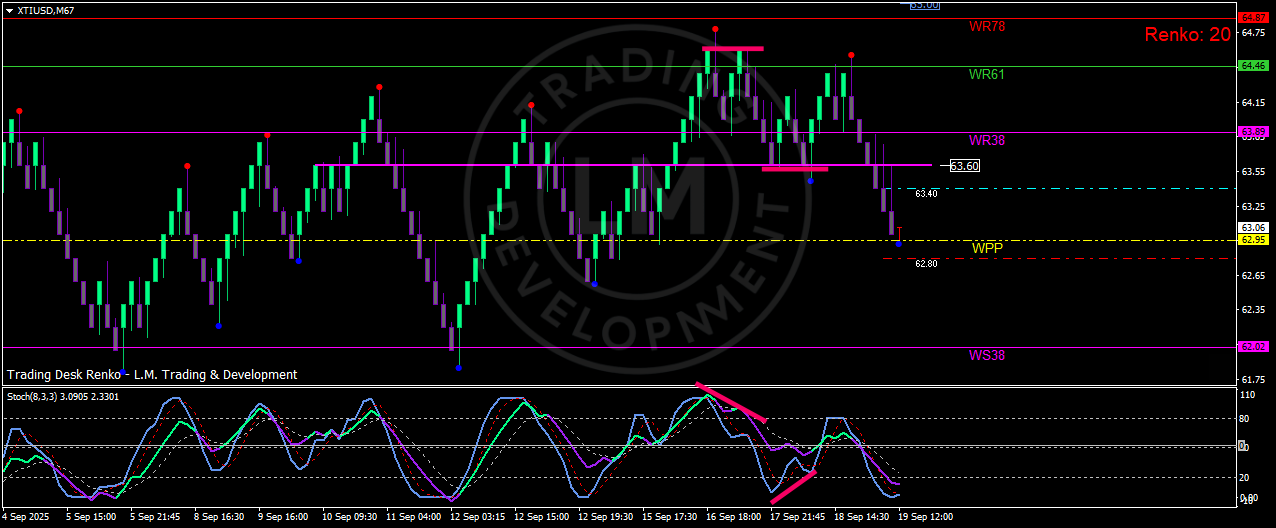
Key Levels & Technical Snapshot
| Asset | Resistance Levels | Support Levels |
|---|---|---|
| Brent | ~69,14 (WR78), ~68,70 | ~68,40 pivot, ~67,80 |
| WTI | ~63,89 (WR38), 63,60 (S/R flip) | ~62,95 (WPP), ~62,00 (WS38) |
-
The 63,60 level is crucial: former support now turned resistance. The downside break has transformed it into an intermediate barrier between 63,90 and 62,95.
-
Momentum is fading above WR38; if the price does not recover and hold firmly between 63,60–63,90, a bearish continuation is likely.
What traders should watch next
-
China stimulus signals: Any indication that Beijing rolls out consumer relief, property support, or credit easing could shift the demand outlook significantly.
-
U.S. labor & consumption data: Retail sales, jobless claims, and manufacturing releases will dictate whether the Fed proceeds with more cuts.
-
Inventory prints (oil & fuels): Any surprise build in U.S. gasoline or distillate stocks could exacerbate downward pressure on prices.
-
FX and carry trades: Monitoring the dollar-yuan differential and policy divergence between Fed, PBOC, and other major central banks.
Beyond the obvious: Two fragile equilibria
Looking deeper, there are two dynamics that markets may be underestimating:
-
The intra-Asia domino effect – China’s slowdown doesn’t just reduce its own consumption; it reverberates across the region. Korea’s semiconductors, Taiwan’s electronics, Vietnam’s light manufacturing, and Singapore’s logistics all rely on Chinese demand and processing. If Beijing stalls, regional export engines stall with it. For FX traders, currencies like KRW, TWD, and SGD often price this stress earlier than the yuan itself—making them a crucial leading indicator of sentiment in Asia.
-
The dollar’s fragile strength – Historically, Fed easing cycles (2001, 2007, 2019) have started with a brief USD rally, driven by safe-haven flows, before giving way to weakness as rate differentials eroded. The current environment—Fed cuts with a still-strong dollar—is an anomaly that rarely lasts. Once markets price deeper easing, the greenback’s support could unravel quickly, setting the stage for sharp FX repositioning.
Conclusion
China’s economic deceleration is no longer just a headline—it is weighing structurally on global demand. At the same time, the Fed’s first cut signals a regime shift, moving from fighting inflation to managing slowdown risks.
But the real market edge lies in seeing the second-order effects: how intra-Asia trade links amplify China’s weakness, and how the dollar’s unusual strength under Fed easing may prove temporary. For traders, the levels to watch in oil are now clear: 63,60 as pivot-resistance, 62,95 as WPP, and 62,00 as deeper support. A rejection at 63,60 keeps the bias bearish, while only a recovery above 63,90 would neutralize the setup.
In short: we’re in a transitional moment. Oversupply concerns may dominate now, but underinvestment risks, policy divergence, and regional contagion create fertile ground for volatility. Stay nimble, focus on data—and don’t mistake today’s equilibrium for tomorrow’s trend.
Author
Luca Mattei
LM Trading & Development
Luca Mattei is a market analyst focusing on FX, metals, and macroeconomic trends. He develops trading tools for retail and professional traders, coding indicators and EAs for MT4/MT5 and strategies in Pine Script for TradingView.

















