China Posts Slowest Growth in 29 Years But Still Overstated

China posted another quarter of 6% annualized GDP. That's the slowest in 29 years.
The Financial Times reports China GDP grows at slowest pace in 29 years
China’s economy last year grew at the lowest rate since 1990 while the country’s birth rate fell to a record low, highlighting the domestic challenges facing Beijing despite a truce in its painful trade war with the US.
Also note that State Grid, China's power utility, forecasts a dramatic fall in growth by 2025 with a risk of falling to 4%.
Michael Pettis at China Financial Markets has a pertinent series of Tweets, summarized below. Emphasis in Tweet 3 is mine.
-
Q4 growth was up 6.0% over the previous Q4, just like Q3, bringing annual growth to 6.1%. I was hoping – but not expecting – that Beijing would've been more serious about restraining debt and would allow Q4 to break the 6% barrier – a meaningless number...
-
...that is nonetheless treated as politically important – but that didn’t happen, and I don’t expect it to happen in 2020 Q1. Of course the very fact that we can reasonably speculate on whether or not Beijing will allow reported GDP to break through a politically sensitive...
-
...barrier only further indicates how reported GDP is at best a measure of total activity, whether or not that activity adds to the economy, and has little to do with real and sustainable changes in the underlying economy. We’re left with one amusing inconsistency which...
-
..a few Chinese economists have already joked about (very quietly): most analysts agree that Q3 was awful, with nearly every indicator slowing so much that the pace of slowdown left Beijing extremely worried, almost panicked, just as we all agree that, at least on the...
-
...surface, Q4 was a huge improvement over Q3 as credit growth was forced up and most indicators improved. And yet it turns out that year-on-year growth in both quarters was 6.0%.
Follow-Up Q&A
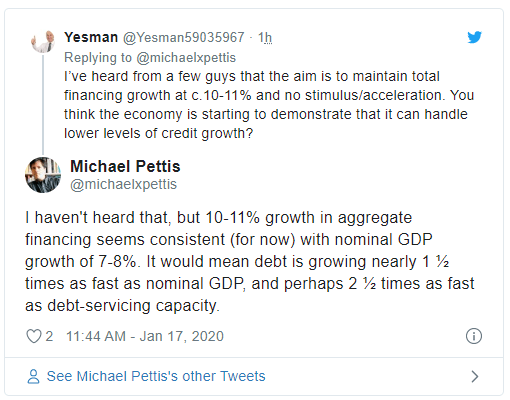
Zombification of China
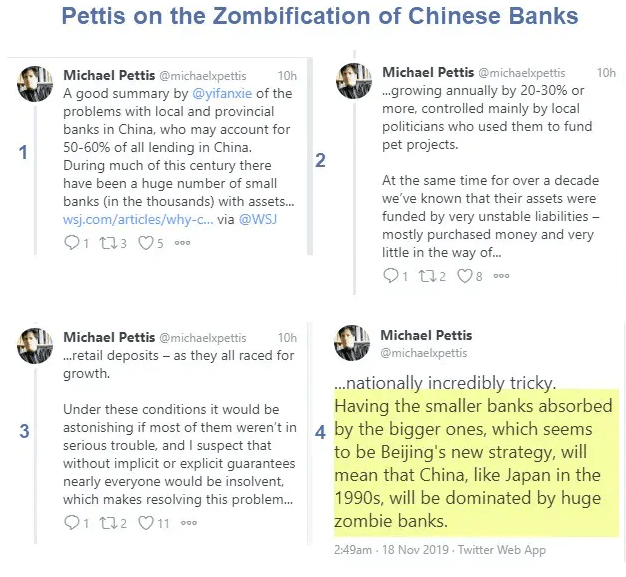
In November of 2019, Pettis commented that China, like Japan in the 1990s, Will Be Dominated by Huge Zombie Banks
"Having the smaller banks absorbed by the bigger ones, which seems to be Beijing's new strategy, will mean that China, like Japan in the 1990s, will be dominated by huge zombie banks," says Michael Pettis.
Pettis is also fond of saying that China's GDP is overstated because of malinvestment. I concur 100%. But the same applies to the US, EU, Japan, everywhere.
The struggle to hit meaningless growth targets is accompanied with struggles to hit equally useless, and even damaging inflation targets.
This is all a matter of degree: So if China's Growth Much Worse Than Reported, What About the US?
Author

Mike “Mish” Shedlock's
Sitka Pacific Capital Management,Llc
Mike “Mish” Shedlock is a registered investment advisor for SitkaPacific Capital Management.