CHF/JPY consolidates below key resistance amid market uncertainty


Market overview
On Wednesday, the CHF/JPY currency pair continues to trade sideways, reflecting the cautious sentiment in the market. Both the Swiss franc and the Japanese yen are regarded as safe-haven currencies, which tend to attract investors during periods of heightened uncertainty. However, in the current climate, the Swiss franc appears to be gaining more favor among investors due to its higher interest rates compared to the Japanese yen. This preference is partly driven by the recent weakening of the U.S. dollar and declining U.S. Treasury yields, which have increased the relative attractiveness of the Swiss franc.
Despite this, the outlook for the CHF/JPY pair could be influenced by potential policy shifts from the Bank of Japan (BOJ) later in 2024. If the BOJ moves towards tightening monetary policy and increasing interest rates, it could shift investor sentiment back towards the yen. However, such a move by the BOJ is contingent on the continued recovery and health of the Japanese economy, which remains a key factor to watch.
Technical analysis
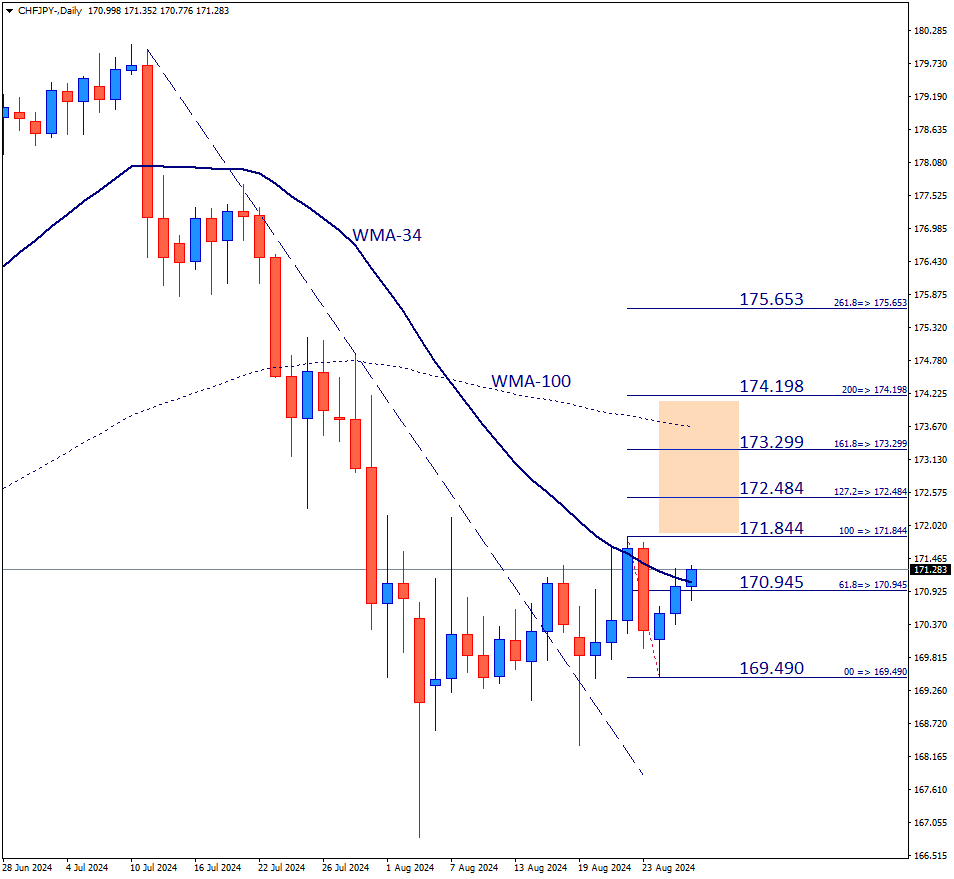
The CHF/JPY pair has been trading in a sideways range over the past month, moving between key support and resistance levels. On the daily chart, the pair is currently holding above the support level of 170.945 and is testing the resistance at 171.844. This range-bound behavior indicates a period of consolidation, as the market awaits clearer direction.
The pair's ability to stay above the 34-day moving average suggests that buyers still have some control, albeit tentative. A successful breakout above the immediate resistance at 171.844 would signal a resumption of the bullish trend and open the path towards the next resistance levels at 172.484 and 173.299, which are near the 100-day moving average. Should the price move beyond this key resistance, it could target higher levels at 174.198 and potentially 175.653, indicating strong bullish momentum.
Oscillators confirmation
RSI (Relative Strength Index): The RSI is neutral, indicating that the market is neither overbought nor oversold, which aligns with the current sideways trading pattern.
MACD (Moving Average Convergence Divergence): The MACD indicator is mixed, reflecting the lack of strong momentum in either direction. This further confirms the current consolidation phase.
Moving Averages: Both the 34-day and 100-day moving averages are relatively flat, supporting the view of a neutral trend with potential for either a breakout or a breakdown depending on upcoming market moves.
Alternative scenario
If sellers manage to defend the 171.844 resistance level and push the market below the 34-day moving average and key support at 170.945, the pair could see a downside move towards the next support at 169.490. A break below this level would confirm a bearish shift, potentially initiating a new downward trend.
Key levels
Resistance levels:
- Resistance 4: 174.198.
- Resistance 3: 173.299.
- Resistance 2: 172.484.
- Resistance 1: 171.844.
Current price (at the time of analysis): 171.283
Support levels:
- Support 1: 170.945.
- Support 2: 169.490.
Key events to watch
Traders should keep an eye on several key economic events that could impact the CHF/JPY pair:
-
Swiss business expectations index: Scheduled for release on Wednesday, this index measures the outlook of Swiss businesses and could influence the strength of the Swiss franc, especially if it shows significant changes in business sentiment.
-
Japan’s foreign bond and stock investment data: To be released on Thursday during the Asian session, this data will provide insights into the flow of foreign investments into Japan, which could affect the yen. A strong inflow might strengthen the yen, while outflows could weaken it.
While these domestic economic indicators are important, historical price analysis suggests that the CHF and JPY often react more significantly to broader international events and shifts in global risk sentiment. Thus, any major geopolitical developments or changes in global economic conditions could also play a pivotal role in determining the next move for CHF/JPY.
Conclusion
The CHF/JPY pair remains in a consolidation phase, with a potential breakout on the horizon if buyers can push above key resistance levels. Technical indicators suggest a neutral to slightly bullish bias, but a move above 171.844 is needed to confirm further upside. Conversely, a break below 170.945 could signal the start of a new downtrend. Market participants should stay vigilant for upcoming economic data releases and any shifts in global risk sentiment that could drive significant moves in this currency pair.
Author
Ali Mortazavi
Errante
BEc, CMSA, Member of IFTA - International Federation of Technical Analysis, Associate Member of STA - Society of Technical Analysis (UK).

















