|premium|

Chart of the Week, Gold: XAU/USD is pressured for the open

The gold price has been consolidating for best part of the past two weeks into month-end. The fundamentals are conflicting from the technically bullish picture. On the one hand, downside risks are prevalent amid a hawkish Federal Reserve, solid US Employment figures and as Russian and Ukraine negotiators continue to work towards a ceasefire. On the other hand, there are prospects of an imminent US recession given the 2-year/10-year curve flirting with inversion and de-escalation or cease-fire remain elusive. 

As for the technical picture, the following illustrates prospects of a breakout to the upside considering the monthly bullish close and wick.

Gold, monthly chart
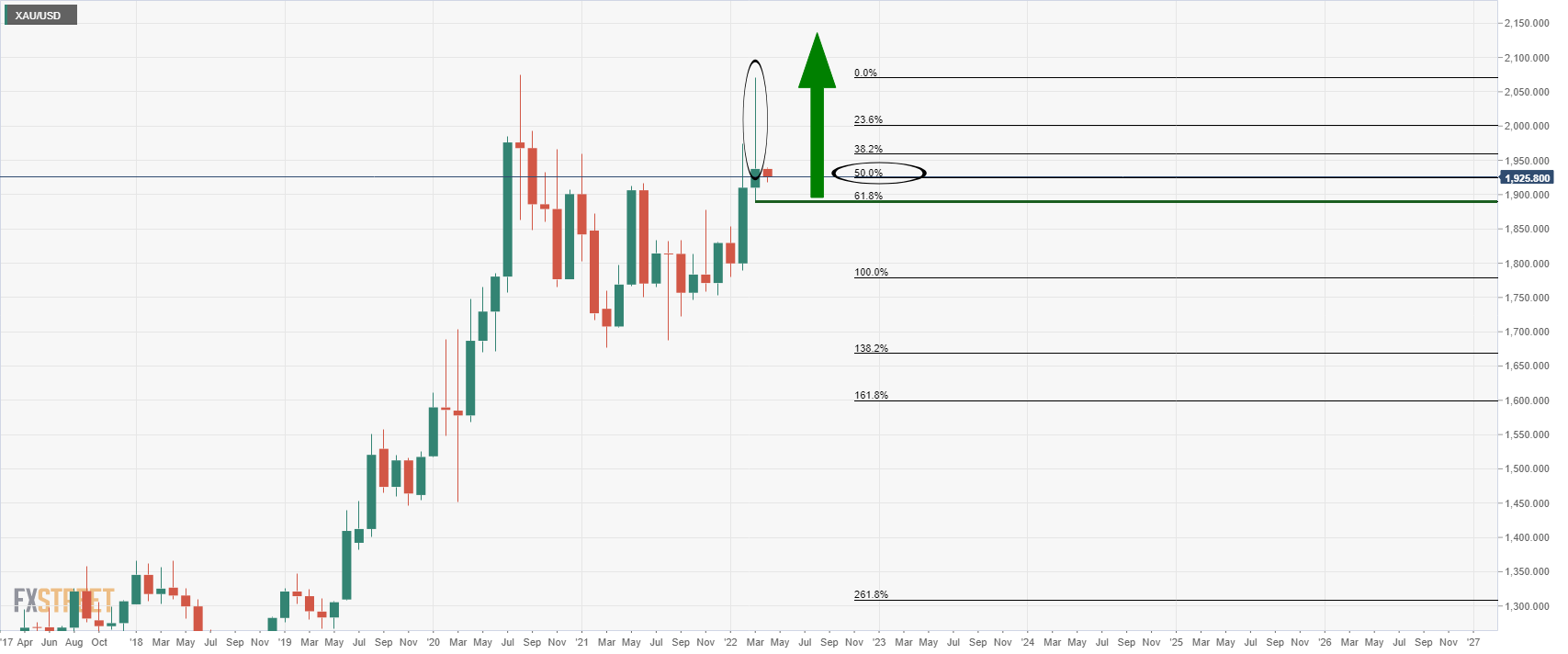
The wick represents the correction of price on the lower time frames. More often than not, once an impulse has been corrected, it attracts demand, in the case of a bullish impulse and higher close. In this case, we have seen the price correct to a 50% mean reversion. There is room, however, for a deeper correction to test the golden ratio, 61.8% Fibonacci at the March lows prior to a move higher again. 

Gold weekly chart
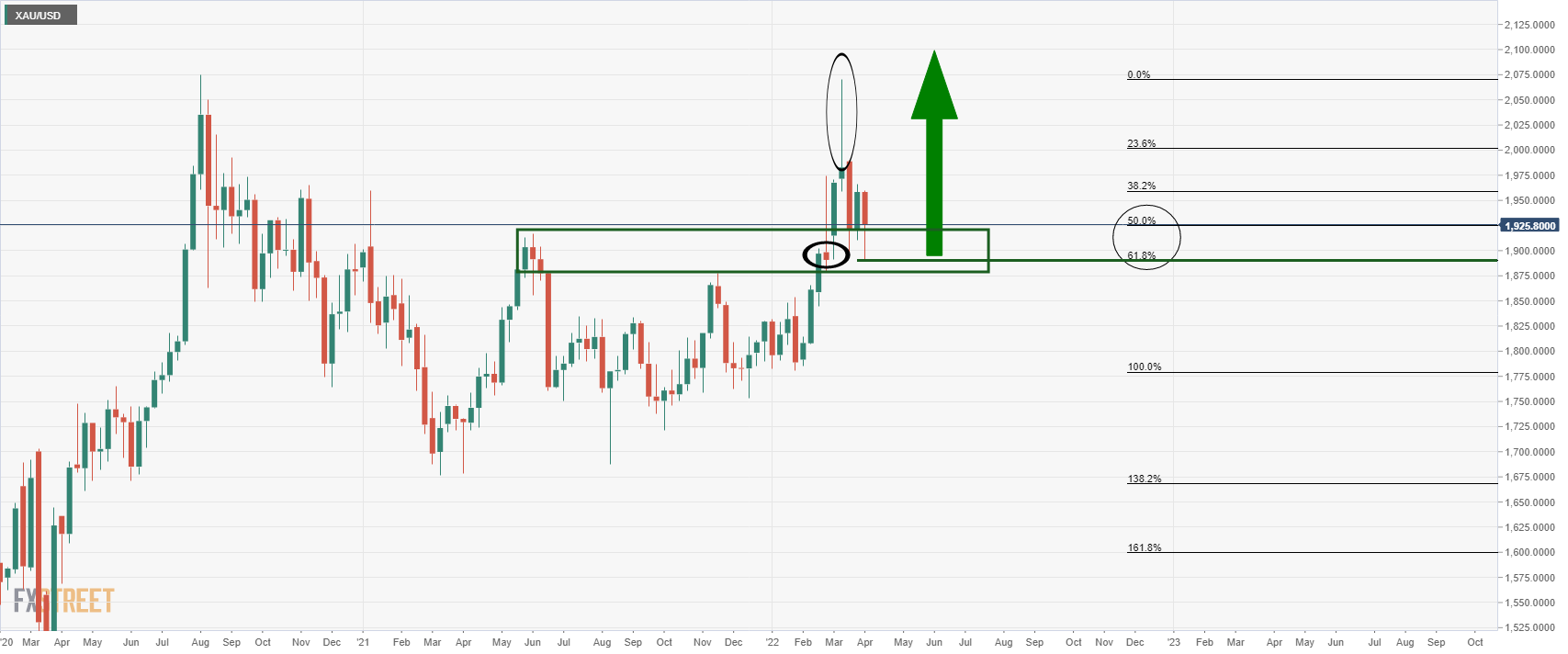
However, from a weekly perspective, there would appear to be strong support around the 61.8% and 50% ratios that coincide with prior resistance across the timeline.  

Gold, daily chart
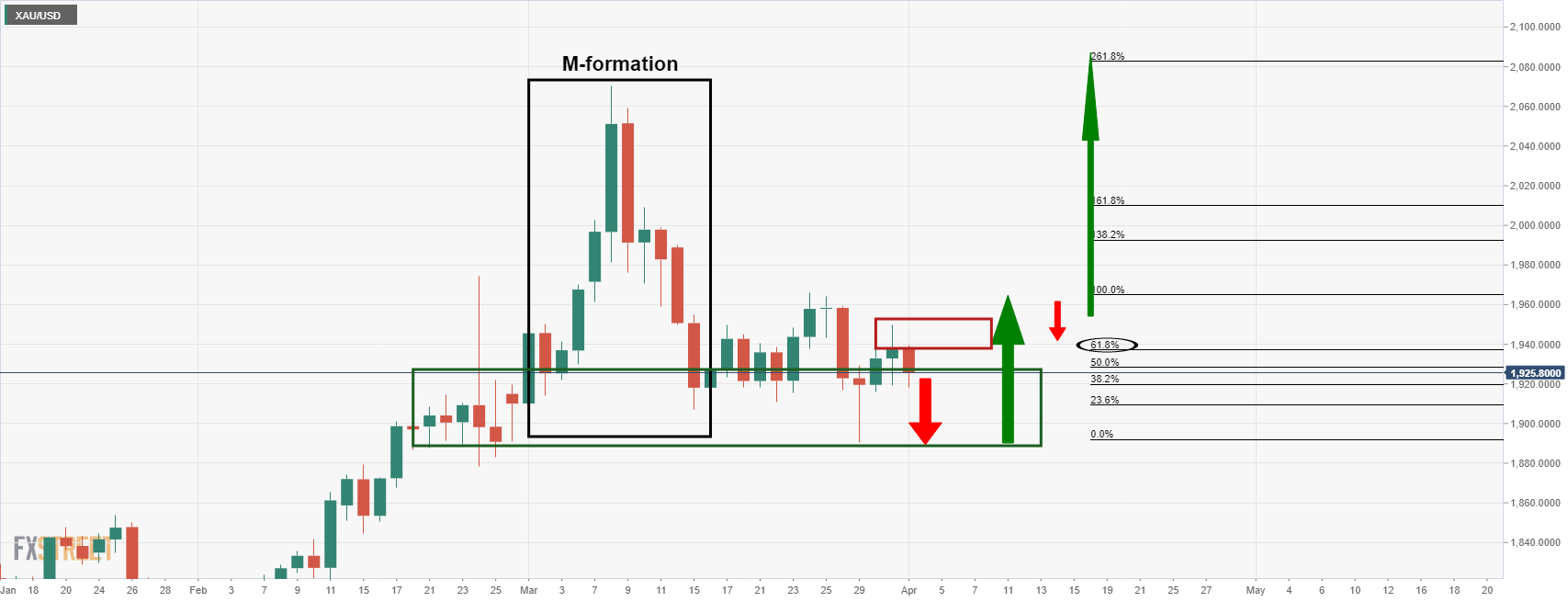
The daily chart is more complex. The M-formation is a bullish reversion pattern and the price would be expected to be attracted to the neckline between 1,980 and 2,000. However, the sideways consolidation has played out to the point that there appears to be a bias to the downside for the near term where gold is being resisted by a 61.8% Fibo currently. With that being said, should the bulls continue to commit in the support area between here and 1,890, then the next fundamental catalyst could tip the balance in favour of the bulls and see the bullish breakout above 1,950 for the week ahead

Premium

You have reached your limit of 3 free articles for this month.

Start your subscription and get access to all our original articles.

Subscribe to PremiumSign In

Author

Ross J Burland

Ross J Burland, born in England, UK, is a sportsman at heart. He played Rugby and Judo for his county, Kent and the South East of England Rugby team.


More from Ross J Burland
Share:

Editor's Picks

AUD/USD advances modestly, hovers around 0.7050

AUD/USD reverses part of Friday’s sharp decline and gyrates around the 0.7050 region ahead of the opening bell in Asia. The pair’s modest recovery comes amid humble losses in the Greenback, always amid the steady uncertainty on the geopolitical front. Moving forward, Westpac’s Consumer Confidence measure will be the salient release on Tuesday.

USD/JPY holds higher ground toward 160.50 despite 'Yentervention' fears

USD/JPY holds higher ground toward 160.50 in Monday's Asian trading, despite intervention fears. Japan’s revised GDP print, which confirmed that the economy lost momentum in the first quarter, weighs on the Japanese Yen. Meanwhile, Friday's upbeat US NFP report and fresh Israel-Iran attacks favor the US Dollar bulls, underpinning the currency pair.

Gold faces initial resistance near  $4,350

Gold manages to reclaim the $4,300 mark per troy ounce and above on Monday. The yellow metal’s small uptick comes on the back of modest losses in the US Dollar, while traders continue to follow geopolitical events in the Middle East and the likelihood of a tighter-for-longer Fed.

Why institutions prefer Solana over newer rivals for stablecoin adoption – Solstice CEO
The cryptocurrency industry has entered a new era spearheaded by stablecoins, real-world asset (RWA) tokenization, decentralized finance (DeFi), and Artificial Intelligence (AI) applications.
$1.75 trillion: Is SpaceX the most popular IPO in history, or the most engineered?

On June 12, the largest initial public offering (IPO) in history is set to hit the tape, and almost nobody is asking whether the price is right, because almost everybody already wants in.

The US economy defies the rules: 100 days into the Oil shock and the recession signal is still missing

More than three months after the start of the Iran war and the resulting disruption to global energy markets, the US economy continues to display remarkable resilience. The conflict has triggered a sharp rise in Oil prices, reignited inflationary pressures and fueled widespread concerns about a potential economic slowdown.