|

Chart of the week: AUD/USD testing bullish commitments at critical resistance area

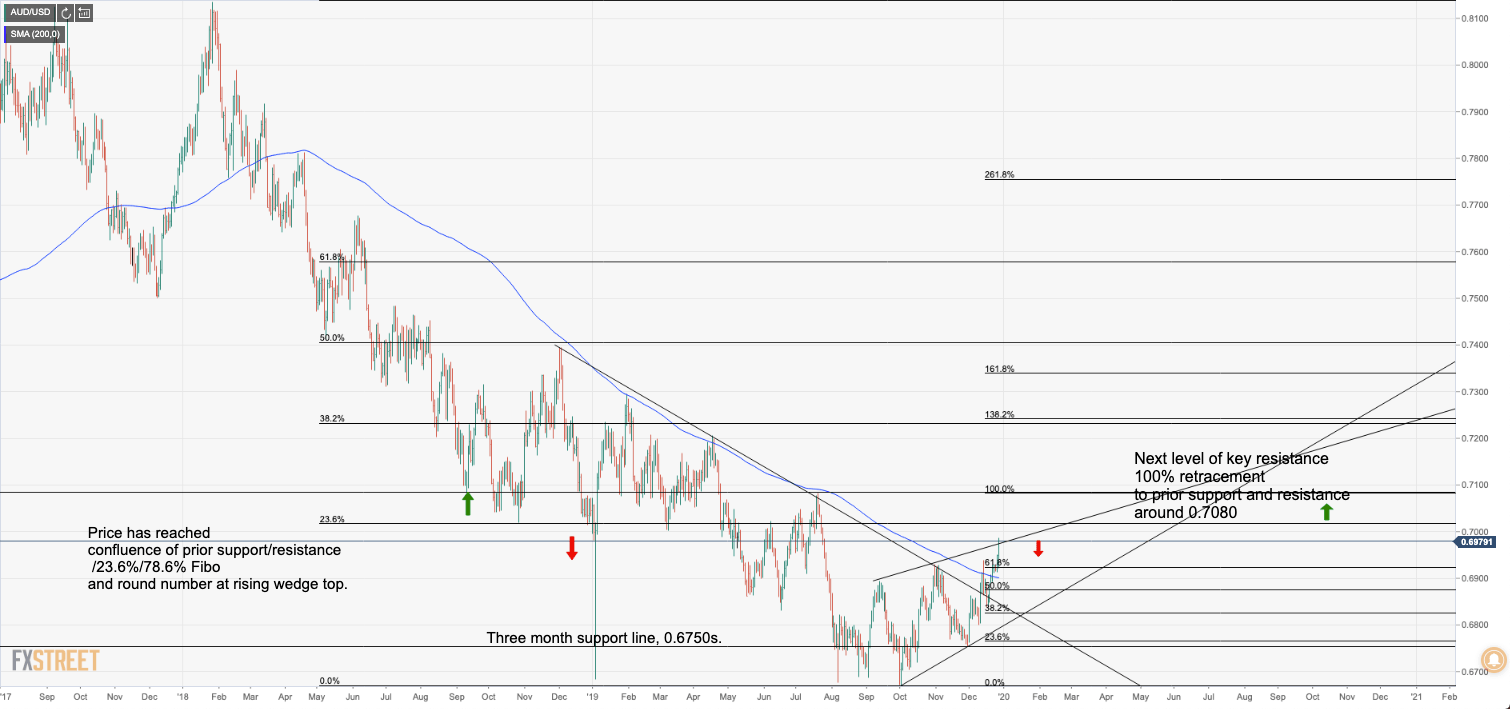
  • AUD/USD reaches the top of the rising wedge in a dominant downtrend and lacks fresh volume.
  • AUD/USD meets tough resistance levels at this juncture despite trading through the 200-DMA. 
  • Bulls can aim for July peak and a 100% retracement confluence level, 0.7070/80.
  • Bears will look for a break of 200-DMA and re-run to wedge support which meets 50% Fibo level, 0.6870.

AUD/USD daily chart
Bullish scenario:

AUD/USD has risen to test the top of a rising wedge which has formed in a broader downside trend and vs negative fundamentals for the medium-term outlook. Therefore, a full-on bullish trend is not the bias at this juncture, although there is room for a continuation should the rising wedge's resistance break, but the scope looks limited to the July peak and a 100% retracement of those swing highs around 0.7077.

Bearish scenario:

In thin holiday trade, there has been a lack of volume and hence the case for a sell-off given the rising wedge formation in a downtrend is compelling. This scenario will open a run back to rising support to the 50% Fibo of said swing-range, just below the 0.69 handle, testing bullish commitments at the 200-DMA. Below here, support below the 55-day moving average can be found at the 0.6800 Dec. 10th low. We then have a three-month support line around 0.6755 as the November low.

Author

Ross J Burland

Ross J Burland, born in England, UK, is a sportsman at heart. He played Rugby and Judo for his county, Kent and the South East of England Rugby team.


More from Ross J Burland
Share:

Editor's Picks

GBP/USD advances to 1.3650 region despite weak sales data

GBP/USD trades in positive territory at around 1.3650 in the European session on Friday. Although Retail Sales data from the UK came in weaker than expected, the pair holds its ground, supported by the persistent US Dollar (USD) weakness following the Treasury Department's decision to boost long-term bond purchases earlier in the week.

EUR/USD holds near 1.1700 ahead of PMI data

EUR/USD consolidates its weekly gains at around 1.1700 in the European session on Friday. Investors await preliminary August PMI data from Germany, the Eurozone and the US, while the persistent USD weakness allows the pair to keep its footing.

Gold hits fresh high since June above $4,550 as receding Fed hike bets undermine USD

Gold sticks to modest gains near its highest level since early June, touched earlier this Friday, and trades just above $4,550 heading into the European session. The commodity is looking to build on the breakout momentum above a technically significant 200-day Simple Moving Average amid a weaker US Dollar. Traders scaled back their bets on an immediate interest rate hike by the Fed after the latest US inflation data released last week signaled signs of cooling price pressures.

Bulls in control with Bitcoin heading toward $80,000, Ethereum $2,500, XRP $1.50
Bitcoin (BTC), Ethereum (ETH) and Ripple (XRP) are extending their rallies as bullish momentum strengthens and continue to cheer the US Treasury’s decision to double its debt buyback operations. BTC has climbed nearly 20%, ETH over 25% and XRP nearly 30% so far this week.
$40 trillion debt black hole: Is a financial crisis coming?

The United States is closing in on a milestone that would have been almost unimaginable not long ago: $40 trillion in national debt. That staggering figure framed the latest episode of the Money Metals Midweek Memo, as host Mike Maharrey examined what he calls the economy’s “debt black hole” and zeroed in on a relatively obscure corner of the financial system that could become a much bigger problem: the $1.4 trillion private credit market.


$20 billion offered, $2 billion taken: Why Treasury doubled its buyback cap

The US Treasury moved off its own calendar on Wednesday, and that is the part worth sitting with. At 12:32 GMT, the department said it would at least double the size of liquidity support buyback operations in the 10-year to 20-year and 20-year to 30-year sectors, lifting the maximum from $2 billion per operation to at least $4 billion, effective September 9 and running to November 4.