|

Canadian Dollar eyes Retail Sales ahead of rate meeting
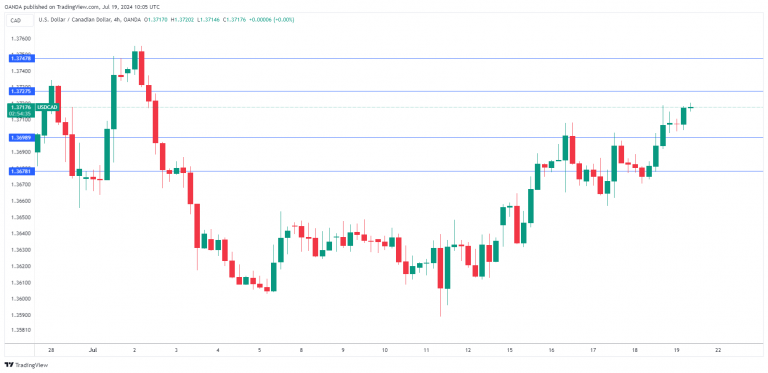
The Canadian dollar is calm on Friday. In the European session, USD/CAD is trading at 1.3717, up 0.08% on the day at the time of writing. We could see stronger movement in the North American session, with the release of Canadian retail sales.

Will Retail Sales suffer a reversal?

Canada’s retail sales is expected to regress in June after a strong reading a month earlier. The market estimate stands at -0.6% m/m, after a gain of 0.7% in May. Annually, retail sales sparkled with a gain of 1.8%.

Today’s retail sales report is the final key release ahead of the Bank of Canada’s meeting on July 24. The BoC is widely expected to cut interest rates for a second straight month after last week’s positive inflation report. Inflation fell from 2.9% to 2.7% y/y in June and CPI declined by 0.1% on a monthly basis, the first decline since December 2023. Core CPI also decreased slightly.

The BoC has already demonstrated that it is ready, willing and able to cut rates as both headline and core inflation are within the 1% to 3% target range. Households and businesses are looking for more relief from high interest rates and the central bank will need to continue lowering rates in order to avoid a recession.

In the US, unemployment claims jumped to 243 thousand last week, up from a revised 223,000 in the previous release and higher than expectations. The increase is another indication that the labor market has been softening, which supports the case for a rate cut. The markets have priced in a 95% probability a rate cut in September, according to CME’s FedWatch.

USD/CAD technical

  • USD/CAD is testing resistance at 1.3727. Close by, there is resistance at 1.3747.

  • There is support at 1.3698 and 1.3678.
USDCAD

Author

Kenny Fisher

Kenny Fisher

MarketPulse

A highly experienced financial market analyst with a focus on fundamental analysis, Kenneth Fisher’s daily commentary covers a broad range of markets including forex, equities and commodities.


More from Kenny Fisher
Share:

Editor's Picks

EUR/USD slumps below 1.1750 as USD benefits from risk-aversion

EUR/USD comes under renewed bearish pressure in the European session and trades below 1.1750 following a recovery attempt earlier in the day. The US Dollar gathers strength and weighs on the pair as investors seek refuge in the wake of Israel and the United States' joint attack on Iran.

GBP/USD targets 1.3500 barrier near moving averages

GBP/USD rebounds from the daily losses, trading around 1.3450 during the Asian hours on Monday. The technical analysis of the daily chart indicates an ongoing bearish bias, as the pair trades within a descending channel pattern.

Gold surges on safe-haven demand, rises above $5,400

Gold benefits from intense risk-aversion on Monday and climbs above $5,400, setting a fresh monthly-high in the process. Tensions in the Middle East remain high as Israel and Hezbollah continue to exchange strikes following the US-Israel joint attack on Iran over the weekend.

Bitcoin, Ethereum and Ripple under pressure as key supports face breakdown risk

Bitcoin, Ethereum, and Ripple prices trade on the back foot at the start of this week on Monday, after extending losses in the previous week. BTC is on the brink of a breakdown, ETH is capped below key resistance, and XRP risks a crack of the trendline.

The market is paying for insurance, not apocalypse

As expected, this morning felt less like a Monday market open and more like a fire drill. Futures screens flickered red. S&P contracts down almost 1%. Nasdaq off 1.2%. Brent leaped 13% through $80. Gold rose 1.6% toward $5350 before paring some gains. The dollar is strutting mildly. The Swiss franc is quietly doing what it always does in a storm, catching some safe-haven flows.

Pi Network Price Forecast: Core team offloads supply, weighing on PI recovery

Pi Network  hovers below $0.1700, broadly steady at press time on Monday, attempting a recovery after a 2% loss the previous day. Sunday’s decline aligned with nearly 49 million PI tokens offloaded by the Pi Foundation, implying a spike in supply pressure that capped the prevailing four-day recovery.