Can excess savings unlock consumer resilience and shape the recession landscape?


Summary
Excess savings enabled consumer staying power and helped delay recession. This report explores how surplus liquidity itself unlocks the capacity for a structurally lower saving rate and how each monthly draw-down of savings could make the coming recession worse for households.
Savings' grace
A stash of excess savings helped fuel the staying power of consumer spending in this cycle and that, in turn, has kept the oncoming recession at bay. Since the early days of the pandemic, many have tallied up the amount of liquidity households stashed away that was in "excess" of pre-pandemic saving levels. We have referred to this as "excess savings" and the idea was that households were able to rely on some of this stashed cash to maintain spending in the face of the pandemic, elevated inflation and now higher interest rates. In tallying up excess savings, we are in fact looking at the deviation from pre-pandemic saving patterns.
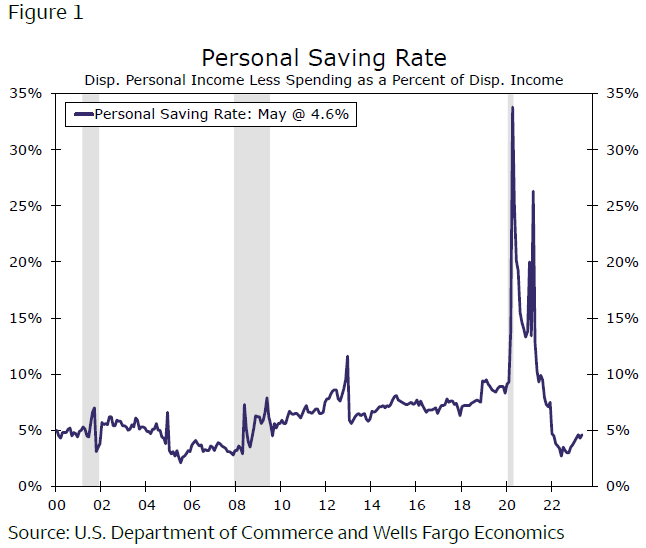
The personal saving rate has undergone large variations since the start of the pandemic. After averaging 7.2% over the prior expansion, the saving rate shot higher to north of 30% in the early days of the pandemic before nearly testing all-time lows last year (Figure 1). This swing was largely attributed to the inflow of fiscal support as well as fluctuations in spending related to life at home and the re-opening of the economy.
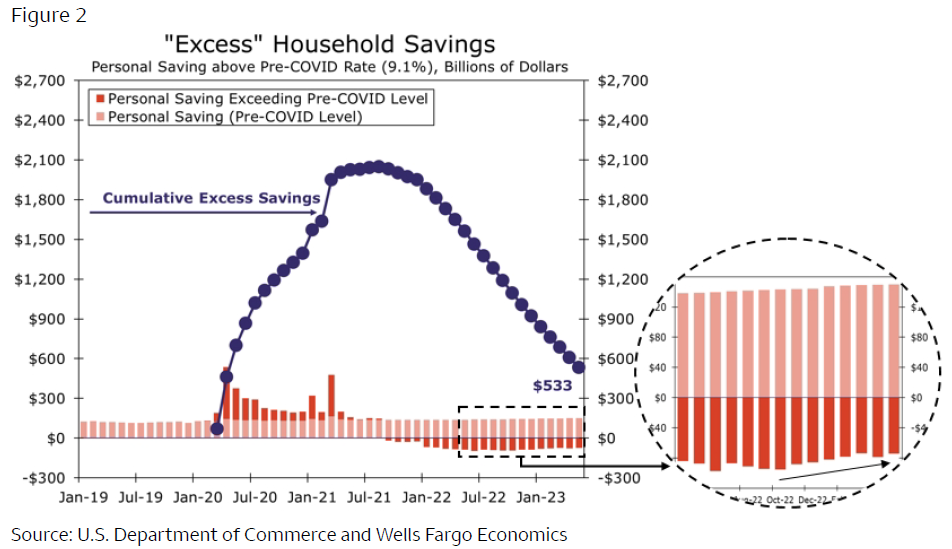
After accumulating cash during the pandemic, liquidity has begun to normalize as consumers spend at elevated rates. Based on the personal saving rate, we estimate there is about $500 billion in excess savings remaining as of May (Figure 2), which amounts to about seven months of spending power based on the average draw-down over the past six months. However, as the insert in Figure 2 shows, the monthly draw-down of excess savings has been getting smaller, on trend, since autumn 2022. If households continue to be more cautious about tapping savings, it could last longer than seven months.
More simple measures of savings, like household checking and saving deposits, suggest "excess" liquidity will last a little longer and not be fully depleted until the first quarter of next year when compared to its pre-pandemic run-rate, or where deposits would have been in the absence of the pandemic.
Whether the pandemic-related buffer runs dry by the end of this year or the start of next, households will still have the ability to spend at elevated rates, it will just come with a greater deterioration in household finances. Said differently, a structurally lower personal saving rate is plausible though it ultimately positions households to be more vulnerable to shocks in the future because households will have accrued less in the rainy day fund.
Author
Wells Fargo Research Team
Wells Fargo