Business insolvencies in Europe: Diverging trends

Our Western Europe business insolvencies index has risen above its pre-COVID level. However, it is still far below the peaks seen after the 2008 crisis and during the eurozone crisis (between 2011 and 2015). In most countries, the business insolvencies level is now higher than it was before the pandemic. This has been the case since 2022 for the UK and Sweden, which were joined by France, Belgium and Germany during 2023. However, in Germany, Italy and the Netherlands, the insolvency levels are still far below their pre-COVID peaks. These diverging evolutions are also being reflected in sectors, with sharper deterioration in construction, trade and real estate agencies in the countries that have suffered the steepest decline in business activity.
WESTERN EUROPE: INSOLVENCIES INDEX
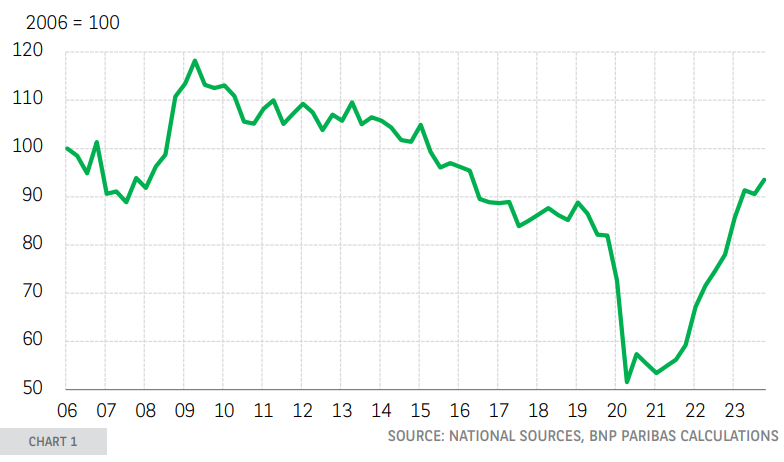
Business insolvencies continued to rise in Europe in 2023 (chart 1[1]), increasing by an annual average of 24% from 2022 (following 2022's annual average rise of 30% on 2021). They rose above their 2019 level in Q2 2023 and, in Q4 2023, stood close to the Q2 2016 figure.
This trend is due to the gradual withdrawal of the exceptional support measures put in place during the COVID-19 period and the impact of significant inflation and rising interest rates between 2021 and 2023. However, the index shows that insolvencies are still far below the levels seen after the 2008 crisis, as well as the high level throughout the eurozone crisis (2011-2015).
Author
BNP Paribas Team
BNP Paribas
BNP Paribas Economic Research Department is a worldwide function, part of Corporate and Investment Banking, at the service of both the Bank and its customers.