British Pound mid-year outlook: Where the Pound is headed as war, fiscal cracks and central banks collide
Looking back, 2026 has not been a bad year for the British Pound (GBP). The GBP/USD pair is less than 1% below the year-opening levels, which, comparatively, is far from the worst performance among major currencies, especially considering that a major conflict erupted in the Middle East, Crude Brent oil reached levels above $120, and the UK cabinet collapsed in the meantime, although the latter is not that uncommon.
The near-term future, however, is not looking that good, at least from today’s standpoint, and the question is whether the Pound will be able to maintain the resilience shown in the last six months through the rest of the year as storm clouds gather.
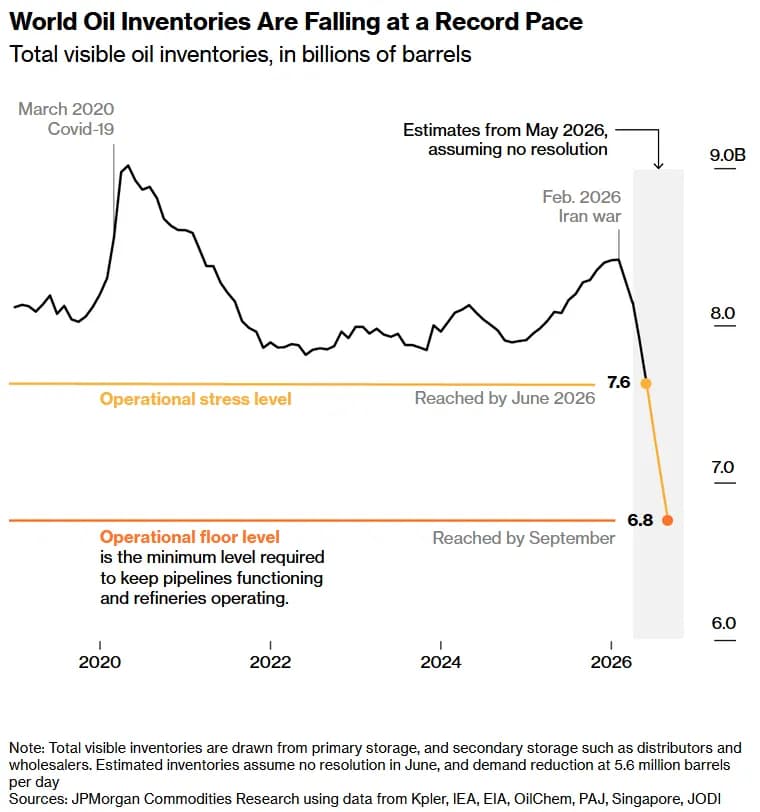
The war in Iran is keeping markets on edge again, as truce attempts remain futile, and risks of spilling over into a highly volatile region are increasing. Blockades in two key bottlenecks for Crude transport, the Strait of Hormuz and Bab el-Mandeb, have boosted fears of supply disruptions, while global Oil inventories are falling at a record pace, pushing reserves near critical operational levels. And triggering sharp rallies in Oil prices. The risk-averse sentiment stemming from fears of an extended conflict that would disrupt energy supply has been a key driver for the USD strength this year.
Monetary policy is not particularly supportive either. Recent developments have prompted some Bank of England (BoE) policymakers to call for higher interest rates, but the odds for a near-term rate hike remain low. Hopes that the US Federal Reserve (Fed) will tighten its monetary policy, on the other hand, remain high, as employment and growth data have cemented the theory of US economic exceptionality.
Beyond that, the first announcements of Prime Minister Andrew Burnham’s policies have raised concerns about fiscal stability, opening the first cracks in investors’ confidence. Government debt has been a very sensitive issue, following the 2022 Liz Truss crisis, and, in that regard, if the new PM’s spending plans fail to convince markets, we might see a significant Pound decline over the coming months.
The US Dollar emerges as the unique winner from the Middle East conflict
The first take from Iran’s war has been the confirmation of the US Dollar (USD) status as investors’ safe-haven asset of choice in times of political crisis, a condition that had been put into question following US President Trump’s erratic trade policies and his attacks on the Federal Reserve’s independence.
And the war in Iran is not looking to be heading to a swift resolution; quite the contrary, recent developments have increased the risks that the conflict extends to neighbouring countries as the Iran-backed Houthis blocked the Red Sea route, Saudi Arabia’s alternative for Oil exports, and the Saudis stepped forward to launch combined strikes with the US against Tehran’s allies in Iraq. US President Donald Trump, meanwhile, keeps threatening to ramp up his attacks, keeping the door open to combined operations with Israel. In a few words, a mess that threatens to ignite the whole region.
These tensions are likely to boost support for the safe-haven US Dollar. Strategists at Societe Generale highlight that energy markets remain a key driver of FX sentiment, and observe that the widening “bond spreads and the ascent of Brent to $100/b has boosted the appeal of long USD/G10,” reinforcing the Dollar’s advantage against most peers.
High Inflation and low growth, the worst nightmare for the BoE
Recent UK data has shown an unexpected improvement in economic activity and a sharper-than-expected decline in inflationary pressures. These data, however, have been taken in stride by the markets as June’s Consumer Prices Index (CPI) remains well above the BoE’s 2% target, and Oil prices escalated to fresh highs following the breach of the ceasefire in Iran.
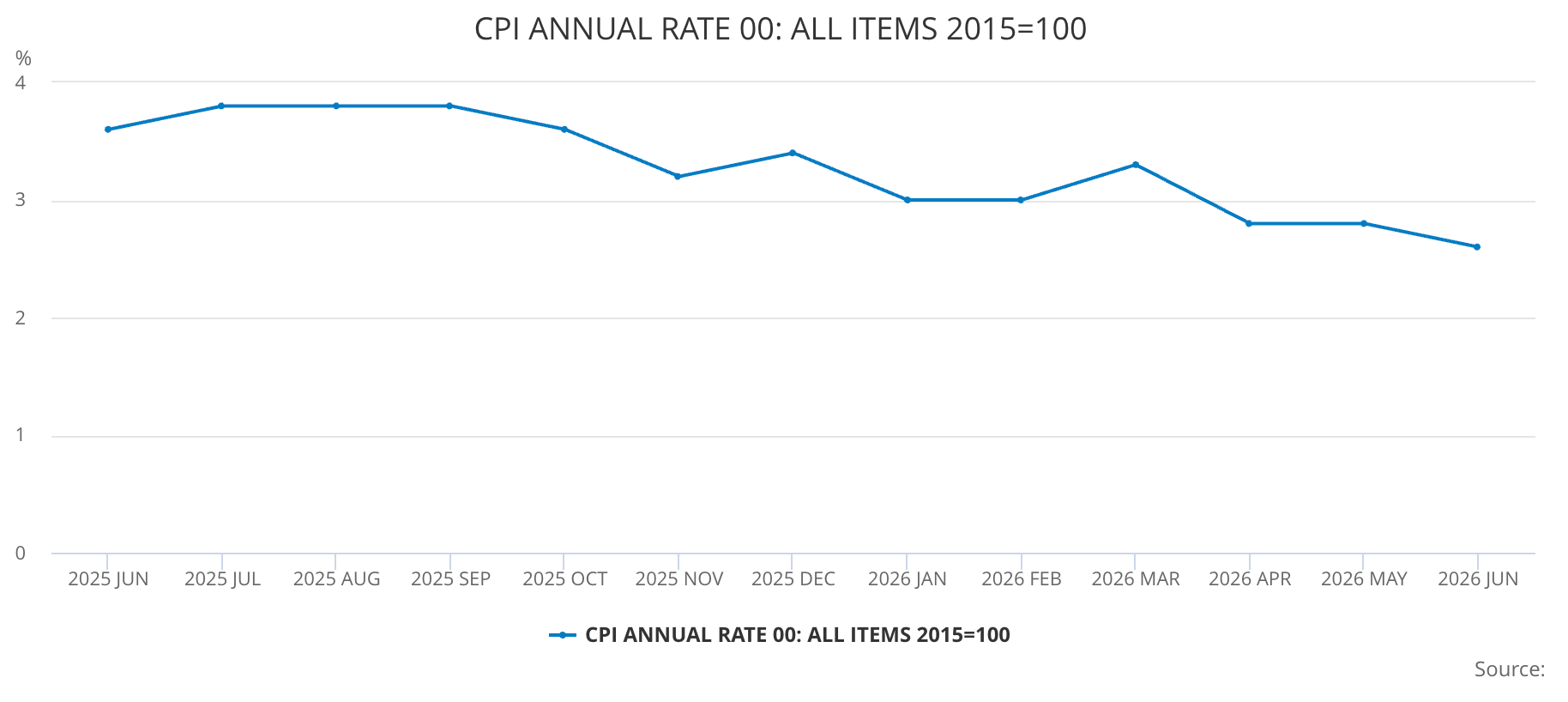
Source: UK Office for National Statistics
High energy prices tend to push broader inflation higher, hurting consumption and industrial output, often leading to a “stagflation” context. This typically poses a headache for central banks, as the monetary tightening needed to tackle inflation might further undermine economic growth. G10 central banks, including the BoE, are heading into that scenario, resulting in divided committees that complicate monetary policy decisions.
The Pound would need a swift resolution of the conflict or, at least, a steady and credible peace plan that allows for the resumption of free flows of Oil traffic from the Arabian Gulf countries. If Iran’s war risk premium is removed, speculative traders will, highly likely, cut back a fair share of their US Dollar long positions, as we saw during June’s ceasefire, with risk appetite boosting demand for the GBP and other G10 currencies.
The Federal Reserve is expected to hike interest rates… Or not
Monetary policy divergence between the BoE and the Fed is another source of weakness for the Pound, at least for now. Here too, however, it's worth noting that we move in shifting waters. Recent US data showed that the labour market stabilised this year, despite the disappointment on June’s Nonfarm Payrolls Report, which, coupled with the above-target inflation levels, has prompted investors to raise bets that the Fed will hike interest rates at least once this year.
If these expectations are met and the US central bank finally opts for tightening its monetary policy, it will provide additional impulse to the US Dollar. However, July’s Fed monetary policy decision has provided no certainty that this is far from a done deal.
Let’s not forget that Fed Chairman Kevin Warsh was appointed by US President Donald Trump after all, whose campaign for slashing borrowing costs during the last year of the former Chairman Jerome Powell’s term reached an unforeseen intensity. Warsh has pledged to defend the bank’s independence with an unmistakable commitment to fight inflation, but he also announced five task forces for advancing monetary policy, one of them regarding the data analysis area, that might water down the current monetary tightening expectations.
So far, July’s Fed monetary policy review left investors wondering about the next steps, and futures markets ramped up bets of another pause in September, to levels around 35%, from 17% in the previous week. Against this background, Strategists at UOB Group highlight that a “divided FOMC” and “ongoing reviews across five task forces” underpin their view that the Fed is likely to stay on hold for an extended period. UOB analysts affirm that the “base case remains an extended pause through 2026 before resuming easing in 2Q and 4Q 2027, once transitory inflation fades,” underscoring expectations that policy normalization will be delayed until price pressures have clearly moderated.
It will be interesting to see how the bank will react in September if inflationary pressures remain high and geopolitical tensions keep supporting Oil prices. The bank’s credibility has been put into question after July’s meeting and, in this context, lower hopes of monetary tightening might likely undermine the US Dollar’s status as a safe-haven currency.
BoE Monetary Policy is a quiz
The Bank of England’s near-term monetary policy remains highly uncertain. The BoE has kept its Bank Rate unchanged at 3.75% since December last year, with a growing number of policymakers calling for higher borrowing costs to keep inflationary pressures in check.
Rising energy prices have fuelled expectations that the bank will be forced to tighten its monetary policy in the second half of the year. Markets are almost evenly split about a rate hike in September and practically fully pricing one before the year-end. BoE Governor Andrew Bailey, however, warned against “thinking that the BoE” is edging towards a rate hike at the press conference following July’s monetary policy decision.
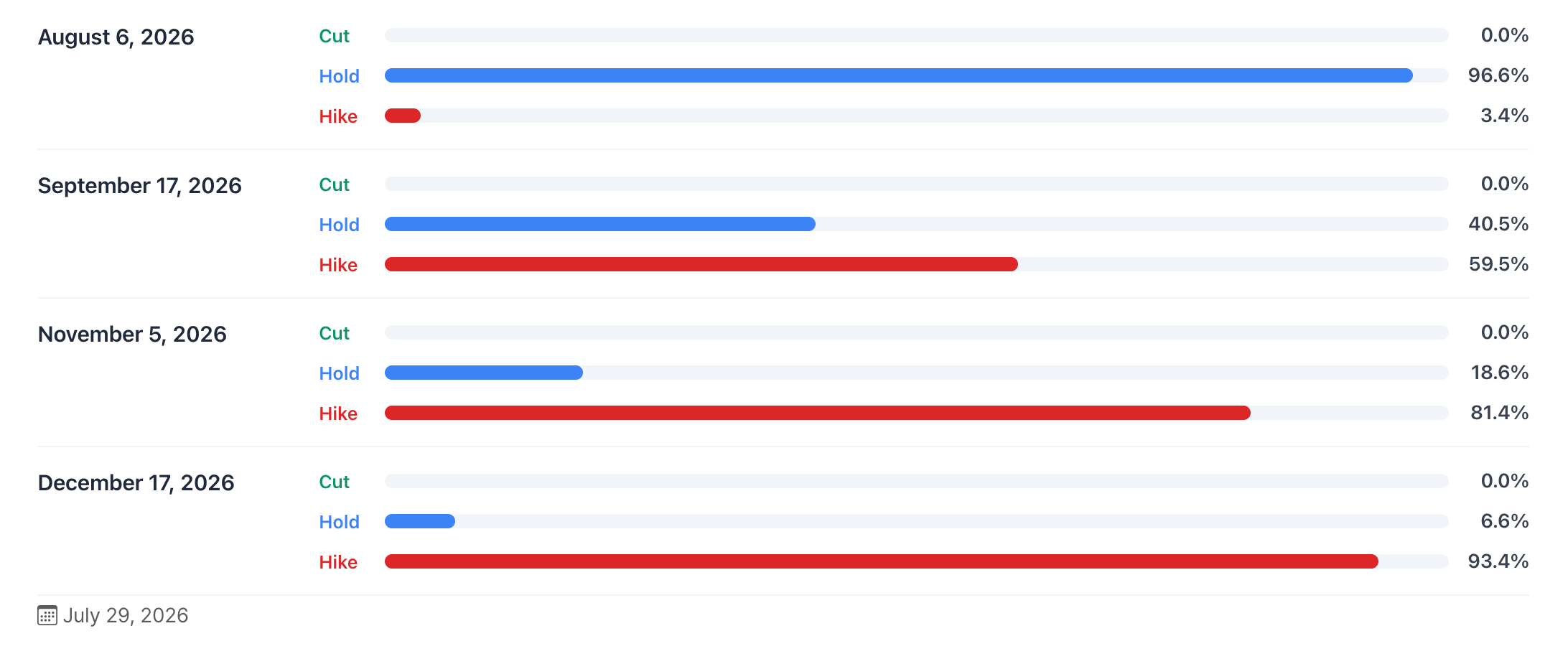
Source: Centralbank.watch
Analysts at Brown Brothers Harriman observe that a “less worrisome UK inflation backdrop gives the BoE room to stand pat,” with “cooling wage growth” pointing to “softer services inflation ahead”. Beyond that, the BoE’s Decision Maker Panel (DMP) business survey shows that “inflation expectations eased in July.”
All things considered, there is a significant chance that the BoE disappoints markets, especially if second-round effects from inflation remain absent and consumer prices continue cooling. This would trigger a dovish repricing and, highly likely, increase bearish pressure on the GBP and most of the Pound’s crosses.
BBH experts advise caution, as, in their opinion, “GBP risks remain skewed to the downside in part because BoE rate hike pricing is too aggressive,” highlighting that “the swaps curve implies 75bps of tightening to 4.50% in the next twelve months.”
Fiscal concerns might hurt confidence in the Pound
But if this was not enough, concerns about the UK’s fiscal stability might reveal a major threat for the Pound. Financial markets initially reacted positively to Prime Minister Keir Starmer’s resignation in June, but the new PM, Andrew Burnham, has opened the first cracks on investors’ confidence, putting some pressure on the Pound.
Burnham pledged observance of the fiscal rules before becoming prime minister, but his first major policy plan focused on lowering the cost of living involves a reduction of the VAT on energy bills and caps on transport fees among other measures. He also promised that he would not hike taxes on working people, and investors are wondering where the funding for those plans will come from, as, according to critics, there is no spare cash lying around.
Recent data revealed that UK public borrowing rose less than expected in June, but bond markets remain on edge about rising debt amid the consequences of Iran’s war and the increasing spending pressures. In this context, the Office for Budget Responsibility (OBR) issued a warning earlier in July, stating that Britain would need extra tax rises or spending cuts equivalent to the entire education budget early next decade to avoid government debt spiralling into unsustainable levels. Not exactly what Burnham is planning to do.
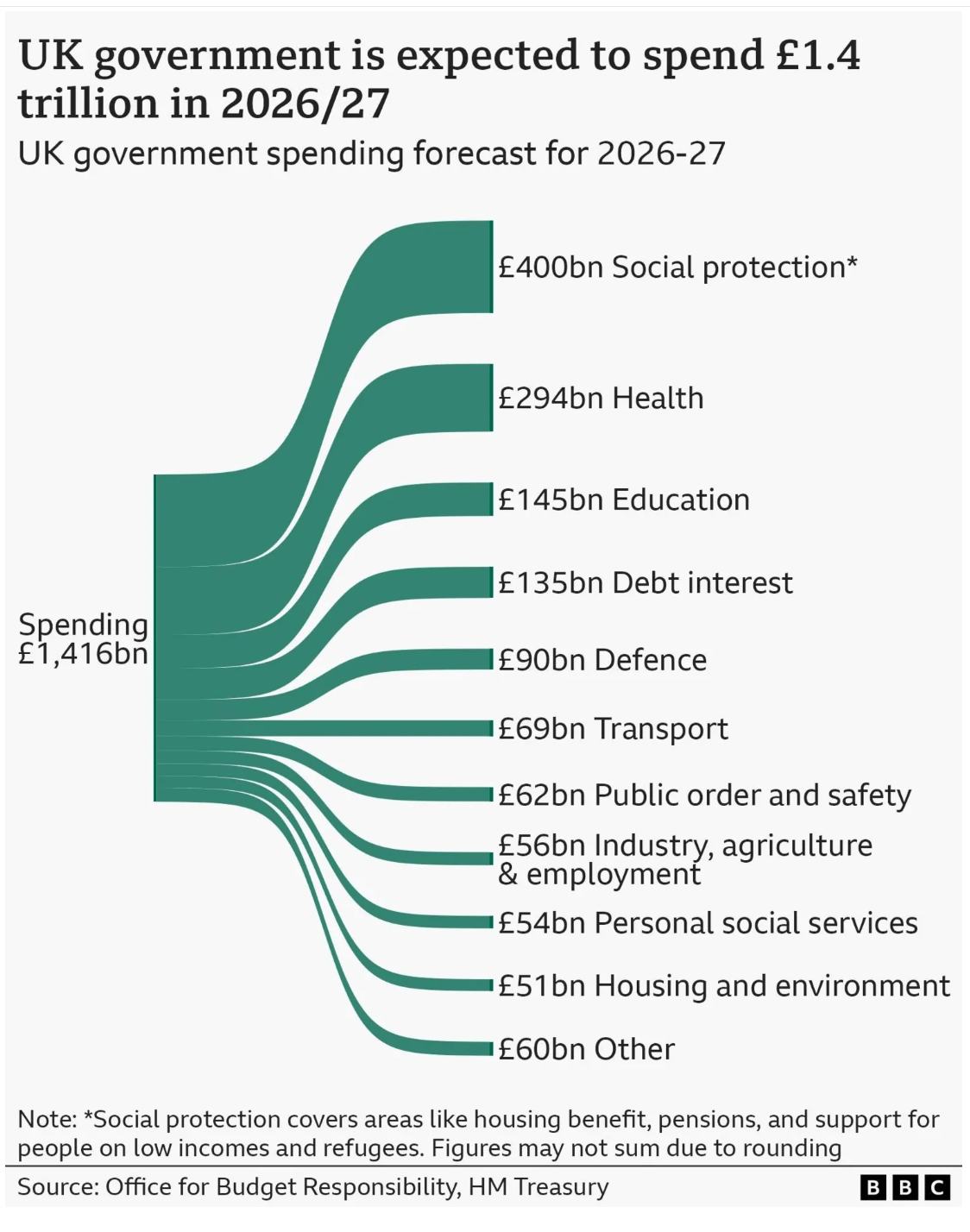
The new UK cabinet is projecting plans that will cost about GBP 1.4 billion, according to data by BBC Verify. The Government assured that the spending increases will be “fully funded” but has not given details, and the numbers do not add up. UK bonds are largely in the hands of foreign investors, which heightens the risk of capital outflows if fiscal concerns worsen, as was evidenced at the 2022 mini-budget crisis.
At this point, Burnham will have to walk a thin line, avoiding unleashing a credit crisis, but honouring his pledges if he does not want to alienate his supporters and create another political crisis; any of these two scenarios would have very negative consequences for the Pound.
US mid-term elections, a challenge for the US Dollar
In the US, November’s mid-term election might become a major driver for currency markets. US voters chose 435 members of the House of Representatives and 35 out of the 100 seats in the US Senate. Historically, midterm elections have tended to weaken the ruling party.
President Trump has repeatedly expressed his concern about the midterms, and also for good reason. The war in Iran and the rising cost of living have undermined his popularity, which, according to the latest polls, has dropped to an approval rate of 36% from around 50% in the first months of his second term in the White House.
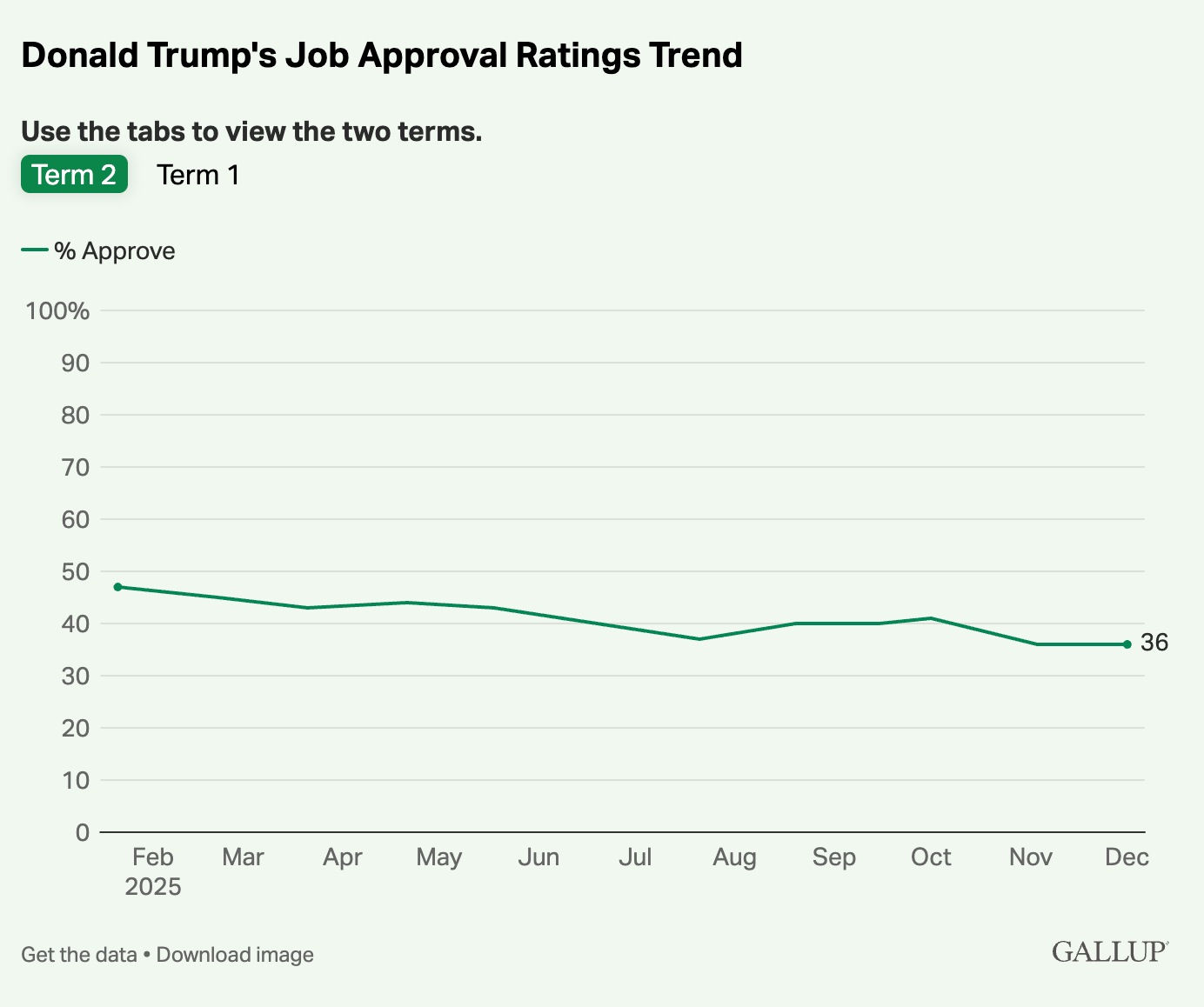
Source: Gallup
This has moved some Republican officials, including the President, to question the voting system, in some states suggesting a redrawing of the congressional map. Trump himself has resurrected the theory of the 2020 fraud, accusing China of meddling in the 2020 elections, when he lost to Joe Biden, and warning about the “shocking vulnerabilities” in American voting systems.
The truth is that Trump does not seem to have a problem with muddling the field if it fits his purposes. It is difficult to foresee how the US Dollar will react if the US electoral system is put into question, but volatility will likely increase. If the elections finally take place without major disruptions, the impact on the US Dollar tends to be short-lived, as monetary policy and the macroeconomic issues return to the forefront.
Technical picture for the GBP/USD
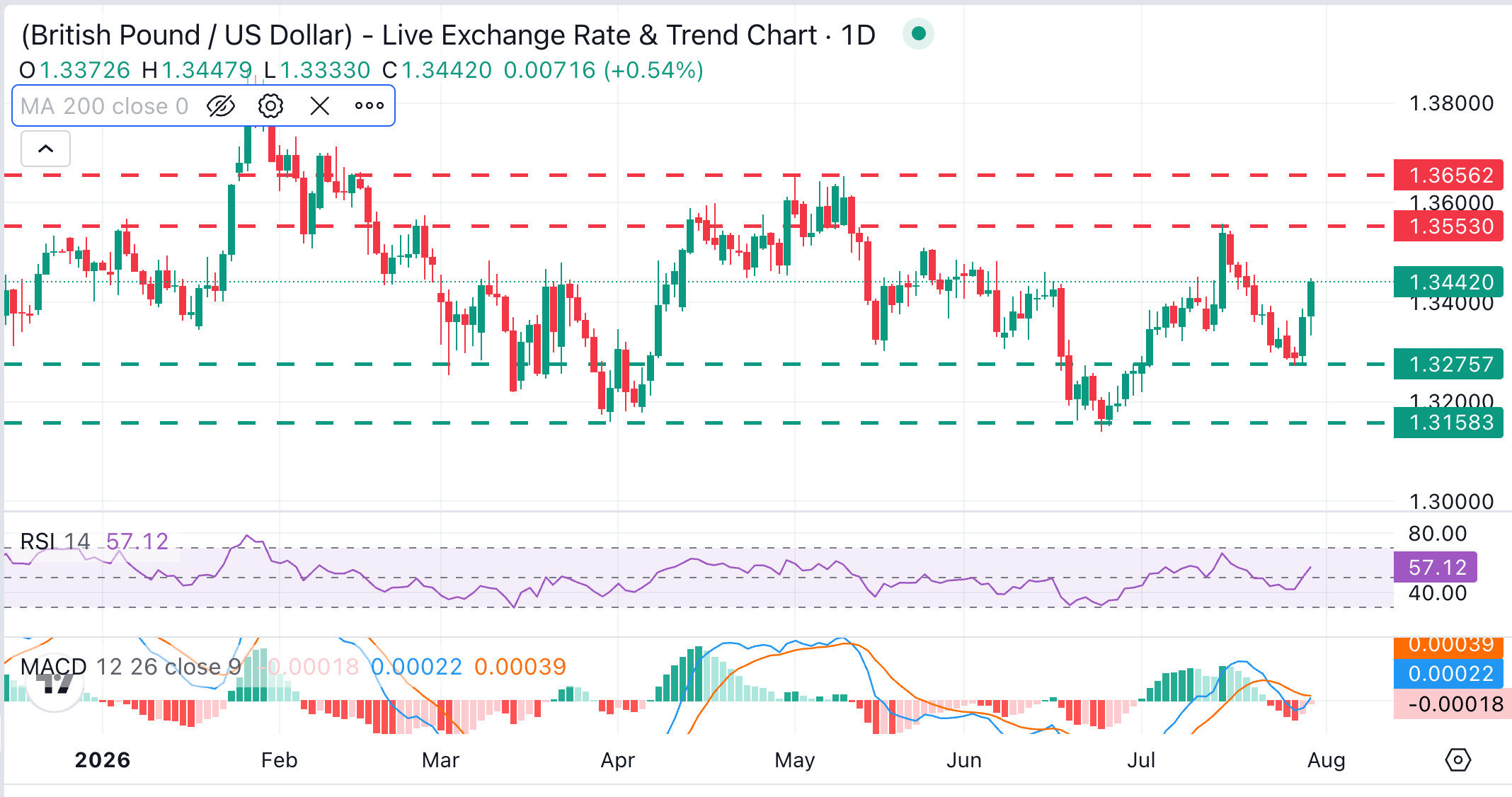
From a technical standpoint, the Pound has been trading in a choppy and sideways manner, within a range from 1.3150 to 1.3650 during most of the first half of 2026, despite hitting a high near 1.3850 in January. The daily chart shows some improving bullish traction at the time of writing, although momentum indicators are mixed, and price action remains halfway through the last few months' range.
The recent rebound seems more related to US Dollar weakness, amid the Fed’s disappointment in its last decision, than intrinsic GBP strength. The fundamental scenario does not give any significant reasons to bet on an extended GBP rally.
Resistances at 1.3550 and 1.3650 are highly likely to cap bulls. On the downside, bears are likely to need additional impulse to break the year-to-date lows at the mid-range of the 1.3100s.
What to expect from now on?
Considering the issues analysed above, the pair faces three main potential scenarios:
The bearish scenario would result from the confluence of an unresolved conflict in the Middle East that keeps underpinning demand for the USD, an extended monetary policy pause by the Bank of England, especially if the Fed finally hikes interest rates, and ongoing concerns about public debt in the UK.
A bullish scenario would require a significant improvement in risk sentiment, with a clear shift to a diplomatic way to solve the Middle East conflict. It would help if PM Burnham manages to convince investors with his welfare plan, as well as a clear hawkish shift from the Bank of England.
The most likely scenario is one keeping the pair within current ranges, mostly because neither the BoE nor the Fed is in a rush to tighten its monetary policy. The Middle East conflict remains in the headlines, with episodes of a fragile truce followed by resuming hostilities, and Oil prices remain well above 2025 levels but without rallying much further than $100.
Political and fiscal stability are likely to be key issues for the Pound in the coming months, and its near-term outlook will be largely dependent on the market’s acceptance of Burnham's political agenda. If he does not manage to regain investors’ confidence, the British Pound might see the earth moving below its feet.
Author

Guillermo Alcala
FXStreet
Graduated in Communication Sciences at the Universidad del Pais Vasco and Universiteit van Amsterdam, Guillermo has been working as financial news editor and copywriter in diverse Forex-related firms, like FXStreet and Kantox.