Brexit: UK election chatter grows as Parliamentary battle recommences

The UK government has signalled it will try to trigger a general election if momentum builds behind a plan to avert a 'no-deal' Brexit. But there's little doubt that an election poses massive risks for both the Conservatives and Labour. Either way, the next few days will prove decisive when it comes to the risk of 'no-deal' next month .
Election chatter builds as lawmakers return
As Westminster braces for an almighty battle this week, there is a growing sense that prime minister Boris Johnson could be on the verge of calling a general election on 14 October.
This poses a major conundrum for the Labour Party, who will need to give consent to an election. While an election would give them an opportunity to seize power, failure would put the Conservative government in a stronger position to pursue Brexit on its terms later in October - including potentially leaving the EU without a deal.
But a general election also poses challenges for the Conservative party, who will need to win over leave-supporters in Labour-held seats to offset potential losses in Scotland and Southern England. If the party fails to convert their current lead in the polls into a working majority, then a Labour-led government could be formed, particularly given their wider pool of potential partners in the House of Commons, if the party falls short of an outright majority.
The bottom line is that an election would be extremely difficult to call, which in turn would make the job of putting probabilities on the different Brexit outcomes much harder. But given that Conservatives currently lead in the polls, an election will almost certainly increase the perceived risk of 'no-deal' within financial markets in the weeks leading up to 14 October.
As our FX team notes, this only means further pressure for the pound.
The logic behind Mr Johnson's election push
On the steps of Downing Street on Monday evening, Mr Johnson said that he did not want a general election.
But minutes later, a government source confirmed to the press that the government is prepared to trigger a national vote if legislative efforts to block 'no deal' gain momentum today. It's easy to see why an election is tempting for the government, and the reasons appear two-fold:
Firstly, the Conservative-led government is operating with the thinnest of working majorities in the House of Commons. Whatever happens over the next few weeks, an election could give Mr Johnson an opportunity to boost his standing in parliament and assume greater authority as prime minister.
Secondly – and perhaps more importantly – a pre-Brexit election could (if successful) theoretically aid the government's reported plan to run down the clock towards the end of October, something that is under threat as lawmakers kick-off their efforts to avert a 'no deal' Brexit.
A pre-Brexit election could aid the government's plan to run down the clock towards the end of October
Today, MPs will attempt to seize control of the House of Commons agenda - the first step on the road to passing a bill that would ultimately force the prime minister to ask for another Article 50 extension, if he fails to agree to a deal with the EU.
This legislative route is fraught with roadblocks (e.g. will Speaker John Bercow allow MPs to seize control using an emergency debate today, something that is unprecedented?). But MPs appear cautiously confident that they have the numbers to get the anti ‘no-deal' legislation passed over the next few days.
For Mr Johnson, this risks losing control of the Brexit process altogether - both in negotiations with the EU (he believes his negotiating leverage would decrease) and within parliament.
In short, this is why the government appears prepared to trigger an election for 14 October. This carries an enormous amount of risk, but if Mr Johnson can convert his current lead in the polls into an election victory, he would enter the final days of the Brexit process with greater control.
The government may have greater clout to try and force a deal through parliament - although as the newspaper The Daily Telegraph notes, there is so far little sign of progress towards a compromise. An election victory could also move the prime minister much closer to a 'no-deal' exit should he wish to take that path.
A pre-Brexit election would be a gamble for the Labour party
An election before the 31 October Brexit deadline poses a major conundrum for the Labour party, who don't forget will need to sign up to an election if it is to go ahead. Under the fixed-term parliament act, two-third of MPs need to approve a motion calling for the country to go to the polls (although we'd note there is talk that Mr Johnson may be able to circumvent this requirement).
On the face of it, this is a dream opportunity for Labour leader Jeremy Corbyn. He and his party have been pushing hard for a general election over recent months.
But Mr Johnson's proposal is also inherently risky for the opposition. While the election would likely take place before 31 October, signing up to this before the legislative efforts have completed would mean there would be no legal mechanism in place to force an Article 50 extension. Don't forget that the government will presumably not be allowed to continue negotiations during the election campaign, making it even less likely that a revised deal would be in place by the mid- October European Council.
So while an election would give Labour an opportunity to seize power, if they fail, then the risk of ‘no deal' could increase substantially.
According to some reports, Mr Johnson also retains the ability to change the date of an election by proclamation after it has been called. Some lawmakers are wary that he could call an election for before 31 October, but subsequently change the date to November, by which time the UK would have left the EU without a deal.
If Labour rejects calls for an election this week, and legislation subsequently passes to force the prime minister's hand when it comes to an Article 50 extension, then this would also undoubtedly deal a blow to the government. An election is still very likely at some stage this year, and if legislation ultimately forces the government to ask for another Brexit delay, then this could complicate Conservative efforts to stem the tide of the Brexit party when/if the nation heads to the polls.
An election is also a massive gamble for the Conservatives
Having said all of that, a 14 October election is also an extremely risky option for the Conservatives, although it's also true that an election on these timescales could also be a reasonable strategic choice for Mr Johnson.
While conventional wisdom suggests that Mr Johnson needs to get Brexit 'done' before going to the polls, an election immediately after a ‘no deal' exit would be incredibly risky given the potential for severe disruption.
A mid-October election would allow Mr Johnson to campaign on a tough Brexit stance, without risking the economic impact of a pre-election ‘no deal'. It would also allow him to tell voters that he didn't want this election, and attack the opposition for trying block Brexit altogether.
But while the Conservatives have maintained a solid lead in the polls, there are a number of headwinds that could prevent the party from converting this into an outright majority at an election.
In Scotland, the Conservatives may well lose seats to the Scottish National party. The Tories hold 13 Scottish seats, all but one of which voted to remain and in many cases, the SNP were only narrowly defeated by the Conservatives at the last election. Meanwhile, in England, the resurgent Liberal Democratic party pose a risk to Conservative-held seats in the South-West and London. To make up this deficit, Mr Johnson will need to attract leave-supporting voters in Labour-held seats. Here, the Conservatives face two dilemmas.
A mid-October election would be impossible to call. But given the Conservatives currently lead in the polls, the prospect of an election means markets will become more nervous about the possibility of a 'no deal' exit.
Firstly, as politics professor Matthew Goodwin noted, Mr Johnson will have to strike a very fine balance in his calls for a 'no-deal' Brexit. 'No-deal' does not have universal support among the electorate - a Mail on Sunday/Deltapoll survey found only 28% of voters would prefer to leave without a deal if necessary. Calling outright for a 'no-deal' could hit the party in the polls, but equally watering down the threat risks fuelling further losses to the Brexit party.
Secondly, Mr Johnson will need to win Labour voters over on key economic policies. Surveys have shown that Labour and Conservative leavers often share views on cultural issues - that's partly why the government is pushing hard on plans to tackle crime but differ on economic interests. Assuming the Labour party fight hard on issues such as nationalisation and public spending, this would pose a challenge for the Conservative campaign.
In short, a mid-October election would be impossible to call. But given the Conservatives currently lead in the polls, the prospect of an election means markets will become more nervous about the possibility of a 'no deal' exit.
Conservatives face challenges in Scotland
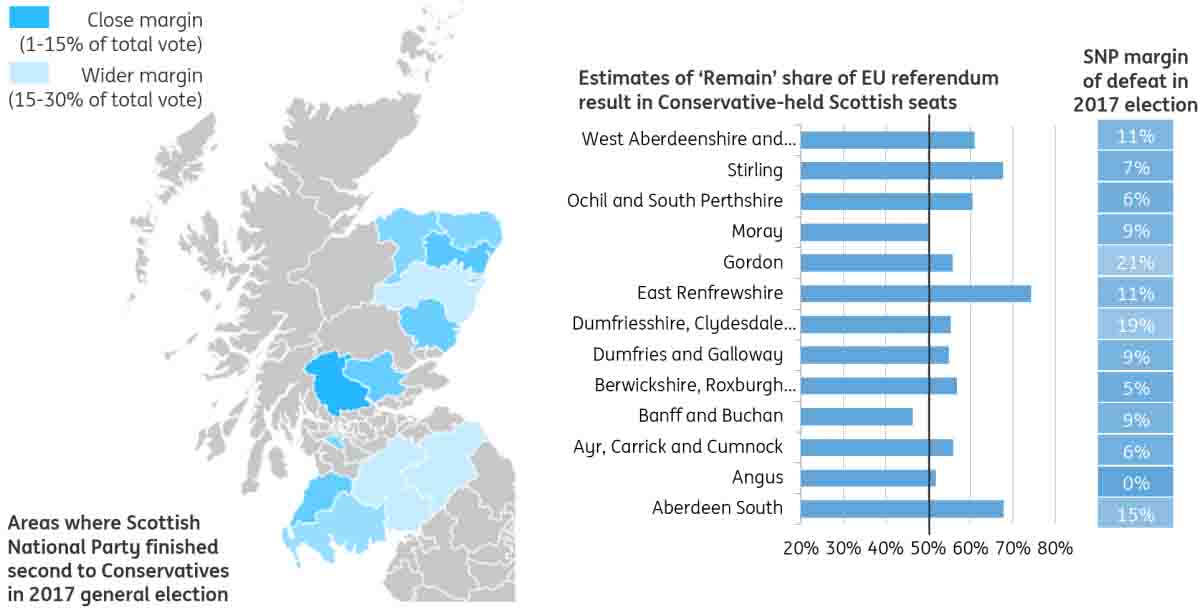
Margin = seats difference between Conservative and Lib Dems, as a proportion of the total votes cast
Source: UK Government, Dr Chris Hanretty Brexit by constituency estimates, ING
Conservatives vulnerable to Lib Dem advances in England
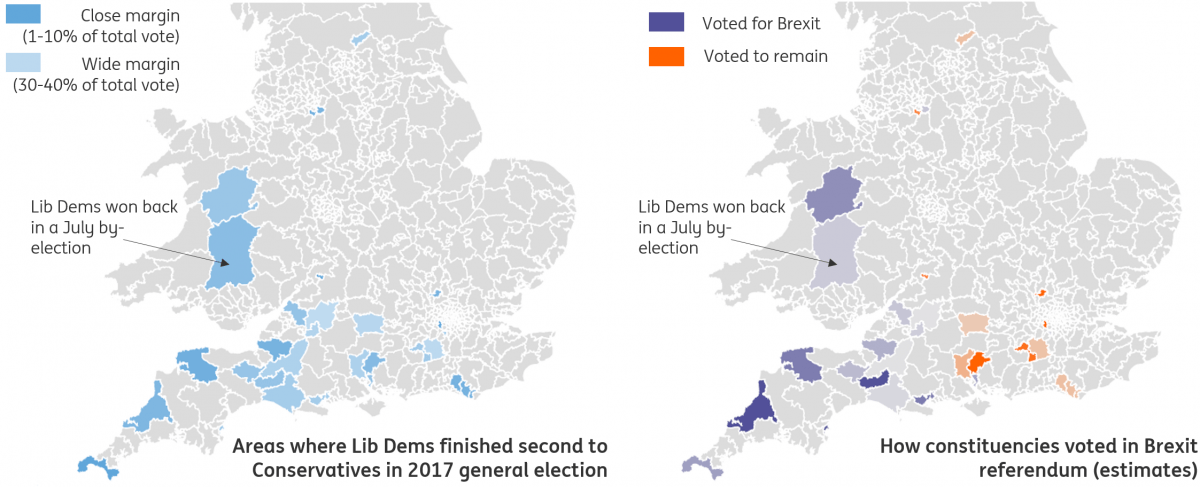
Margin = seats difference between Conservative and Lib Dems, as a proportion of the total votes cast
Source: UK Government, Dr Chris Hanretty Brexit by constituency estimates, ING.
Read the original article: Brexit: UK election chatter grows as Parliamentary battle recommences
Author
James Smith
ING Economic and Financial Analysis
James is a Developed Market economist, with primary responsibility for coverage of the UK economy and the Bank of England. As part of the wider team in London, he also spends time looking at the US economy, the Fed, Brexit and Trump's policies.