Brexit: Snap election increases number of uncertainty factors

PM May wants to hold snap election on 8 June
Very surprisingly, PM Theresa May has announced she wants a snap election on 8 June, as the other political parties (and ‘unelected members of the House of Lords’) oppose the government’s Brexit plan. Holding an election now exploits the fact that the serious part of the Brexit negotiations will not start until after the German election in September and it means that the new term will cover both the Brexit negotiations and probably also the transitional phase after April 2019+. Due to the fixed-term elections system, PM May needs a two-thirds majority of the Commons to call for a snap election. Tomorrow PM May will move a motion in the House of Commons calling for a general election. We think it is likely that most parties will support the motion. In her statement, PM Theresa May repeated that Brexit is going to happen and ‘there can be no turning back’.
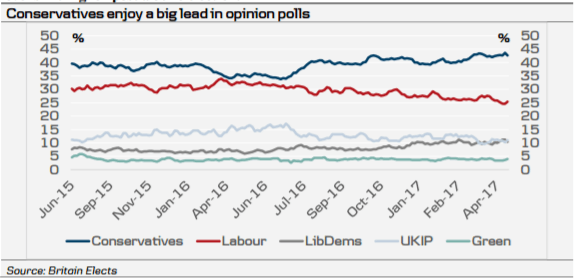
Based on the most recent opinion poll, the Conservative lead is +21pp over Labour, see chart below. Due to the UK’s ‘first past the post’ system, this means that the Conservatives will likely increase their majority lead in the Commons. If the opinion polls are right, this means that PM Theresa May will be less vulnerable in the Brexit negotiations, as the result would consolidate her power within the Conservative party (both against ‘hard Brexiters’ and ‘Bremainers’). That said, one should be cautious relying too heavily on the opinion polls, as they have been quiet, which may also change through the election campaign.
EUR/GBP traded lower on the election announcement and given that very short noncommercial GBP positioning, EUR/GBP could decline further in the very near term driven by short covering caused by higher uncertainty. As such, a new test, and potentially a break of the post-Brexit lows around 0.83 should not be ruled out. Short-term, the general election means there is one more uncertainty factor for GBP, as the sample space for UK-EU relations have suddenly widened again with notably a chance now that Brexit may be softened (or cancelled altogether should the May government be ousted). Given May’s lead in the polls the most likely outcome is that she will receive the more broad-based backing she is seeking heading into the negotiations on Brexit, due to start for real post the German election in the autumn. Our base case remains that May will stay in power and negotiate a ‘decent Brexit’ (neither too hard nor too soft), but the probability of other outcomes has clearly risen with today’s election call. Hence, in our main scenario that May resumes negotiations EUR/GBP should be in for a level shift higher post a June election.
Author
Danske Research Team
Danske Bank A/S
Research is part of Danske Bank Markets and operate as Danske Bank's research department. The department monitors financial markets and economic trends of relevance to Danske Bank Markets and its clients.

















