|

Brent outlook: Oil price falls on fresh US-Iran peace deal optimism

Oil

Brent price fell $7 on gap-lower opening on Monday, deflated by the latest de-escalation in the Middle East after President Trump called off the latest planned attack on Iran and announced fresh round of peace talks starting today.

Adding to renewed pressure on oil prices was decision of OPEC+ to increase production by 188.000 barrels per day from September.

Fresh optimism over potential peace solution for the war provided relief, as the price fell away from dangerous $100 zone which was violated on July 23/24 but without sustained break higher.

Markets remain cautiously optimistic after several attempts to stop the war failed and keep hopes that the US and Iran would this time reach a deal and prevent deepening crisis, which many analysts expect to be worse than the one in 2008.

The most sensitive points of all peace talks remain the situation of control of Hormuz strait and Iran’s nuclear program (red lines for Iran, but also key points for the US), with maximal demand from the US on these questions and Iran’s reluctance to compromise, warn that the whole process may fail again.

Daily studies weakened following a double rejection at $90 resistance zone (Thu/Fri) and subsequent acceleration lower, as south-heading 14-d momentum hits the centreline and the price broke below daily cloud.

Bears eye key near-term supports at $80.66/50 (July 28 low / 200DMA) and $80.00 (psychological) break of which to signal continuation of descend from 101.97 (July 23 peak) on completion of bearish failure swing pattern and unmask $70 zone (July 2 low / psychological).

Broken cloud base reverted to initial resistance ($83.48), followed by broken daily Kijun-sen ($86.05) which should cap corrective upticks.

Res: 83.48; 86.05; 86.70; 90.00.
Sup: 80.50; 80.00; 75.28; 71.92.
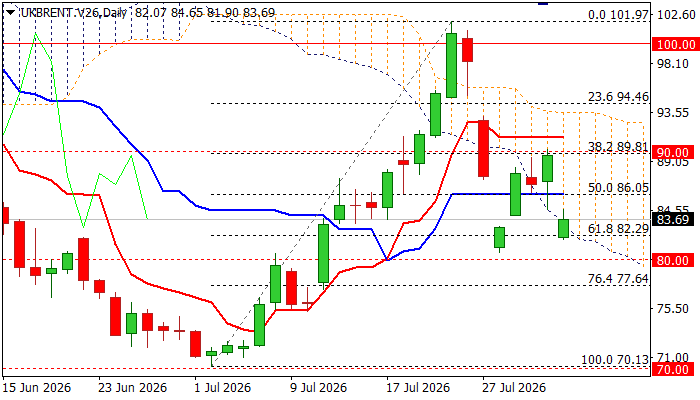
Chart

Author

Slobodan Drvenica

Slobodan Drvenica

Windsor Brokers

Industry veteran with over 22 years’ experience, Slobodan Drvenica joined Windsor Brokers in 1995 when he was an active trader for more than 10 years, managing the trading desk and own account departments.


More from Slobodan Drvenica
Share:

Editor's Picks

British Pound eases to 1.3450 area following downwardly revised Manufacturing PMI data

The British Pound is trimming previous gains against the US Dollar on Monday, returning to the mid-range of the 1.3400s down from fresh seven-week highs, above 1.3500 earlier on the day. Weaker-than-expected UK manufacturing data added pressure on the Pound, which rallied at the Asian session opening, amid news of a halt to the hostilities in Iran.

EUR/USD struggles above 1.1500 despite USD weakness

EUR/USD struggles with its recovery above 1.1500 in European trading on Monday, despite broad US Dollar weakness and improved risk sentiment. The USD loses traction following US President Trump's call off an attack on Iran and that talks between the two sides would happen on Monday. Traders will closely monitor the developments surrounding US-Iran negotiations and US ISM PMI data.

Gold extends range play below $4,100 as rebounding USD meets receding Fed hike bets

Gold struggles to capitalize on a modest weekly bullish gap opening, and remains below the $4,100 mark heading into the European session. The US Dollar stages a modest recovery from its lowest level since June 17, which is seen capping the upside for the commodity. The upside for the USD, however, seems limited amid renewed hopes for a US-Iran peace deal and receding US Fed rate-hike expectations.

Week ahead: US payrolls report and AI earnings to keep investors on edge

After the Fed decision, NFP report awaited for more rate hike clues. Employment also on the agenda in Canada and New Zealand. Chinese trade and Japanese wage data to be watched too. But Iran and AI headlines to remain in driver’s seat for risk sentiment.

Solana risks a steeper decline below $70 despite steady ETF inflows

Solana (SOL) is trading in the red, losing bullish momentum and remaining capped below its 50-day Exponential Moving Average at $75.68. SOL-focused Exchange Traded Funds show resilience with a monthly inflow of $14.62 million in July, while the near-term retail support wanes with the funding rate turning negative.

9-3: Is the Federal Reserve’s vote tally Warsh's new forward guidance?
The rate did not move. Neither did the statement, and that’s the more interesting fact. Set the July 29 Federal Open Market Committee (FOMC) statement beside the one issued on June 17, and the two documents are identical apart from a single verb and a paragraph at the bottom naming three dissenters.














