US election: Both candidates expected to widen the budget deficit


Kamala Harris emerged as the winner of the presidential debate against Trump. Harris stood out with her more forward-looking vision, emphasizing themes such as abortion, rule of law and foreign policy towards wars in Ukraine and Gaza. Conversely, Trump focused on criticizing the current administration without providing clear plans or detailed initiatives.
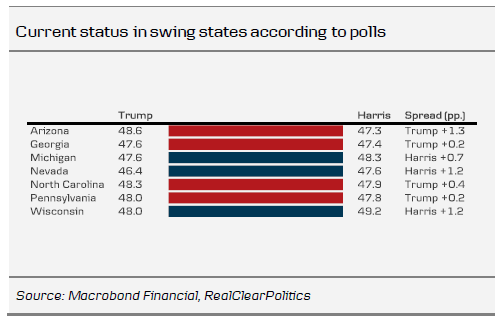
Harris’ stronger performance was noted in the prediction markets as well. The candidates were practically tied prior to the debate (see p. 2), but Harris now holds a narrow (55%/45%) lead over Trump. She has performed well in post-debate polls as well, but we emphasize that the situation in key swing states remains far from clear. Harris maintains a narrow lead in Nevada and Wisconsin, while Trump has a slight edge in Arizona and North Carolina. In this scenario, delegates would be divided 242 for Harris to 246 for Trump with 50 still undecided over Michigan (15), Pennsylvania (19) and Georgia (16). Both candidates would need to win 2/3 of the tied states to clinch the victory. Historically, Pennsylvania has voted for the winning candidate, and securing it has also led to victories in Michigan and Wisconsin in the past eight elections.
On the economic front, both candidates are expected to widen the budget deficit compared to the latest CBO forecast, which stands at USD 1.9tn (-6.5% of GDP) in 2025.
Harris would continue much of Biden’s FY2025 budget, with proposals to reduce taxes for low- and middle-income households through expanded tax credits and healthcare subsidies, partially financed by corporate tax raises. Her largest proposal, the reintroduction of the Child Tax Credit, is expected to increase deficits by USD133.5bn on average over the next four years, widening the deficit as % of GDP by 0.4 pp. on average.
On the other hand, Trump’s budget plans are estimated to drive larger deficit increases , focusing on extending the 2017 Tax Cuts and Jobs Act (TCJA), lowering corporate taxes, and eliminating income taxes on Social Security benefits. For instance, extending individual TCJA tax provisions would add USD 260bn to the deficit on average during the next four years, corresponding to an average increase in deficit as % of GDP by 0.8 pp.
While Trump’s policies are expected to widen the budget deficit the most, polls show that 37% of respondents see Trump as more likely to focus on reducing debt compared to 30% for Harris, with 30% indifferent, based on post-debate data. Besides changes in public spending, the implications for economic growth matter for the deficits as well. Trump’s proposed tariff increases have been estimated to counteract most, if not all of the positive growth impact from easier tax policies.
Importantly, it is far from certain that either candidate can fully implement their policies, as political deadlock is possible. Republicans remain favourites to regain control of the Senate, which means they also have a relatively better chance of winning all three elections. Prediction markets price the odds of a Republican sweep at 28.5%, compared to 21.5% for Democrats. However, the spread narrowed after the Fed’s largerthan- expected rate cut, which could provide tailwinds to the economy (chart on p. 2).
Author
Erste Bank Research Team
Erste Bank
At Erste Group we greatly value transparency. Our Investor Relations team strives to provide comprehensive information with frequent updates to ensure that the details on these pages are always current.