Boomers: House of Horrors or Empty Nest in Paradise?


A decade after the housing bust, homeownership and real estate assets for Boomers have yet to recover, limiting real estate equity to tap in retirement. The expected wave of Boomer downsizing remains a ways off.
Fewer Homeowners and Still Holding Debt as Retirement Looms
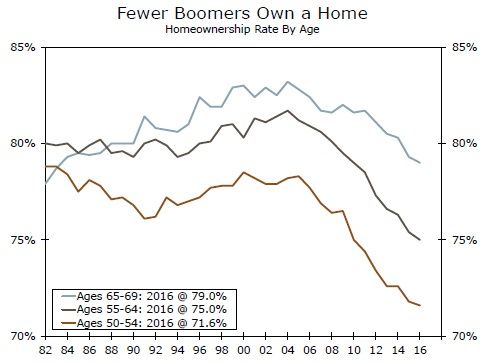
As Baby Boomers transition to retirement, their changing housing needs will ripple through the real estate market. The desire to be closer to family, cut down on maintenance or even upsize are all factors that will shape housing decisions. The Boomers are now of the age when homeownership rates tend to peak. However, homeownership among 55-64 year olds is the lowest in decades and indicates this generation's relationship with housing will be different from prior retirees (top chart).
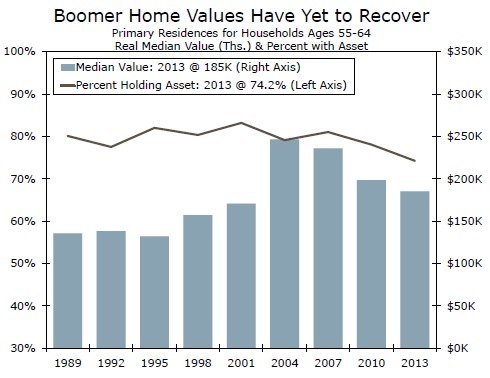
Lower homeownership implies a smaller share of Boomers will have home equity to tap in retirement. For most households, their home is their largest asset, but home values for the typical Boomer have yet to fully recover (middle chart). Moreover, fewer Boomers own their home free and clear as they near retirement. In 2013, only one-third of homeowners ages 55-64 had no debt on their primary residence compared to 54 percent in 1989.
Downsizing, Upsizing, or Staying Put?
It's a common assumption that as Baby Boomers reach retirement they will downsize to smaller, more manageable and affordable housing. However, a 2015 study by Fannie Mae found little evidence of Boomers downsizing as home sizes among this group had ticked up in recent years 1 Similarly, the Demand Institute found that nearly half of Boomers planning to move actually intended to upsize, although the vast majority—nearly two-thirds— of Boomers had no plans to move.2
Downsizing may not be entirely off the table for Boomers, but, like major housing decisions for Millennials, the time horizon may be pushed back. Many Boomers are working longer (the topic of our next note) or have less equity than they thought at this point in their lives following the housing bust. In addition, the elevated share of adult children living at home is likely hindering some Boomers from downsizing.
With fewer Boomers planning to downsize, fears that there will not be enough trade-up buyers to purchase their homes may be overdone. With the majority of Boomers wanting to age in-place, single-family home inventories look set to remain tight, barring a meaningful pickup in new construction. In addition, there have been few signs of retirement-age households moving into multifamily housing in recent years, with the share of households age 65 and over living in single-family homes (owned or rented) edging up between 2010 and 2015.
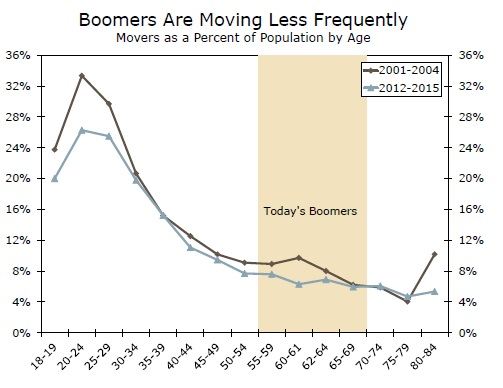
Like younger households, Boomers are moving less than prior generations (bottom chart). For Boomers who do move, job-related reasons and the desire for cheaper housing have taken on greater importance over the past decade. However, the share citing the main reason for moving was to own, not rent, has moved up since the mid-2000s, signaling the housing bust has not led Boomers to fully give up on homeownership.
Author
Wells Fargo Research Team
Wells Fargo