Bank of Japan Preview: Kuroda’s and ultra-loose policy farewell
- The Bank of Japan will announce its monetary policy decision, widely anticipated to remain on hold.
- March meeting will be the last helmeted by Haruhiko Kuroda, Kazuo Ueda taking over.
- USD/JPY could post a wild reaction if Kuroda announces fresh measures before departing.

The Bank of Japan (BoJ) will announce its decision on monetary policy on Friday, March 10, at around 3:00 GMT. It will be the last meeting led by Governor Haruhiko Kuroda, as Kazuo Ueda has been appointed to succeed Kuroda from April on. Kuroda finishes his mandate after a decade, most of which was focused on ending stagnation through an ultra-loose monetary policy.
How it started
It all started back in the 1990s when the housing market crashed in the country. Inflation and growth remained subdued, and it was not until 2006, when Shinzo Abe became Prime Minister, that the government finally put its hands on the matter. Abe announced the “three arrows” plan meant to bring Japan’s economy back to life, known as Abenomics. The three arrows were monetary easing from the BOJ, fiscal stimulus through government spending, and structural reforms.
Abenomics partially worked, as Japan’s growth picked up while unemployment fell to multi-decade lows. However, economic progress was far from impressive, and inflation held below the 2% central bank’s target. Such a target was only achieved in April 2022, not as a result of government policies but as a result of the supply-chain issues triggered by the pandemic and Ukraine’s war.
What’s going on so far
At this point, the main issue is that BoJ’s massive monetary policy has become so complex it will be quite a job to dismantle. For months, market players believed Kuroda would kick out the process to make it easier for his successor. And in fact, the central bank made an unexpected change to it in December 2022. The yield curve control, one of the BoJ’s multiple open fronts, is meant to maintain the yield on the 10-year Japanese Government bond at around 0%. Back in December, Kuroda announced it would allow long-term yields to fluctuate plus and minus 50 basis points (bps), doubling the previous 25 bps range. The movement was seen as a de-facto rate hike, although Governor Kuroda denied it. Furthermore, he stressed the need to maintain the ultra-loose monetary policy.
What’s next
No changes are expected in this March meeting. Market participants anticipate the interest rate will be held at -0.1% while the yield curve control will maintain the current cap of 0.5%. A policy shift by Kuroda in his last meeting would be a shocker, and he usually aims to avoid introducing too much noise.
The Core Consumer Price Index hit an over four-decade high of 4.2% YoY in January, while real wages fell the most in almost nine years, as inflation takes its toll on consumers’ purchasing power. Therefore, a shift in monetary policy is on the docket. Nobody expects it for the April meeting, but speculative interest has begun pricing in potential rate hikes before year-end. Incoming Governor Kazuo Ueda will be under pressure to phase out the massive stimulus program.
USD/JPY possible scenarios
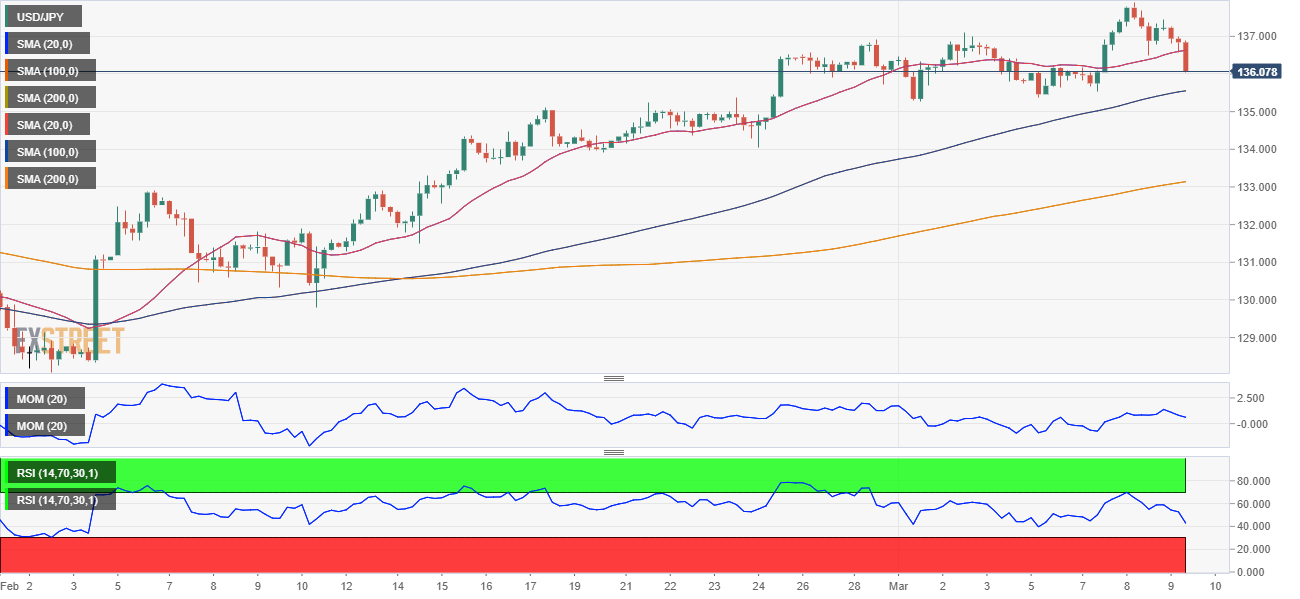
The USD/JPY pair trades around 136.00 ahead of the announcement after hitting a multi-decade high of 151.93 in October. The pair lost roughly 700 pips in a few hours following the December announcement and has been quite volatile ever since. It bottomed at 127.21 in January, slowly grinding higher afterwards amid renewed US Dollar demand.
A no change in the monetary policy stance should see the pair holding within the current level without relevant changes triggered by BoJ.
On the other hand, fresh twists to the yield curve control will be read as Kuroda paving the way for further tightening. The USD/JPY pair will plunge, with the extension of the decline directly linked to the movement. The more aggressive the announcement, the more the pair could decline. Widening the limit of the 10-year yield or even removing the yield curve control will be seen as ultra-aggressive, although the changes happening are pretty much null.
A word of warning. A press conference will come around three hours after the monetary policy announcement. Ueda will likely be introduced and make an introductory speech. Market players will rush to price in any hint he gives on whether he will be between the hawks or the doves.
Author

Valeria Bednarik
FXStreet
Valeria Bednarik was born and lives in Buenos Aires, Argentina. Her passion for math and numbers pushed her into studying economics in her younger years.