Bank of England reduces bank rate by 25 basis points
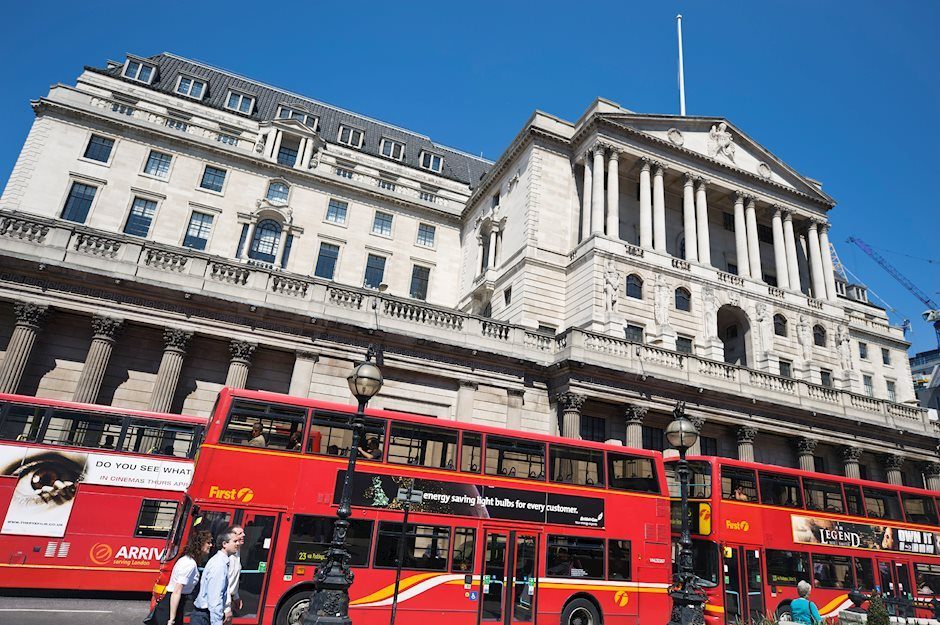

In an 8-1 vote, the Bank of England’s (BoE) Monetary Policy Committee (MPC) decided to reduce the Bank Rate by 25 basis points (bps) to 4.75%. This marks the second cut this year and was widely expected by markets and economists. BoE policymaker Catherine Mann (an external member), the sole dissenter, opted to keep the Bank Rate on hold at 5.00%. Today’s announcement follows the central bank holding rates unchanged at 5.00% in September and a 25bp cut in August in a 5-4 MPC vote.
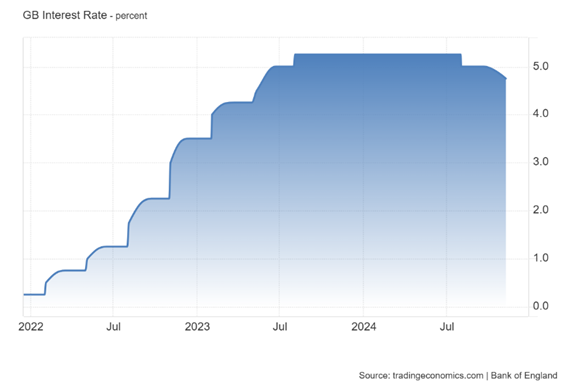
Notably, the rate cut also follows the UK’s bumper Annual Budget delivered by the Chancellor of the Exchequer, Rachel Reeves, on 30 October and Donald Trump’s election victory in the US earlier this week.
The BoE’s rate statement communicated that inflation will likely remain above the inflation target of 2.0% for longer than anticipated due to the recent budget expected to boost inflation by 0.5%. This has made policy easing a bit more challenging for policymakers; the budget’s raid on national insurance and the increase in the national minimum wage will increase employment costs. The BoE noted: ‘The impact of the Budget announcements on inflation will depend on the degree to and speed with which these higher costs pass through into prices, profit margins, wages and employment’.
Reeves also made the airwaves today, stating: ‘Today’s interest rate cut will be welcome news for millions of families, but I am under no illusion about the scale of the challenge facing households after the previous Government’s mini-budget’.
While nothing is set in stone, Trump has vociferously indicated that his administration’s policies will include lower taxes, trade tariffs and measures to curb illegal immigration. This could have an inflationary effect on the US and other major economies, prompting the BoE to adopt more of a cautious approach going forward. The BoE’s rate statement did not explicitly refer to Trump’s election victory; the only indication, if you can call it that, was that upside risks to goods prices were likely from ‘greater trade fragmentation’.
BoE projections: Inflation likely to peak at 2.8% next year
You will likely recall that headline CPI inflation for the UK dipped below the BoE’s 2.0% inflation target to 1.7% in September. But, according to the BoE’s quarterly forecast update today, the central bank projects CPI inflation at 2.7% over the next year (revised from August’s forecast of 2.4%), with peak inflation expected at 2.8% in Q3 25. Interestingly, the BoE is not expecting inflation to hit the target until late 2026, adding a hawkish vibe to the announcement.
Regarding forecasts for the Bank Rate, with inflation set to accelerate according to the central bank’s forecasts, markets (as of writing) and the BoE anticipate rates to remain unchanged at December’s meeting. The BoE, however, implies greater policy loosening than was projected in the August forecasts; the Bank Rate is expected to fall to 3.7% by Q4 25 and remain at this level until Q4 26 before slightly dropping to 3.6% in Q4 27.
In terms of GDP (Gross Domestic Product), the BoE projects growth will increase from 1.0% to 1.5% next year before slightly pulling back to 1.25% the following year. In addition, the unemployment rate is projected to drop to 4.2% in Q4 24, down from August’s forecast of 4.4%, and fall further by Q4 25 to 4.1% before increasing to 4.3% by Q4 26 and 4.4% by Q4 27.
BoE governor Andrew Bailey: ‘Continued progress in disinflation’
Alongside the central bank’s update, the BoE Governor Andrew Bailey commented: ‘Inflation is just below our 2% target, and we have been able to cut interest rates again today. We need to ensure inflation stays close to target, so we can't cut interest rates too quickly or by too much. But if the economy evolves as we expect it's likely that interest rates will continue to fall gradually from here’.
Shortly after the rate announcement, Bailey’s press conference started with him referring to the progress in disinflation. Despite this, he emphasised that the central bank wants service inflation to continue slowing. You may remember that service inflation cooled to 4.9% in the twelve months to September from 5.6% in August.
Bailey also made note of the recent budget and highlighted points put forward in the minutes: the reduction of the margin of spare capacity in the economy and the possibility of employers passing on the higher costs to consumers or absorbing the additional costs. Still, he did note that the central bank has to monitor the effects of the budget measures and how they pass through in terms of their economic effects.
Sterling bid
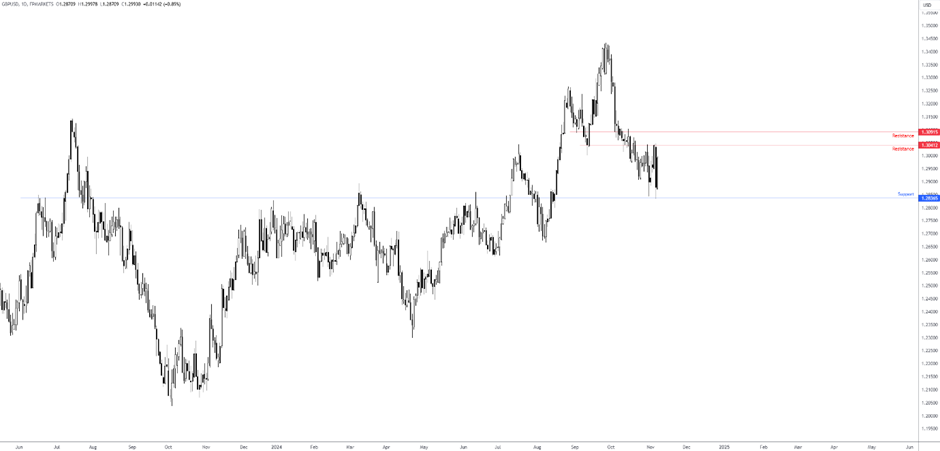
Despite the dovish MPC vote split, today’s language particularly from the BoE Governor regarding his gradual approach and, of course, the projections around inflation, conveyed a ‘cautious’ tone. This increased demand for the British pound (GBP), with the currency immediately catching a bid following the announcement and remaining in positive territory versus the US dollar, as we write. However, daily resistance on GBP/USD from between US$1.3092 and US$1.2994 could pose a problem for buyers (chart below).
Investors largely stood their ground regarding rate-cut expectations, with December’s policy meeting expected to hold steady and about 62bps of easing priced in for 2025. Gilt yields immediately elbowed higher, though the move was short-lived and swiftly faded.
Author
Aaron Hill
FP Markets
After completing his Bachelor’s degree in English and Creative Writing in the UK, and subsequently spending a handful of years teaching English as a foreign language teacher around Asia, Aaron was introduced to financial trading,