The Fed is doing the exact opposite of what it should be doing

About the Yen: The WSJ has a front-page story about how the Fed is doing the exact opposite of what it should be doing—lending dollars to Japan to buy yen.
“Put simply: America is printing dollars so Japan can buy yen. It isn’t quite quantitative easing, because the Federal Reserve is lending Japan money in return for temporary ownership of Treasury in repurchase agreements, rather than outright buying the Treasury. But like QE it expands the Fed balance sheet and pumps billions of dollars into the economy.
“When the Fed is widely thought to be moving toward raising rates, this is exactly the opposite of what it should be doing. Expanding the balance sheet is also the opposite of what Chairman Kevin Warsh has repeatedly said he wants to do.”
On another front, the NYT connects the yen intervention and the US stock market (via the bonds). Several analysts are cited pointing out that if inflation-expectation-fuelled yield increases are joined by Japanese selling, the stock market could founder and also make AI company borrowings too expensive. This is on top of doubts about stability overall. Stocks, bonds and the yen are joined at the hip.
Outlook
Our collective obsession with inflation and inflation expectations has a new chapter—renewed emphasis on the implied inflation in swap rates. Now that oil prices have fallen a lot—from $102 in late July to under $80 recently—the markets are cutting back some of the inflation premium.
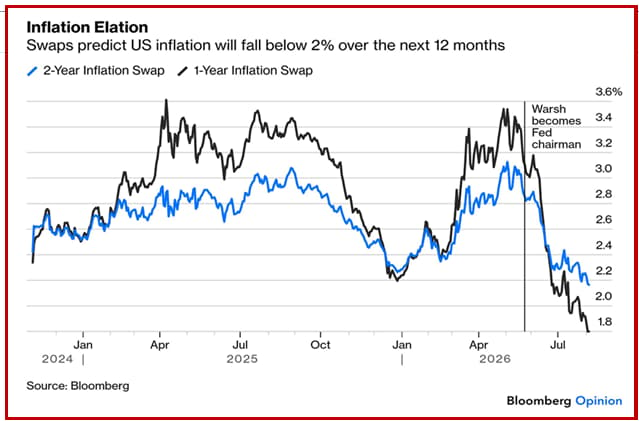
Mr. Warsh wants the market to figure out risk and proper pricing by itself, so would be happy to see the 1-year inflation swap rate at 1.71% yesterday, the lowest since 2024. “The 2-year swap rate got as low as 2.07%.”
This bit comes hot on the heels of an article by Bloomberg writer Authers. See his disturbing chart showing that inflation expectations as measured by the swaps market have collapsed in the last two months. This is about the time Warsh became top dog at the Fed.
“With inflation forecast to drop below the Fed’s 2% target, worries about higher interest rates ahead will naturally tend to abate.”
We sort of understand, if only dimly, how the swaps market predicts inflation expectations. The party wanting a fixed rate and the other party wanting a floating rate agree on a breakeven that incorporates an inflation forecast.
The party that wants a fixed rate prefers a lower inflation expectation. If floaters feel confident enough, they can drive the expectation down.
“An inflation swap allows one party to exchange fixed cash flows for inflation-indexed payments, transferring inflation risk to another party. One party in an inflation swap pays a fixed rate, while the other party pays a rate linked to an inflation index, such as the CPI.”
The swaps version of inflation expectations tends to have a good track record for getting actual inflation right in the short term. Longer-term, not so much. Outcomes get skewed by extreme market events… you know, like war. We had that during the Covid pandemic, for example. Liquidity dries up for extreme-event or other reasons. There is also plain, old-fashioned bias, like wishful thinking.
We say this is likely why we have the inflation expectations falling like a rock at the exact time Warsh came in. He shouted anti-inflation sentiment from the rooftops. These guys believed him, despite the absence of actual action.
Swap based inflation expectations are better than economists’ forecasts… but where do the swappers get their information? A key source: economists’ forecasts. Bottom line: we are not sure we buy it. For one thing, those who do actual swaps are a minority of participants. For another, the data depends entirely on what source you check. We looked at several and they do not agree on much of anything, assuming we read them right. The St. Louis Fed has discontinued its series—what can that mean?
Then there is the other measure, the CME Fed funds betting market. From two hikes between now and Q1 2026, the odds have shifted to two hikes between now and September 2027.
The market has lost faith in Warsh raising rates aggressively. Perhaps they think other actions, like trimming the Fed balance sheet, will contribute. If a lot of FX traders are watching this, it may be the reason the dollar has lost weight. We used to say it doesn’t matter what inflation may be, it matters what the Fed is going to do. Now we may be dependent on the goofy swaps market, which hardly represents the full spectrum of outlooks. And do not forget that the CME data changes all the time. We don’t know its liquidity but again, not everyone trades these contracts.
Forecast
Bloomberg is promoting the return of “sell America.” It cites the 30-year Treasury yield over 5% to the highest since 2007 while the dollar is falling over the past month. “Some investors warn the Fed risks losing its grip on the debt market without a clearer inflation strategy, while any direct US effort to support the yen weakens the dollar.”
Bloomberg includes the chart of its dollar index vs. the 10-year yield. It’s about the same as ours in the Chart Package. The higher yield normally provides support for the dollar, but not this time. It’s weird and unsettling.
We disapprove of a news outlet peddling a theory. To be fair, Bloomberg offers a counter-argument: “US assets generally still remain attractive to foreign buyers, and one sign is the absence of major correlated selloffs, Lotfi Karoui, multi-asset credit strategist at Pacific Investment Management Co. wrote in a note.
“This year, only around 2% of trading days and rolling five-day periods have seen 10-year Treasuries, US investment-grade corporate bond spreads and the dollar all sell off in tandem, he said.’“If there were a true loss of confidence in US exceptionalism, we would expect such selloffs to be much more frequent.’”
Bloomberg counters with this: “But the catch is that their buying has not kept pace with how fast US borrowing is growing. The Treasury this week boosted its estimated borrowing needs for the current quarter to $739 billion, and market participants expect officials to carry on their bill-heavy issuance strategy in the months ahead.”
All the talk about yields and swaps ruling inflation expectations aside, we get CPI next week and attention may turn to that. Remember that CPI came in at 3.5% in June, the first decline in five months, from 4.2% in May and below forecasts of 3.8%. The Cleveland Fed has a forecast for July next Wednesday at 3.42%v,so another dip. Trading Economics has 3.4%, too.
Since the main driver of rising inflation was energy costs and they have now retreated, these forecasts are not unrealistic. The question is whether the Fed takes the opportunity to talk of inflation as having been only “temporary” and drive the prospect of a rate hike in September further away.
If so, that would be to ignore the bond market’s evaluation of the inflation risk premium. Where is the Taylor Rule when you need it?
Then there is the Iran war. We may get re-escalation but more likely is a deal on Iran’s terms. Trump is a notorious mismanager and it would be silly to expect the US comes out of this with any real gains.
Tidbit: After all that swaps talk, it seems quaint to go back to PCE. But the St. Louis Fed has an essay on why core calculated ex-energy goods could be a better measure. Energy goods are electricity and natural gas.
Tidbit: A leak holds that the one time Trump consults an expert instead of a lackey seems to be Mr. Warsh. The WSJ reports Trump calls Warsh a lot, then not much, on subjects like the war and AI—but not about rates. It’s rare for the president and the Fed chief to confer at all. Normally you might sneer at Trump breaking norms, again, but it’s better he consults a knowledgeable guy than his usual unqualified clowns.
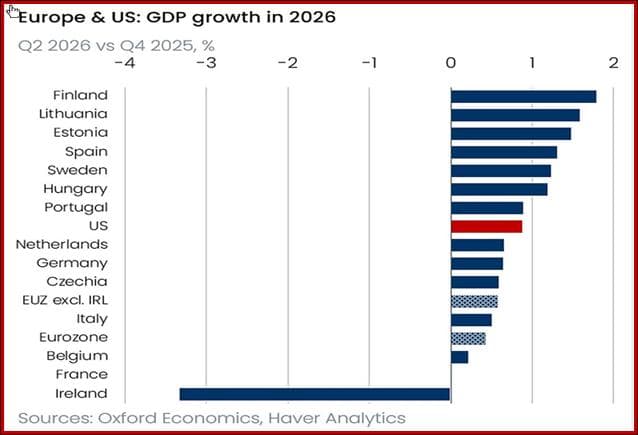
Tidbit: A hard-to-find chart is the number of European countries with growth higher than the US. The big countries (Germany. France, Italy) have lower growth than the US, but a slew of them have higher growth. The latest to report is Finland, which has GDP of about $300 billion vs. nearly $30 trillion for the US. This wild discrepancy aside, we need to be careful not to picture the US as the powerhouse and everyone else a lame dog.
This is an excerpt from “The Rockefeller Morning Briefing,” which is far larger (about 10 pages). The Briefing has been published every day for over 25 years and represents experienced analysis and insight. The report offers deep background and is not intended to guide FX trading. Rockefeller produces other reports (in spot and futures) for trading purposes.
To get a two-week trial of the full reports plus traders advice for only $3.95. Click here!
Author

Barbara Rockefeller
Rockefeller Treasury Services, Inc.
Experience Before founding Rockefeller Treasury, Barbara worked at Citibank and other banks as a risk manager, new product developer (Cititrend), FX trader, advisor and loan officer. Miss Rockefeller is engaged to perform FX-relat


![How Wall Street rigs the game [Video]](https://editorial.fxsstatic.com/images/i/market-chaos-01.jpg)