Australian Employment Preview: Moving into the right direction but at a slow pace
- Australian wages grew at the slowest pace on record in Q4 2020.
- The RBA remains committed to maintain the 3-year yield target at 0.1%.
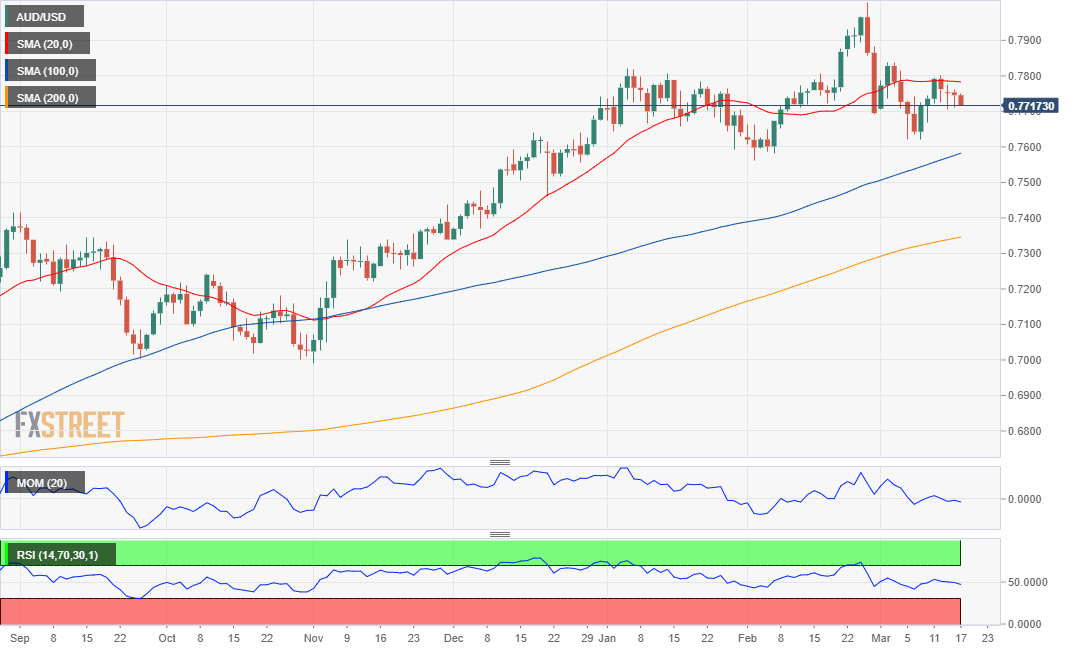
- AUD/USD is developing a head and shoulders figure in the daily chart.

Australia will publish Thursday its February employment figures. The country is expected to have added 30K new jobs in the month, while the unemployment rate is foreseen shrinking to 6.3%, despite the participation rate is expected to have increased to 66.2%.
RBA and salaries
Wage growth is reported on a quarterly basis in the country. The latest available data indicates that wages were up 0.6% in the last quarter of 2020. The annual comparison printed at 1.4% the weakest pace on record.
Meanwhile, the Minutes of the latest Reserve Bank of Australia meeting showed that policymakers are committed to maintaining the ultra-loose monetary policy, as they don’t expect a tight enough labour market to be consistent with the inflation target before 2024. The RBA indicated that wage growth would need to be sustainably above 3% before considering any rise in interest rates. The last time salaries grew by 3% was back in 2013.
In this scenario, a sharp increase in jobs’ creation could provide temporal support to the local currency but will be short of suggesting a substantial recovery in the sector. A disappointing reading, on the other hand, could see the aussie edging firmly lower.
Growing inflation concerns
Worth noting that the US Federal Reserve will announce its newest decision on monetary policy ahead of the Australian event, which may introduce some noise among major pairs, mainly if chief Jerome Powell changes its view on raising government bond yields.
For the last couple of month, government bond yields have been sharply up, amid expectations of higher inflation on the back of an economic comeback. However, higher yields are translating into higher borrowing costs, which somehow could delay the economic recovery. Authorities are utterly cautious about the fact that inflation may pick up soon.
The RBA latest announcement poured some cold water on local yields but is not expected to last amid mounting global pressures. The central bank is applying yield curve control, committed to maintain the 3-year yield target at 0.1%.
AUD/USD possible scenarios
The AUD/USD pair has managed to hold above the 0.7700 level, regardless of the recent greenback’s strength. The pair is developing a H&S formation in the daily chart, with the neckline at 0.7561, the low set in February. It seems unlikely that the pair could hit such a low with the employment report, but as closer it gets the higher the risk of a slump towards 0.7200 in the mid-term.
In the near-term, the pair offers a neutral-to-bearish stance. The immediate support level is 0.7690, followed by the 0.7640/50 price zone. On the upside, resistances are located at 0.7770 and 0.7820, with gains beyond the latter supporting a bullish extension in the next sessions.
Author

Valeria Bednarik
FXStreet
Valeria Bednarik was born and lives in Buenos Aires, Argentina. Her passion for math and numbers pushed her into studying economics in her younger years.

















