Australian Employment Preview: Long way to recovery
- Australian wage growth bounced modestly from record lows in Q1.
- The Reserve Bank of Australia set a target of 3% on wages growth before acting.
- AUD/USD at risk of falling further, but still range-bound.


Australia will report May employment figures this Thursday. The country is expected to have added 30,000 new jobs in the month after losing 30.6K in the previous month. The Unemployment Rate is foreseen steady at 5.5%, while the Participation Rate is seen ticking up to 66.1% from 66% in the previous month. Back in April, the country added 33.8K full-time positions but lost 64.4K part-time ones.

Employment, wages and the RBA
Australia publishes wages growth separately from its employment report and on a quarterly basis. According to the latest available data, salaries recovered in Q1 from record lows at the end of 2020, with the annual Wage Price Index reaching 1.5%. On a quarterly basis, the index was up 0.6%. On average, wages growth has been just above 2% throughout a couple of years before the pandemic sent it to record lows.
While encouraging, the Q1 figure stands halfway to the Reserve Bank of Australia desired level. Policymakers have said that wages need to grow at 3% to actually impact inflation. Inflation in the country has been well below the RBA’s 2-3% target for several years, and as it happened with salaries, the negative trend was exacerbated by the pandemic.
In such a scenario, policymakers expect not to reach the desired levels until 2024. Hence, rate hikes are unlikely in the next couple of years.
Short-term vs long-term
The result of the employment report will likely impact the aussie, mainly if the outcome diverges from expectations. However, the report is unlikely to set a sustainable trend. The effects will likely be temporal, as once the dust settles, investors will turn their eyes somewhere else.
Australia has lost roughly 870,000 job positions in the first year of the pandemic, increasing the count in April to around 900,000. That means it will take long to recover to pre-pandemic levels if the country adds 30K per month, as previewed for May.
Meanwhile, the US Federal Reserve will announce its latest decision on monetary policy ahead of the event, which can distort the technical view, as US inflation and the possibility of speeding up tapering have been the main market theme.
AUD/USD possible scenarios
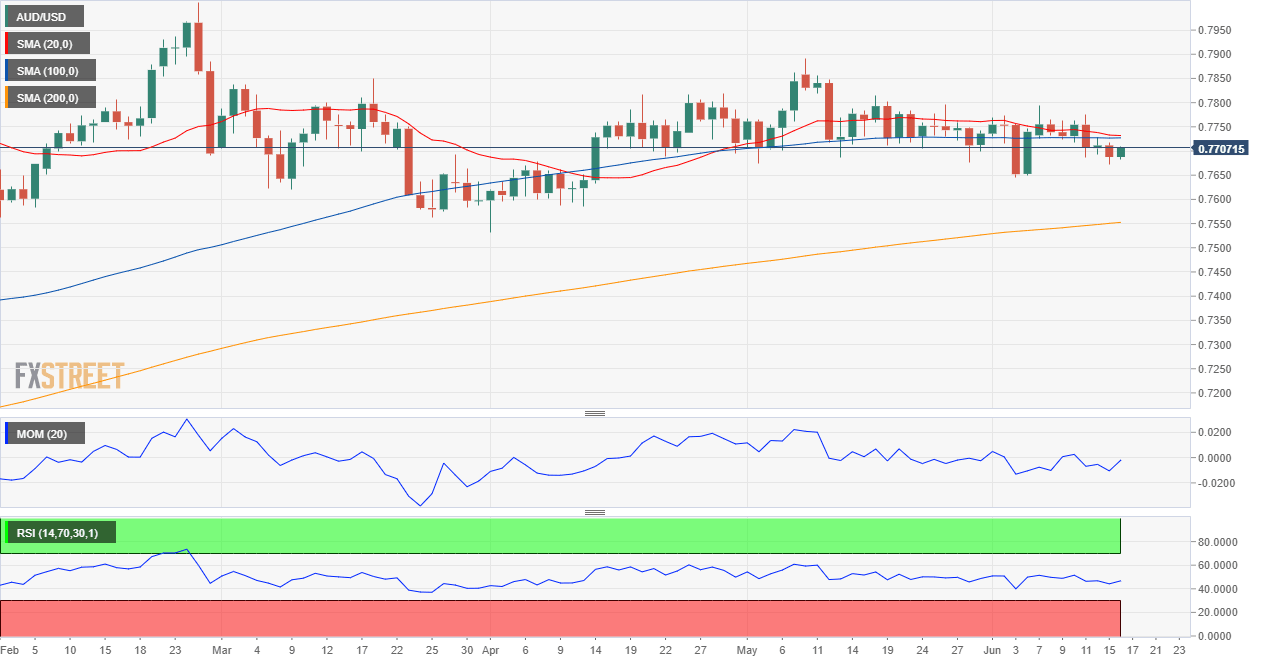
The AUD/USD pair has been directionless for over a month, now trading at the lower end of its range, struggling to retain the 0.7700 threshold. The risk is skewed to the downside, according to the daily chart, as the pair is developing below its 20 and 100 DMAs, both converging directionless in the 0.7740 price zone. Technical indicators lack directional strength but remain within negative levels.
The immediate support level is 0.7675, followed by the 0.7600 figure. The yearly low comes next, standing at 0.7531. To the upside, and if the pair manages to advance beyond the mentioned 0.7740 area, the next levels to watch are 0.7780 and 0.7820.
Premium
You have reached your limit of 3 free articles for this month.
Start your subscription and get access to all our original articles.
Author
Valeria Bednarik
FXStreet
Valeria Bednarik was born and lives in Buenos Aires, Argentina. Her passion for math and numbers pushed her into studying economics in her younger years.

















