Australian Employment Preview: Aussie unlikely to benefit from a strong jobs report
- Unemployment Rate in Australia is expected to edge lower to 4.5%.
- December report is not expected to reflect the impact of Omicron.
- RBA might refrain from taking a hawkish step in February.

AUD/USD advanced to its highest level in two months above 0.7300 last week but lost more than 100 pips since then. The dollar started to regather strength on rising US Treasury bond yields and the souring market mood made it difficult for the Aussie to find demand.
The Australian Bureau of Statistics’ December jobs report is unlikely to change how markets price the Reserve Bank of Australia's (RBA) policy outlook and AUD/USD’s fate depends on the dollar’s valuation and the overall risk sentiment.
Investors expect the Unemployment Rate in Australia to edge lower to 4.5% from 4.6% in November with the Employment Change rising by 30,000. Even if these data were to come in better than analysts’ estimates, investors could ignore them due to the fact that the survey to derive the data from was taken between November 28 and December 11.
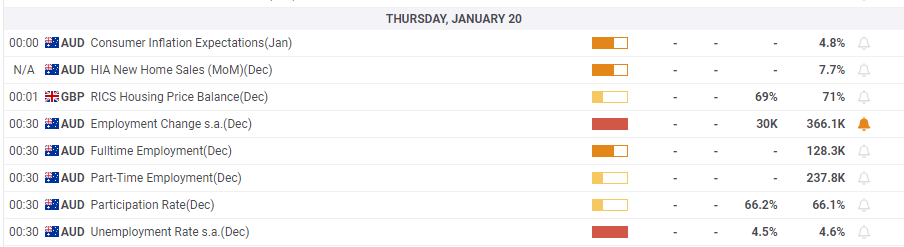
Market participants will want to know what kind of an impact the coronavirus Omicron variant had on the labour market and this insight will show up in January’s job report. It is difficult to say whether or not the RBA would take December data into account when deciding what to do with weekly bond purchases.
The minutes of the RBA’s December policy meeting showed the bank was considering a couple of options regarding the quantitative easing (QE) program. The RBA looks to either reduce the pace of bond purchases, which currently stands at 4 billion Australian dollars per week, and end the program in May or end the program in February and reassess it in May.
The RBA will evaluate inflation developments, the potential negative effects of the slowdown in China’s economy on Australia’s growth and the state of the labour market after the Omicron outbreak. Hence, the market reaction to the December jobs report is likely to remain short-lived.
AUD/USD Technical Outlook
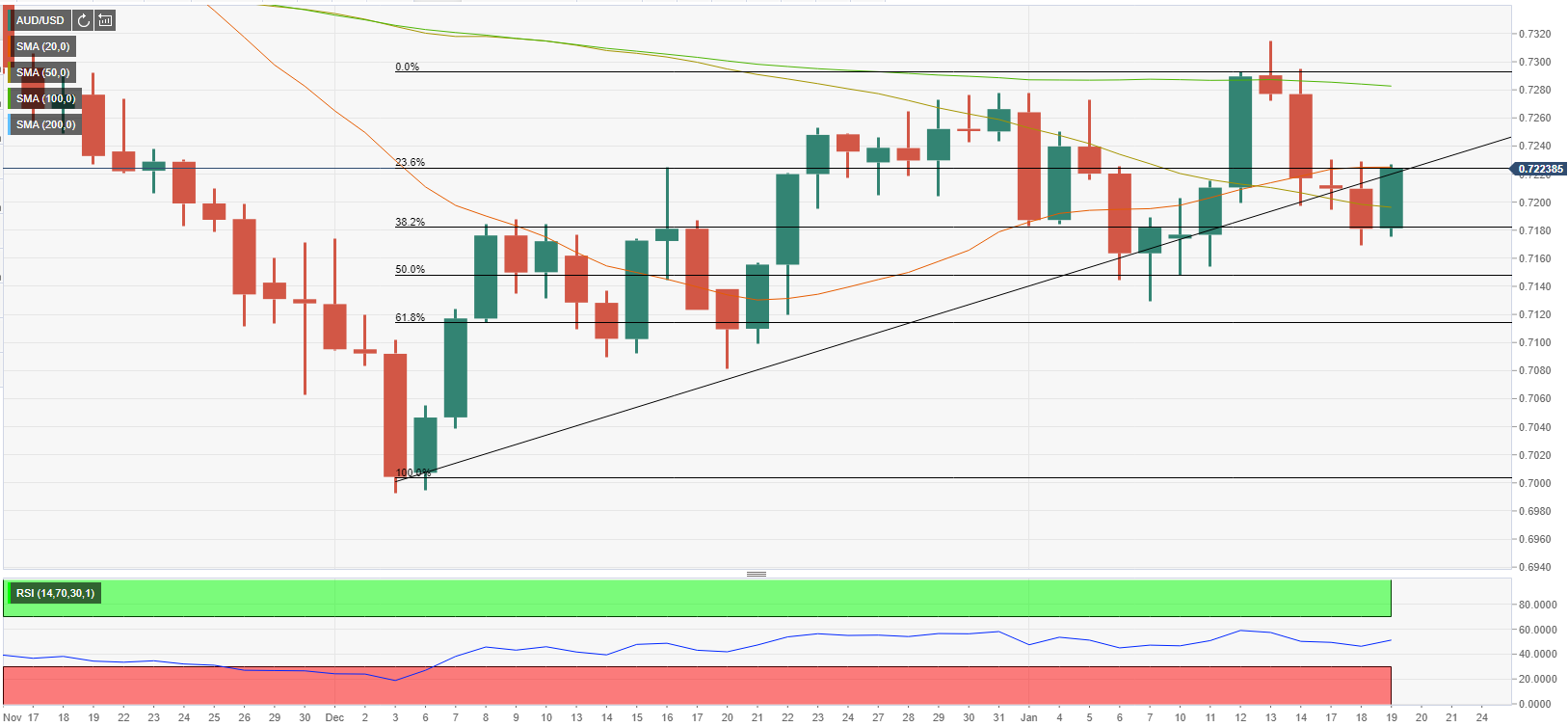
AUD/USD dropped below the ascending trend line coming from early December on Tuesday. Although this could be seen as a negative development, the fact that the Relative Strength Index (RSI) indicator on the daily chart holds near 50 suggests that sellers are struggling to dominate the pair at least for the time being.
A daily close above 0.7230 (Fibonacci 23.6% retracement, ascending trend line) could be taken as a sign that the latest decline was the technical correction of the uptrend. Above that level, the 100-day SMA forms the next resistance at 0.7280 ahead of 0.7300 (psychological level).
On the downside, 0.7150 (Fibonacci 50% retracement) aligns as initial support. In case this level turns into resistance, additional losses toward 0.7100 (psychological level, Fibonacci 61.8% retracement) could be witnessed.
Author

Eren Sengezer
FXStreet
As an economist at heart, Eren Sengezer specializes in the assessment of the short-term and long-term impacts of macroeconomic data, central bank policies and political developments on financial assets.