Australian Dollar Price Forecast: Solid contention lines up near 0.6400
- AUD/USD added to the ongoing leg lower, revisiting 0.6550-0.6540.
- The US Dollar picked up extra upside momentum, helped by firm data.
- The RBA is expected to keep its OCR unchanged on September 30.

The Australian Dollar (AUD) kept sliding on Thursday, with AUD/USD hovering near three-week lows around 0.6540. That makes it three straight days in the red.
What’s driving the move? The US Dollar Index (DXY) keeps pushing higher, helped by firm data and another lift in US yields across the curve.
Inflation still keeping the RBA on edge
Australia’s inflation story isn’t over yet. July’s Monthly CPI Indicator (Weighted Mean) picked up to 2.8%, up from 1.9% in June. On a quarterly basis, Q2 CPI rose 0.7% and 2.1% YoY.
That explains why the Reserve Bank of Australia (RBA) is staying cautious. With prices running hotter than target, policymakers aren’t keen to cut rates too fast. They are balancing their support for growth with the avoidance of a new wave of inflation.
The economy is holding its ground
Despite global headwinds, Australia’s economy is proving sturdier than many feared. Early numbers for September suggest Manufacturing PMI could ease to 51.3 and Services PMI to 52.0, but both readings remain in growth territory.
Other indicators have looked solid too. Retail Sales rose 1.2% in June, the trade surplus widened to A$7.3 billion in July, and business investment ticked higher in Q2. GDP has also been steady, up 0.6% vs. the previous quarter and 1.8% from a year earlier in Q2.
The labour market shows a few warning signs. Unemployment was unchanged at 4.2% in August, but total employment slipped by 5.4K jobs.
RBA holding steady, watching the data
Earlier in September, the RBA trimmed the Official Cash Rate (OCR) by 25 basis points, bringing it down to 3.60%. At the same time, it lowered its 2025 growth forecast.
Governor Michele Bullock has made it clear that deeper cuts aren’t on the table right now, stressing that policy will stay data-driven. The Minutes backed that up: if the labour market deteriorates further, the RBA might speed up cuts; if the economy holds steady, easing will be gradual.
In her remarks to the House Economics Committee, Bullock said both growth and inflation were in a “good place”, signalling there’s no urgency to shift course.
Markets seem to agree. For next week’s meeting, investors expect the RBA to keep rates unchanged, while implied rates see just over 15 basis points of easing by the end of the year.
China remains the wild card
Australia’s outlook is still closely tied to China. Q2 GDP grew 5.2% year-on-year, but August retail sales disappointed at 3.4%. PMIs were mixed: Manufacturing dipped into contraction at 49.4, while Services barely stayed above water at 50.3. Deflation worries haven’t gone away either, with the CPI falling 0.4% in the year to August.
The People’s Bank of China (PBoC) kept its Loan Prime Rates (LPR) unchanged in September: 3.00% for the One-Year and 3.50% for the Five-Year, exactly as markets expected.
Traders trimming bearish bets
Positioning is also shifting. CFTC data for the week ending September 16 showed speculators cutting back on AUD shorts, with net bearish contracts down to 51.2K, the lowest since May. That said, overall open interest fell sharply to around 154K, meaning traders have generally reduced exposure.
Technical picture
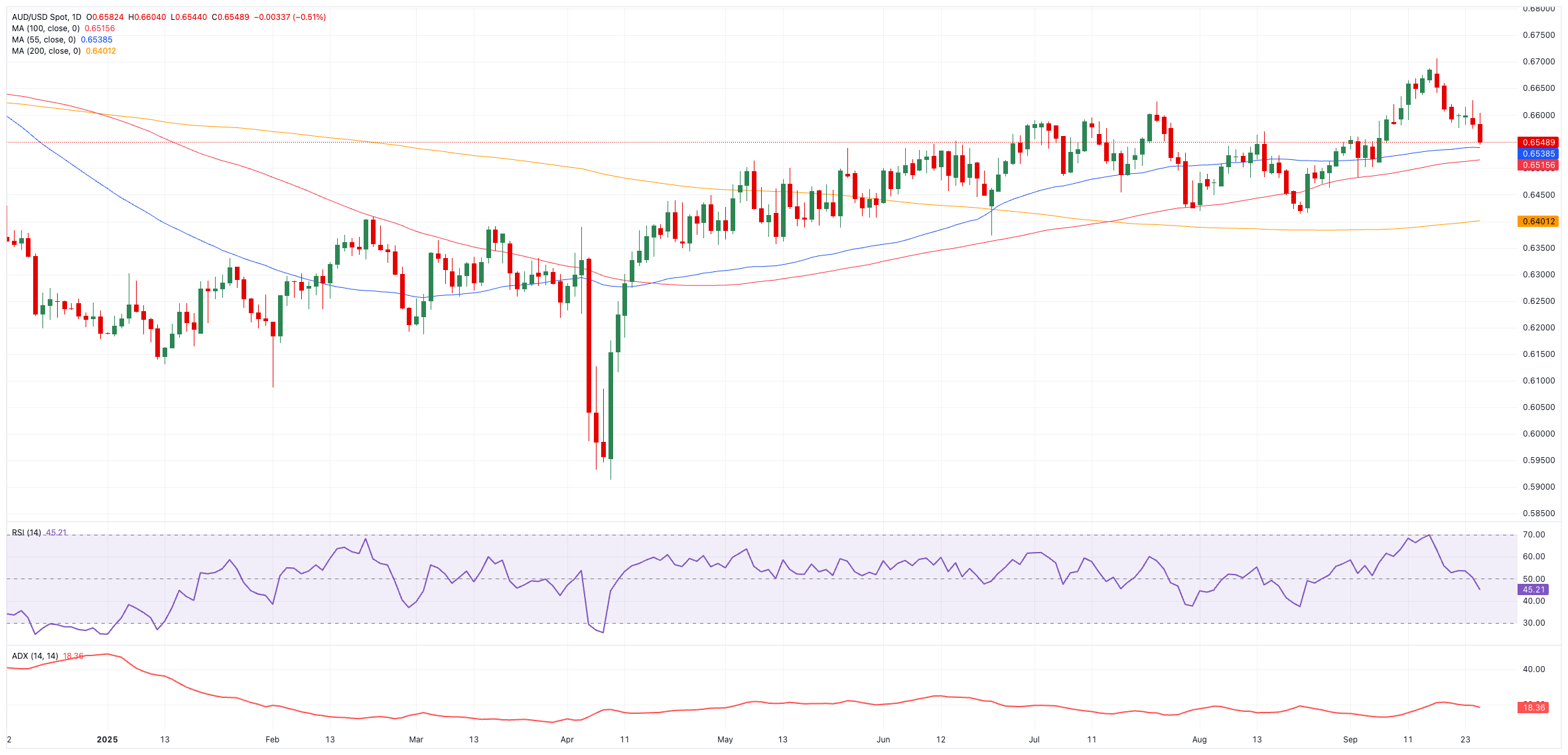
Technically, the sell-off still has room to run. AUD/USD is testing its 55-day and 100-day Simple Moving Averages (SMAs), sitting at 0.6537 and 0.6540, respectively. A clear break lower would open the way back to the August low at 0.6414 (August 21), with the 200-day SMA nearby at 0.6400. Below that lies the June trough at 0.6372 (June 23).
On the flip side, if buyers regain control, the pair could retest the September ceiling at 0.6707 (September 17). A clean move through there would put the 2024 high at 0.6942 (September 30) on the radar, just shy of the psychological 0.7000 mark.
Momentum indicators lean bearish: The Relative Strength Index (RSI) has slipped to around 45, hinting at downside pressure, while the Average Directional Index (ADX) near 18 suggests the trend still looks pale.
AUD/USD daily chart
Near-term outlook
Right now, AUD/USD is stuck in a bit of a holding pattern, drifting between 0.6400 and 0.6600 without much conviction. To really break out of that range, the market probably needs a bigger nudge, maybe a run of stronger numbers out of China, a softer shift from the Federal Reserve (Fed), or the RBA surprising with a tougher stance.
RBA FAQs
The Reserve Bank of Australia (RBA) sets interest rates and manages monetary policy for Australia. Decisions are made by a board of governors at 11 meetings a year and ad hoc emergency meetings as required. The RBA’s primary mandate is to maintain price stability, which means an inflation rate of 2-3%, but also “..to contribute to the stability of the currency, full employment, and the economic prosperity and welfare of the Australian people.” Its main tool for achieving this is by raising or lowering interest rates. Relatively high interest rates will strengthen the Australian Dollar (AUD) and vice versa. Other RBA tools include quantitative easing and tightening.
While inflation had always traditionally been thought of as a negative factor for currencies since it lowers the value of money in general, the opposite has actually been the case in modern times with the relaxation of cross-border capital controls. Moderately higher inflation now tends to lead central banks to put up their interest rates, which in turn has the effect of attracting more capital inflows from global investors seeking a lucrative place to keep their money. This increases demand for the local currency, which in the case of Australia is the Aussie Dollar.
Macroeconomic data gauges the health of an economy and can have an impact on the value of its currency. Investors prefer to invest their capital in economies that are safe and growing rather than precarious and shrinking. Greater capital inflows increase the aggregate demand and value of the domestic currency. Classic indicators, such as GDP, Manufacturing and Services PMIs, employment, and consumer sentiment surveys can influence AUD. A strong economy may encourage the Reserve Bank of Australia to put up interest rates, also supporting AUD.
Quantitative Easing (QE) is a tool used in extreme situations when lowering interest rates is not enough to restore the flow of credit in the economy. QE is the process by which the Reserve Bank of Australia (RBA) prints Australian Dollars (AUD) for the purpose of buying assets – usually government or corporate bonds – from financial institutions, thereby providing them with much-needed liquidity. QE usually results in a weaker AUD.
Quantitative tightening (QT) is the reverse of QE. It is undertaken after QE when an economic recovery is underway and inflation starts rising. Whilst in QE the Reserve Bank of Australia (RBA) purchases government and corporate bonds from financial institutions to provide them with liquidity, in QT the RBA stops buying more assets, and stops reinvesting the principal maturing on the bonds it already holds. It would be positive (or bullish) for the Australian Dollar.
Author

Pablo Piovano
FXStreet
Born and bred in Argentina, Pablo has been carrying on with his passion for FX markets and trading since his first college years.