Australian Dollar Price Forecast: Losses remain contained near 0.6440
- AUD/USD reverses its multi-day leg lower and retakes the 0.6500 barrier.
- The US Dollar struggles to extend its march north despite higher yields and firm data.
- Chinese business activity cooled a tad in October, as per the latest PMI readings.
The Australian Dollar (AUD) finally found its footing on Wednesday, pushing AUD/USD back above the 0.6500 mark after five straight days in the red.
What’s interesting is that the rebound came even without a clear driver from the US Dollar (USD). Traders are still digesting stronger-than-expected readings from the ADP National Employment Report (ADP) and the ISM Services Purchasing Managers’ Index (PMI), both of which fuelled speculation that the Federal Reserve (Fed) could hold off on cutting rates at its December meeting.
At the same time, the unresolved US government shutdown drama continues to hang over markets, keeping risk sentiment fragile and giving the Greenback some safe-haven support.
Australia: resilient, but showing a few stress lines
Australia’s economy isn’t setting any records, but it’s holding up better than many expected. The October PMIs were a mixed bag, manufacturing slipped back below the 50 mark to 49.7 (from 51.4), while services ticked up to 53.1 (from 52.4).
Elsewhere, Retail Sales rose 1.2% in June, and the August trade surplus narrowed only slightly to A$1.25 billion. Business investment also picked up in Q2, helping GDP grow 0.6% QoQ and 1.1% YoY. It’s not exactly booming, but it shows there’s still some momentum underneath.
That said, the labour market is starting to soften a touch. Unemployment edged up to 4.5% in September (from 4.3%), while job growth slowed to 14.9K. Nothing alarming yet, but the hiring pace seems to be easing.
RBA: staying calm and prudent
The Reserve Bank of Australia (RBA) kept interest rates steady at 3.60% for a second consecutive meeting on Tuesday, banging on forecasts. The decision was unanimous, and the message was clear: no rush to move in either direction.
The RBA acknowledged that inflation pressures remain a bit firm, but also noted the labour market is still tight despite the small uptick in joblessness. Governor Michele Bullock described the current stance as “pretty close to neutral,” with no clear bias toward tightening or easing.
She also pointed out that the 75 bps of cuts already in place haven’t fully worked their way through the economy. Policymakers are keeping an eye on whether demand starts running ahead of supply. For now, markets are only pricing in about 3 bps of easing by the December 9 meeting, and roughly 13 bps by early 2026.
China: still calling the shots
Australia’s outlook remains closely tied to China’s fortunes. Chinese GDP expanded 4.0% YoY in Q3, while retail sales rose 3.0%. The RatingDog Manufacturing PMI slipped to 50.6, and the Services PMI softened to 52.6 in October, a sign that momentum is levelling off.
Furthermore, China’s trade surplus narrowed from $103.33 billion to $90.45 billion in September, while CPI stayed negative at –0.3% YoY.
It is worth recalling that earlier in October, the People’s Bank of China (PBoC) kept its Loan Prime Rates (LPR) unchanged at 3.00% (one-year) and 3.50% (five-year), as widely expected.
Technical view
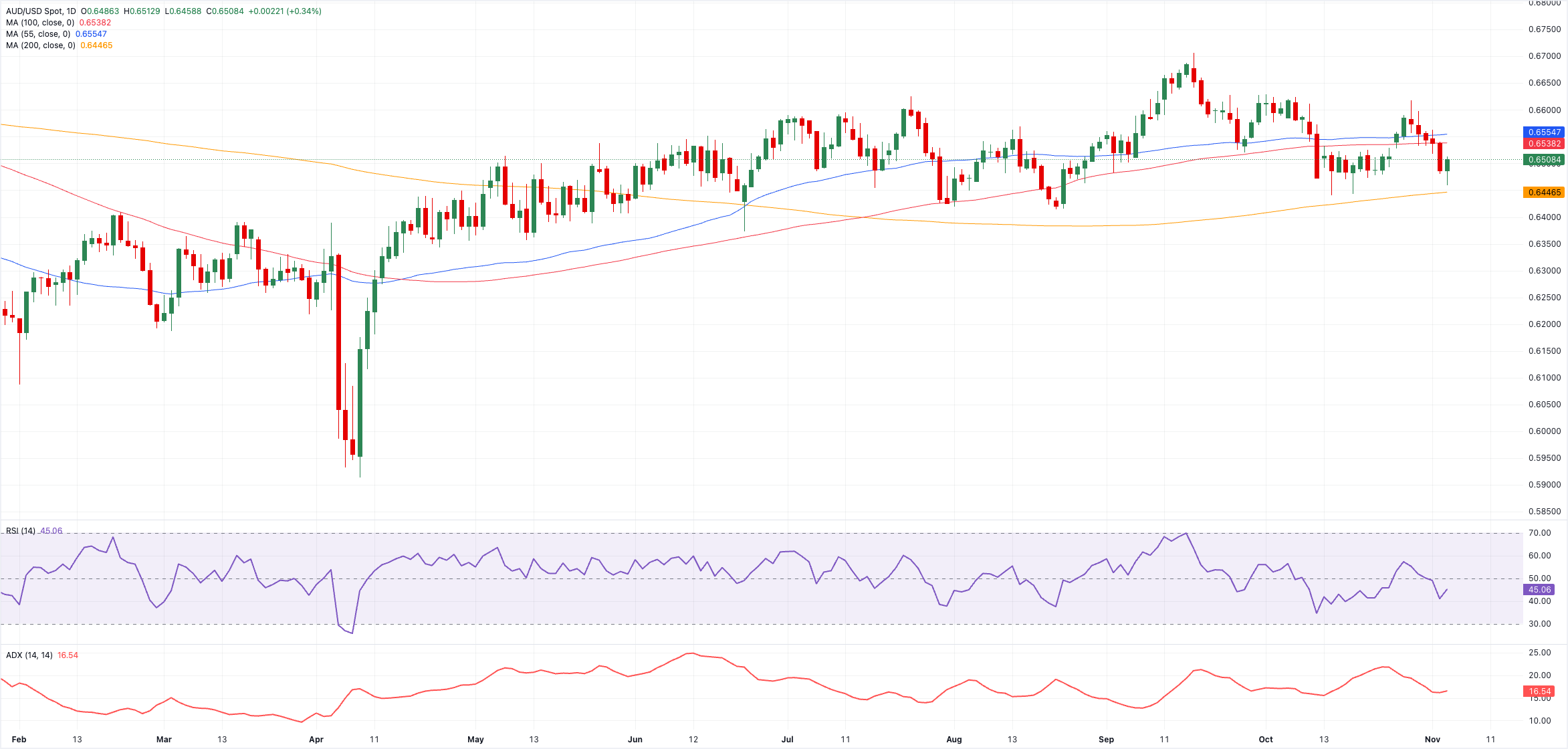
There is no change to the broad consolidative theme around AUD/USD, with the key 200-day SMA emerging as an important contention zone around 0.6440, a region underpinned by the October lows.
The resurgence of the downside trend could prompt AUD/USD to challenge the key 200-day SMA at 0.6445, prior to the October valley at 0.6440 (October 14). Extra retracements could prompt a test of the August trough at 0.6414 (August 21) to emerge on the horizon ahead of the June bottom of 0.6372 (June 23).
In case bulls regain control, there is an immediate hurdle at the October high of 0.6629 (October 1). If the pair surpasses the latte, it could then attempt a move to the 2025 ceiling of 0.6707 (September 17), seconded by the 2024 peak at 0.6942 (September 30), and the 0.7000 round level.
Furthermore, momentum indicators give some hope to a potential recovery: the Relative Strength Index (RSI) bounces past the 45 level, indicating potential gains along the road, while the Average Directional Index (ADX) above 16 suggests a trend that remains juiceless.
AUD/USD daily chart
The takeaway
For now, AUD/USD remains range-bound between 0.6400 and 0.6700, waiting for a clear catalyst, whether that’s data from China, the Fed’s next move, the RBA’s tone, or a shift in the US–China trade landscape.
Inflation FAQs
Inflation measures the rise in the price of a representative basket of goods and services. Headline inflation is usually expressed as a percentage change on a month-on-month (MoM) and year-on-year (YoY) basis. Core inflation excludes more volatile elements such as food and fuel which can fluctuate because of geopolitical and seasonal factors. Core inflation is the figure economists focus on and is the level targeted by central banks, which are mandated to keep inflation at a manageable level, usually around 2%.
The Consumer Price Index (CPI) measures the change in prices of a basket of goods and services over a period of time. It is usually expressed as a percentage change on a month-on-month (MoM) and year-on-year (YoY) basis. Core CPI is the figure targeted by central banks as it excludes volatile food and fuel inputs. When Core CPI rises above 2% it usually results in higher interest rates and vice versa when it falls below 2%. Since higher interest rates are positive for a currency, higher inflation usually results in a stronger currency. The opposite is true when inflation falls.
Although it may seem counter-intuitive, high inflation in a country pushes up the value of its currency and vice versa for lower inflation. This is because the central bank will normally raise interest rates to combat the higher inflation, which attract more global capital inflows from investors looking for a lucrative place to park their money.
Formerly, Gold was the asset investors turned to in times of high inflation because it preserved its value, and whilst investors will often still buy Gold for its safe-haven properties in times of extreme market turmoil, this is not the case most of the time. This is because when inflation is high, central banks will put up interest rates to combat it. Higher interest rates are negative for Gold because they increase the opportunity-cost of holding Gold vis-a-vis an interest-bearing asset or placing the money in a cash deposit account. On the flipside, lower inflation tends to be positive for Gold as it brings interest rates down, making the bright metal a more viable investment alternative.
Author

Pablo Piovano
FXStreet
Born and bred in Argentina, Pablo has been carrying on with his passion for FX markets and trading since his first college years.

















