Australian Dollar Price Forecast: Further consolidation looks likely
- AUD/USD reverses two daily advances in a row and revisits the low-0.7100s.
- The US Dollar climbs to two-day highs on the back of geopolitical uncertainty.
- Australian GDP data will be the salient event in Oz later in the week.

The Aussie Dollar seems to have embarked on a consolidative phase, with gains in AUD/USD so far limited by the key 0.7200 region. In this scenario, the pair continues to look for a stronger catalyst to attempt another move to the area of yearly peaks. In the meantime, the AUD’s positive outlook remains unchallenged for now, reinforced by still-elevated domestic inflation and the RBA’s cautious approach.
In quite a negative start to the week for the risk complex, the Australian Dollar (AUD) gives away part of the recent advance and faces renewed selling pressure, prompting AUD/USD to retest the low 0.7100s.
That said, the pair’s decent decline comes in response to the resurgence of the bid bias around the US Dollar, always in the ongoing context of heightened uncertainty stemming from the US-Iran conflict.
Australia: Resilient, but no longer immune
The Australian economy does look healthy and stable altogether and, honestly, in much better shape than many of its G10 peers.
This performance appears underpinned by a solid domestic demand and pretty decent figures when it comes to economic growth. The spectre of sticky inflation seems to justify the cautious and data-dependent stance from the Reserve Bank of Australia (RBA), particularly following the latest meeting, where it raised rates to 4.35%, broadly in line with market expectations.
Supporting the above, the final data from the May Purchasing Managers’ Index (PMI) showed Manufacturing at 50.7 (from 51.3), while the advanced Services gauge came in at 47.7 (from 50.7).
In the same vein, the latest trade balance figures showed an unexpected deficit of A$1.841 billion in March, markedly lower than the A$5.026 billion recorded in February. The Gross Domestic Product (GDP), meanwhile, showed the economy expanded by 0.8% QoQ and 2.6% YoY in late 2025. Later this week, we will see how the economy performed in the January-March period, with consensus pointing to quite solid results.
On the not-so-bright side, the labour market has been cooling in the last couple of months. Indeed, the Unemployment Rate ticked higher to 4.5% in April (from 4.3%), and the Employment Change dropped by 18.6K individuals (from the revised 23.3K gain seen in the prior month).
Regarding inflation, April data saw the Consumer Price Index (CPI) come in at 4.2% from a year earlier (from 4.6%), the Trimmed Mean ticking higher to 3.4% (from 3.3%), and the Weighted Median holding steady at 3.5% over the last twelve months. All in all, a real sense of disinflation remains pale, although direction appears just about right. Somehow reinforcing that view, the latest Melbourne Institute’s Consumer Inflation Expectations eased to 5.6% in May (from 5.9%).
For the RBA, that means the job is far from done, as policymakers continue to signal that inflation may only return to target around mid-2028, keeping the focus firmly on patience rather than any imminent pivot.
China is providing stability, not momentum
China now looks more like a stabilising force than the tailwind it usually was for the Australian economy.
Let’s see some numbers: the economy expanded by 5.0% YoY in Q1, Retail Sales gained 1.9% since the beginning of the year and a meagre 0.2% in a year to April. In addition, Industrial Production disappointed expectations last month after expanding by 4.1% from a year earlier and 5.6% YTD.
Of note is the sharp reduction of the trade surplus, which narrowed to just over $51 billion in March from nearly $214 billion previously, all in response to weaker demand dynamics.
However, business activity seems to be regaining traction after the National Bureau of Statistics (NBS) reported Manufacturing PMI at 50 in May (from 50.3), while Services returned to the expansion territory at 50.1 (from 49.4). At the same time, private gauges such as RatingDog still point to expansion, despite Manufacturing easing to 51.8, while Services is due later this week.
The disinflationary pressure in China has been losing steam, as the CPI rose 1.2% YoY in April, while Producer Prices jumped by 2.8% YoY, moving further away from deflation.
And what about the People’s Bank of China (PBoC)? The central bank kept the Loan Prime Rates (LPR) unchanged at 3.00% for the one-year tenor and 3.50% for the five-year tenor at its latest event, matching the broad consensus.
To sum up, China is no longer pushing growth higher, but it is not dragging it down aggressively either. It is simply keeping things steady.
Sticky prices keep the RBA on guard
The Reserve Bank of Australia (RBA) matched expectations earlier this month, raising the Official Cash Rate (OCR) by 25 basis points to 4.35%, but the overall message was one of growing uncertainty.
The central bank now expects inflation to stay higher for longer, with the CPI returning to target only around 2027–2028, while growth slows and unemployment gradually rises. A big part of that shift comes from the oil shock linked to the Middle East conflict, which the RBA sees as both a drag on activity and a fresh source of inflation pressure.
Even so, policymakers do not believe demand has weakened enough yet, while businesses are increasingly expected to pass on higher costs.
Governor Michele Bullock struck a slightly calmer tone in the press conference, saying rates are now clearly restrictive and giving the bank room to “sit and see” how the situation evolves. Still, she made it clear that further tightening remains possible if higher energy costs start feeding into inflation expectations.
The Minutes reinforced the hawkish side of the story after policymakers appeared more concerned about persistent inflation than slowing growth, with some warning inflation expectations could become de-anchored if the RBA does not remain firm enough.
For markets, the broader message is that the RBA still looks far from dovish. Interest rates are likely to stay restrictive for longer, a backdrop that should continue to offer some support to the Australian currency, particularly if inflation remains sticky.
In the meantime, markets expect the RBA to keep its OCR unchanged at its June 16 gathering while pencilling in roughly 24 basis points of extra tightening by year-end.
The Aussie looks solid, but doubts linger
Base case
The pair has managed to refocus its attention to the key 0.7200 level, but it still feels heavily dependent on the broader backdrop. Without a sustained improvement in risk sentiment or continued US Dollar weakness, the move could start to lose traction.
Bull case
Further conviction is needed. If risk appetite picks up serious pace, spot could extend the uptrend and challenge the 2026 peak near 0.7280, just ahead of the minor 0.7300 barrier. Further up, the 2022 ceiling at 0.7593 awaits. Speculative positioning seems to be leaning toward this scenario.
Bear case
The loss of further momentum should not be ruled out in the current volatile context. If sentiment deteriorates, the Greenback picks up extra pace, or Chinese data keep disappointing, spot could recede further and dispute the key 0.7000 neighbourhood in the relatively short-term horizon.
The rally is there, although markets are still not fully convinced.
Positioning remains supportive of the Aussie
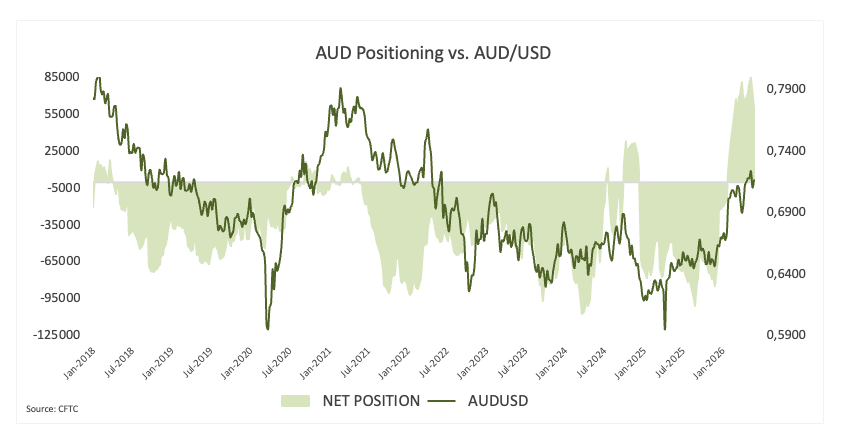
According to the latest Commodity Futures Trading Commission (CFTC) data, speculative net longs in the Australian Dollar retreated to the lowest level since early March at nearly 60.2K contracts for the week ending May 26.
The move also came in tandem with the continuation of the move higher in open interest, which climbed to around 302.8K contracts.
It is worth recalling that speculators’ sentiment toward the Aussie shifted in late January following several years of being net short.
Despite the side-lined move in the pair during that period, its prospect remains largely constructive, paving the way to further gains in the short-term horizon.
The catalysts to watch from here
In the near term, it is still all about the US Dollar, global risk sentiment, and geopolitics. Those remain the key drivers of price action. Next on tap on the Australian docket will be data from the housing sector alongside the Q1 Current Account results and the speech by the RBA’s Harper.
Key risks include a sharper slowdown in China, a more aggressive Fed, a change of heart from investors when it comes to risk sentiment, or any shift in the RBA’s stance. Any of these could quickly destabilise the Australian currency in the near term.
Technical landscape
In the daily chart, AUD/USD trades at 0.7158, holding a mild bullish bias as it stays above the key moving averages. The 55-day simple moving average (SMA) at 0.7104, the 100-day SMA at 0.7053 and the 200-day SMA at 0.6817 all sit below spot, suggesting an underlying constructive trend despite the latest consolidation. Momentum is lacklustre, with the Relative Strength Index (RSI) hovering near the neutral 50 mark and the Average Directional Index (ADX) around 17, hinting that directional conviction remains modest for now.
On the topside, immediate resistance emerges at 0.7278, with a nearby cap at 0.7283 forming a tight barrier; a sustained break above this zone would open the way toward the next key hurdle at 0.7661. On the downside, initial support is seen at the recent horizontal level of 0.7079, reinforced by the 55-day SMA at 0.7104 and the 100-day SMA at 0.7053 slightly lower, while deeper floors appear at 0.6833 and 0.6660, ahead of 0.6593 and 0.6414–0.6373 if sellers regain control.
(The technical analysis of this story was written with the help of an AI tool.)
The verdict: constructive, but not convincing
The broader backdrop for the Australian Dollar remains supportive, and the RBA’s stance should continue to provide a degree of support on dips.
But this is still a currency that trades heavily on sentiment. When confidence is strong, the Aussie performs well. When uncertainty creeps in, the Greenback tends to take over.
So while the medium-term story still leans constructive, the near-term outlook feels less certain. The move higher is there, but conviction is not quite there yet.
Australian Dollar FAQs
One of the most significant factors for the Australian Dollar (AUD) is the level of interest rates set by the Reserve Bank of Australia (RBA). Because Australia is a resource-rich country another key driver is the price of its biggest export, Iron Ore. The health of the Chinese economy, its largest trading partner, is a factor, as well as inflation in Australia, its growth rate and Trade Balance. Market sentiment – whether investors are taking on more risky assets (risk-on) or seeking safe-havens (risk-off) – is also a factor, with risk-on positive for AUD.
The Reserve Bank of Australia (RBA) influences the Australian Dollar (AUD) by setting the level of interest rates that Australian banks can lend to each other. This influences the level of interest rates in the economy as a whole. The main goal of the RBA is to maintain a stable inflation rate of 2-3% by adjusting interest rates up or down. Relatively high interest rates compared to other major central banks support the AUD, and the opposite for relatively low. The RBA can also use quantitative easing and tightening to influence credit conditions, with the former AUD-negative and the latter AUD-positive.
China is Australia’s largest trading partner so the health of the Chinese economy is a major influence on the value of the Australian Dollar (AUD). When the Chinese economy is doing well it purchases more raw materials, goods and services from Australia, lifting demand for the AUD, and pushing up its value. The opposite is the case when the Chinese economy is not growing as fast as expected. Positive or negative surprises in Chinese growth data, therefore, often have a direct impact on the Australian Dollar and its pairs.
Iron Ore is Australia’s largest export, accounting for $118 billion a year according to data from 2021, with China as its primary destination. The price of Iron Ore, therefore, can be a driver of the Australian Dollar. Generally, if the price of Iron Ore rises, AUD also goes up, as aggregate demand for the currency increases. The opposite is the case if the price of Iron Ore falls. Higher Iron Ore prices also tend to result in a greater likelihood of a positive Trade Balance for Australia, which is also positive of the AUD.
The Trade Balance, which is the difference between what a country earns from its exports versus what it pays for its imports, is another factor that can influence the value of the Australian Dollar. If Australia produces highly sought after exports, then its currency will gain in value purely from the surplus demand created from foreign buyers seeking to purchase its exports versus what it spends to purchase imports. Therefore, a positive net Trade Balance strengthens the AUD, with the opposite effect if the Trade Balance is negative.
Author

Pablo Piovano
FXStreet
Born and bred in Argentina, Pablo has been carrying on with his passion for FX markets and trading since his first college years.

















