Australian Dollar Price Forecast: Extra gains likely in the short term
- AUD/USD rose to new YTD highs around 0.6680, refocusing on the 0.6700 hurdle.
- The US Dollar came under strong selling pressure ahead of the FOMC meeting.
- The Fed is expected to reduce its interest rates by 25 bps on Wednesday.


The Australian Dollar (AUD) built on recent gains on Tuesday, adding to Monday’s optimism and sending AUD/USD to the 0.6680 region for the first time since early November 2024.
The push higher came as the US Dollar (USD) lost further momentum. Indeed, the US Dollar Index (DXY) faced heavy downside pressure, breaking below the 97.00 contention zone to reach fresh two-month lows alongside mixed US yields across the board.
Stubborn inflation keeps pressure on the RBA
Inflation in Australia is proving sticky. July’s Monthly Consumer Price Index (Weighted Mean) jumped to 2.8% from 1.9% in June, while Q2 CPI rose 0.7% quarter-on-quarter and 2.1% year-on-year. That persistence explains the Reserve Bank of Australia’s (RBA) caution, with policymakers reluctant to push through aggressive cuts.
Australia’s economy shows resilience
Despite global headwinds, the domestic economy is holding up. August’s final Manufacturing PMI came in at 53.0 and Services at 55.8, both comfortably expanding. Retail sales grew 1.2% in June, while July’s trade surplus widened to A$7.3 billion.
The labour market remains firm, too: unemployment edged down to 4.2% as payrolls added 24.5K jobs. Private capital expenditure rose 0.2% in Q2, while GDP surprised on the upside with 0.6% quarterly growth and 1.8% annualised.
RBA sticks to data-driven path
Earlier this month, the RBA trimmed rates by 25 basis points to 3.60% and cut its 2025 growth forecast. Governor Michele Bullock pushed back against calls for deeper easing, stressing that policy will remain firmly data-dependent.
Minutes from the latest meeting showed the central bank could cut faster if the labour market weakens, but a slower approach is more likely if the economy stays resilient.
For now, markets anticipate the Official Cash Rate (OCR) to remain unchanged on September 30, with an estimated 30 basis points of easing still factored in for year-end.
China’s recovery remains the wild card for the Aussie
Australia’s economic fortunes remain tightly linked to China. Q2 GDP grew 5.2% year-on-year, with industrial output up 5.2%, though retail sales disappointed expectations following a 3.4% yearly expansion in August. August PMIs painted a mixed picture: manufacturing slipped to 49.4, while services inched up to 50.3.
Deflation worries linger, with the August CPI falling 0.4% over the last twelve months. The People’s Bank of China (PBoC) left Loan Prime Rates (LPR) steady in August, keeping the One-Year at 3.00% and the Five-Year at 3.50%, and is expected to maintain its steady hand at its meeting later in the week.
AUD/USD technical outlook: still stuck in its range
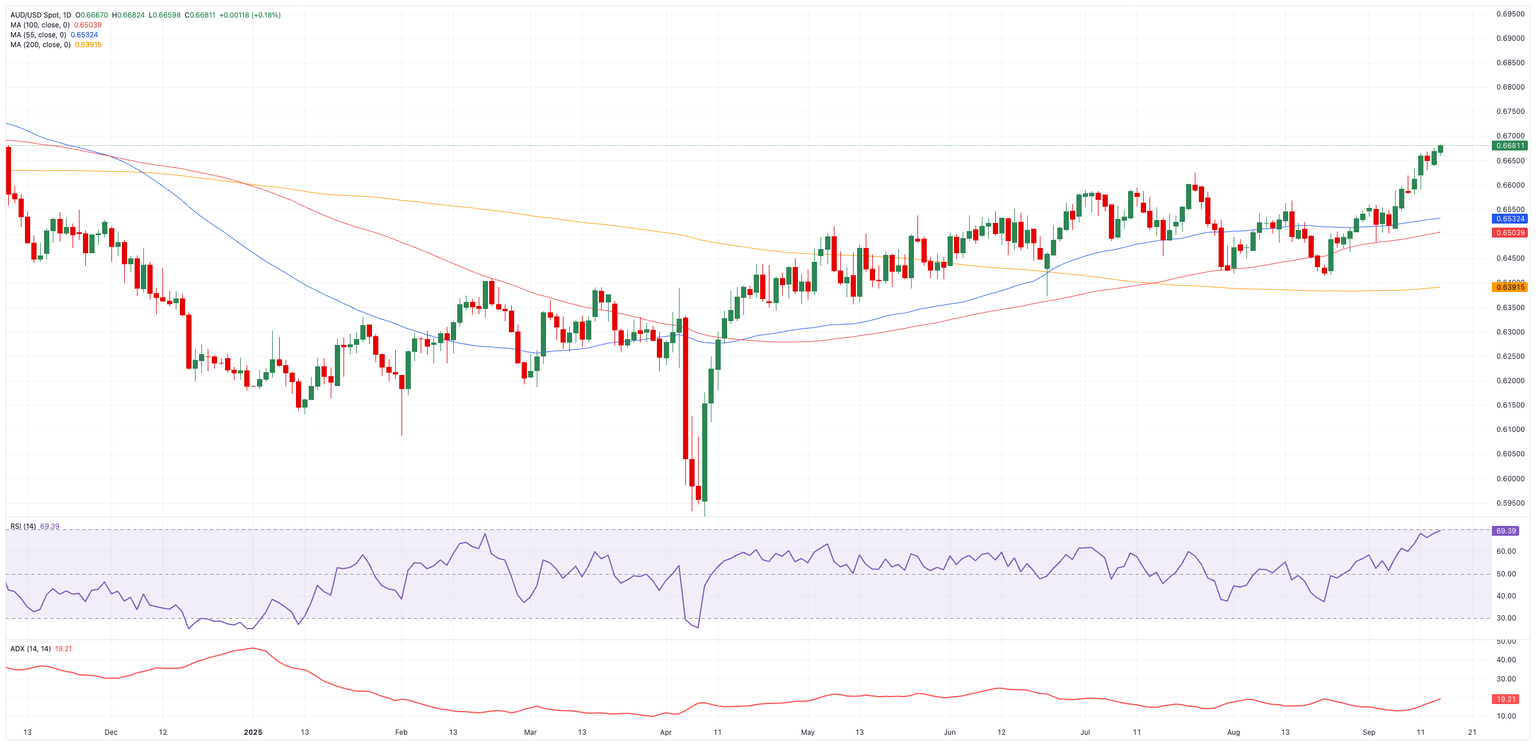
AUD/USD attempts to break above its 0.6400–0.6600 range.
Resistance sits at the 2025 ceiling of 0.6679 (September 16). A break higher would bring the November 2024 peak at 0.6687 (November 7) into view, with the big psychological 0.7000 mark further ahead.
On the downside, the first layer of support is the August low of 0.6414 (August 21), which lines up just above the 200-day SMA at 0.6392 and the June low at 0.6372 (June 23).
Momentum indicators are flashing bullish signals. While the Relative Strength Index (RSI) flirts with the overbought zone above 69, suggesting further upside potential, the Average Directional Index (ADX) around 19 indicates a trend that appears to be gathering momentum.
AUD/USD daily chart
Where next for AUD/USD?
AUD/USD looks set to remain range-bound in the very near term. A convincing breakout would likely need stronger Chinese data, a shift in Fed policy, or an unexpected move from the RBA.
US-China Trade War FAQs
Generally speaking, a trade war is an economic conflict between two or more countries due to extreme protectionism on one end. It implies the creation of trade barriers, such as tariffs, which result in counter-barriers, escalating import costs, and hence the cost of living.
An economic conflict between the United States (US) and China began early in 2018, when President Donald Trump set trade barriers on China, claiming unfair commercial practices and intellectual property theft from the Asian giant. China took retaliatory action, imposing tariffs on multiple US goods, such as automobiles and soybeans. Tensions escalated until the two countries signed the US-China Phase One trade deal in January 2020. The agreement required structural reforms and other changes to China’s economic and trade regime and pretended to restore stability and trust between the two nations. However, the Coronavirus pandemic took the focus out of the conflict. Yet, it is worth mentioning that President Joe Biden, who took office after Trump, kept tariffs in place and even added some additional levies.
The return of Donald Trump to the White House as the 47th US President has sparked a fresh wave of tensions between the two countries. During the 2024 election campaign, Trump pledged to impose 60% tariffs on China once he returned to office, which he did on January 20, 2025. With Trump back, the US-China trade war is meant to resume where it was left, with tit-for-tat policies affecting the global economic landscape amid disruptions in global supply chains, resulting in a reduction in spending, particularly investment, and directly feeding into the Consumer Price Index inflation.
Premium
You have reached your limit of 3 free articles for this month.
Start your subscription and get access to all our original articles.
Author
Pablo Piovano
FXStreet
Born and bred in Argentina, Pablo has been carrying on with his passion for FX markets and trading since his first college years.