Australian Dollar hits four-year high: What’s driving the AUD/USD rally?

The Australian Dollar (AUD) has emerged as one of the strongest G10 currencies this year, with AUD/USD climbing to its highest level in nearly four years above the 0.7200 area. What initially appeared to be a cyclical rebound from deeply oversold levels has gradually evolved into a broader structural re-rating of the currency, driven by a combination of domestic resilience, restrictive monetary policy, strong commodity dynamics and persistent weakness in the US Dollar (USD).
The key question for medium-term investors is no longer whether the rally has been justified, but whether the Australian Dollar can sustain its gains, or whether the move is becoming overstretched after such a strong advance.
A structural weakening of the US Dollar is supporting AUD/USD
One of the most important drivers behind the AUD/USD rally is not necessarily Australian strength alone, but rather the gradual erosion of the US Dollar’s structural support.
Over the past year, markets have increasingly questioned the traditional safe-haven appeal of the Greenback. Concerns about US fiscal deficits, policy unpredictability under the President Donald Trump administration, geopolitical tensions and the prospect of Federal Reserve (Fed) easing have all contributed to a broader diversification away from the US Dollar.
This shift has become particularly visible in the behavior of the US Dollar Index (DXY), which has struggled to sustain rallies even during periods of geopolitical stress. Historically, geopolitical tensions in the Middle East and rising Oil prices tended to support the US Dollar through safe-haven and energy-security flows. However, recent market behavior suggests this relationship has weakened materially in 2026.
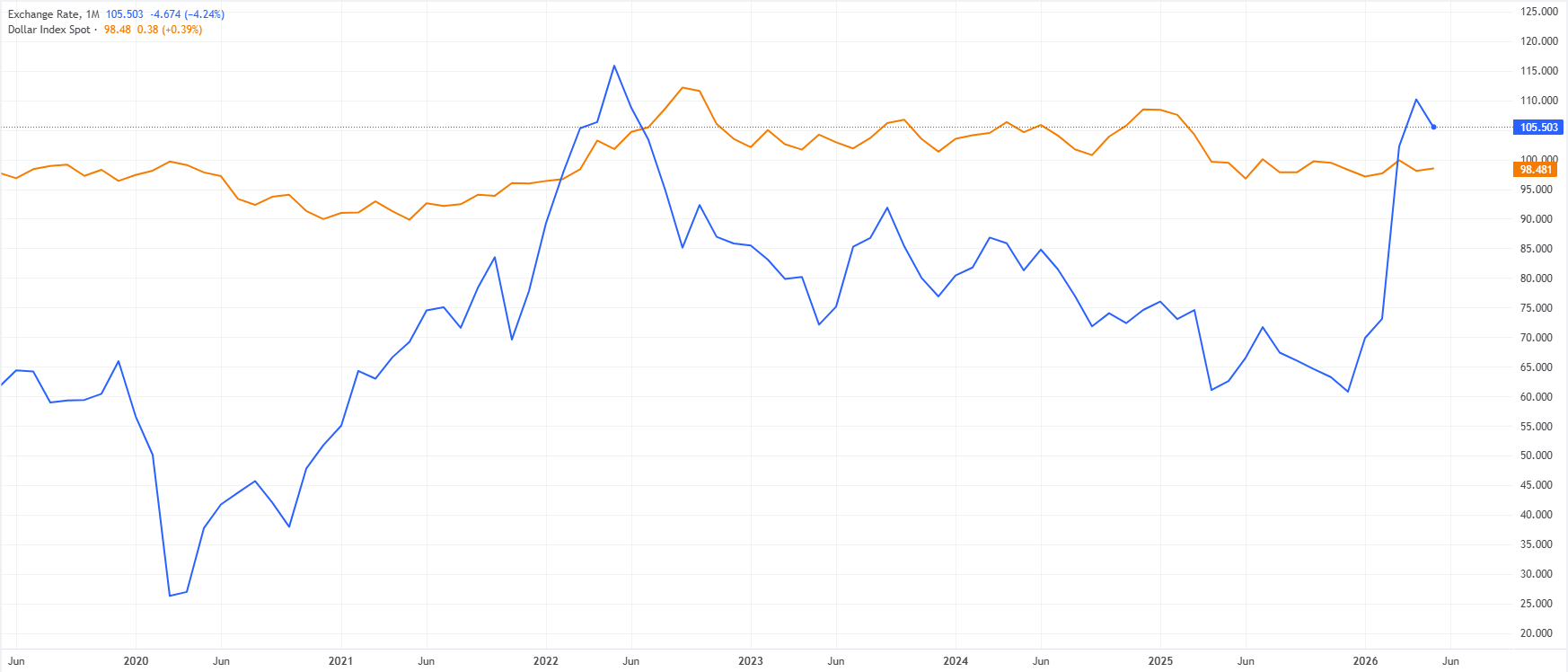
Several analysts now highlight that the US Dollar is no longer behaving as the dominant energy security currency it once was. The deterioration in the correlation between the DXY and Oil prices illustrates this changing regime.
At the same time, expectations for the Federal Reserve have shifted. While the Fed remains cautious due to sticky inflation, markets still expect US monetary policy to remain less restrictive over the medium term compared to Australia.
The Reserve Bank of Australia remains one of the most hawkish major central banks
A major pillar of the Australian Dollar’s strength is the Reserve Bank of Australia’s (RBA) relatively hawkish stance. Unlike many developed market central banks that are discussing rate cuts or prolonged pauses, the RBA continues to maintain a tightening bias due to persistent inflationary pressures and a resilient domestic economy.
The Australian cash rate currently stands at 4.35%, following several rate hikes since early 2025. More importantly, markets still price a meaningful chance of additional tightening later this year, particularly if inflation remains elevated due to energy prices and strong wage growth.
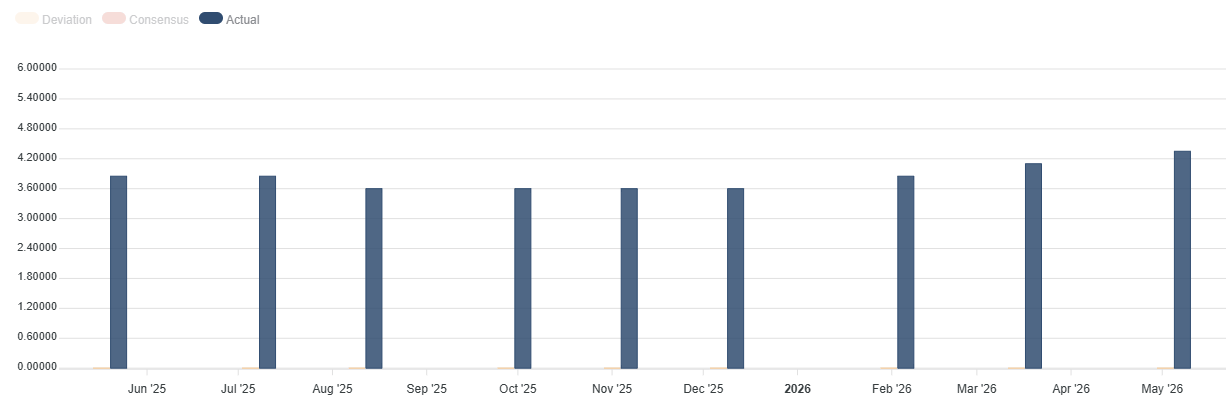
“Swaps imply around a 15% chance of a further move in June. An increase to 4.60% by September is about fully priced, which would be the highest since late 2011,” according to a Reuters report.
Several major banks continue to argue that the RBA may need to keep rates elevated for longer than other central banks. This policy divergence matters significantly for FX markets. Higher Australian yields continue to attract foreign capital flows into Australian Bonds and fixed-income assets, supporting demand for the Australian Dollar.
Commodity markets and China remain key structural tailwinds
Australia’s commodity-heavy export profile continues to provide medium-term support to the currency.
Iron ore prices have remained resilient despite concerns surrounding the Chinese property sector, while demand for energy commodities and industrial metals remains robust. Australia also continues to benefit from rising global demand for strategic resources such as Lithium and Uranium, both critical for the global energy transition.
China remains another essential component of the bullish AUD narrative. Although Chinese growth has moderated structurally compared to previous decades, Beijing’s stimulus measures and resilient import demand continue to support Australian exports.
Recent Chinese trade data have shown solid import growth. Historically, AUD/USD has often traded as a liquid proxy for Chinese growth expectations, and improving sentiment surrounding US-China relations could further reinforce support for the pair.
The Trump-Xi summit this week, therefore, carries particular importance for medium-term sentiment. Even limited progress on trade or geopolitical tensions could reinforce global risk appetite and benefit the Australian Dollar.
What could threaten the Australian Dollar rally?
Despite the constructive backdrop, several risks could challenge the sustainability of the AUD/USD advance.
The most obvious risk is a sharp deterioration in global risk sentiment. The Australian Dollar historically underperforms during periods of financial stress, equity market corrections or global growth fears. A significant selloff in technology stocks or a broader risk-off episode would likely pressure AUD/USD lower.
Geopolitical escalation also remains a major uncertainty. While markets currently appear relatively optimistic regarding the Middle East situation, a prolonged energy shock or renewed disruption to global trade routes could eventually trigger a broader flight to safety back into the US Dollar.
China also remains a medium-term concern. Although the Chinese economy has stabilized, structural issues linked to the property sector, demographics and weak domestic demand have not disappeared. Any meaningful slowdown in Chinese industrial activity would likely weigh heavily on Australian exports and commodity prices.
Domestically, the Australian economy is not without vulnerabilities either. Household debt levels remain extremely high, mortgage stress is rising and consumer confidence remains fragile despite resilient labor market conditions. Higher interest rates could eventually weigh more aggressively on domestic demand.
Finally, positioning risk cannot be ignored. Speculative positioning in favor of the Australian Dollar has become increasingly bullish according to CFTC data, raising the possibility of sharper corrections if market sentiment shifts suddenly.
AUD/USD Technical Analysis: Multi-year breakout keeps medium-term bullish structure intact
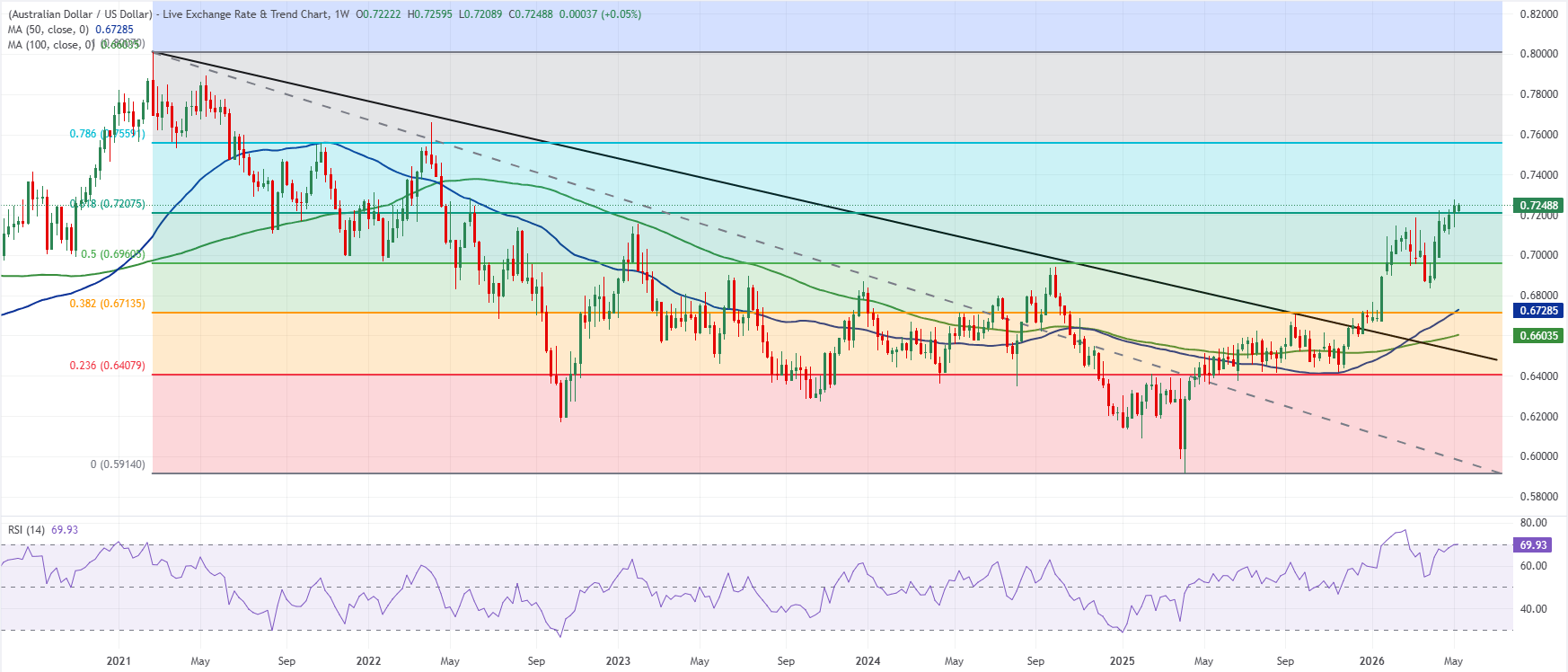
In the weekly chart, AUD/USD trades at 0.7249. The pair preserves a bullish bias as price holds above the 50-week and 100-week simple moving averages (SMAs) at 0.6729 and 0.6604, respectively, and has also reclaimed the former downward trend-line break area near 0.6521 as structural support. The 14-week Relative Strength Index (RSI) hovers just below overbought territory around 70, suggesting strong but stretched upside momentum while the exchange rate consolidates above the 61.8% Fibonacci retracement at 0.7207 of the broader downswing from 0.8007.
On the downside, initial support is now seen at the 61.8% retracement at 0.7207, ahead of the 50% retracement at 0.6961, with the 50-week SMA at 0.6729 and the 38.2% level at 0.6714 forming a secondary demand zone if a deeper pullback unfolds. On the topside, further gains would expose resistance at the 78.6% Fibonacci retracement at 0.7559, with the cycle high near the 100% level at 0.8007 acting as a more distant bullish objective if buyers maintain control.
(The technical analysis of this story was written with the help of an AI tool.)
AUD/USD outlook remains constructive despite volatility risks
The Australian Dollar’s rally toward four-year highs reflects more than a temporary rebound. The move is increasingly supported by a combination of structural US Dollar weakness, hawkish Reserve Bank of Australia expectations, resilient commodity demand and improving global risk appetite.
From a medium-term perspective, the fundamental backdrop still appears constructive for AUD/USD, particularly if the RBA maintains restrictive policy while the Fed remains on hold. Continued resilience in China and commodity markets would further reinforce this outlook.
However, the path higher is unlikely to be linear. The Aussie remains highly sensitive to global sentiment and geopolitical developments, meaning periods of volatility and corrections should be expected.
Overall, unless global growth deteriorates sharply or the US Dollar regains broad safe-haven dominance, the balance of risks still appears tilted toward additional upside in AUD/USD over the medium term.
Author
Ghiles Guezout
FXStreet
Ghiles Guezout is a Market Analyst with a strong background in stock market investments, trading, and cryptocurrencies. He combines fundamental and technical analysis skills to identify market opportunities.