Australia Retail Sales Preview: Good news for the RBA = bad news for the Aussie
- Australian Retail Sales are expected to have posted a modest 0.1% uptick in October.
- The Reserve Bank of Australia hiked the Cash Rate to 4.35% early in November.
- The AUD/USD is bullish ahead of the announcement, aiming for 0.6670.


The Australian Bureau of Statistics (ABS) will publish October Retail Sales on Tuesday, November 28. The figure is relevant as it is seen as a measure of consumer spending in the country. Financial markets expect a modest 0.1% increase after sales rose 0.9% in September, beating the market’s expectations.
Reserve Bank of Australia concerns
The Reserve Bank of Australia (RBA) lifted the Cash Rate to 4.35% in the November monetary policy meeting, as policymakers were concerned businesses were passing on inflation costs to consumers, according to the meeting minutes. The document also showed that even a modest increase in inflation expectations would be risky and would end up being more challenging to bring inflation back to the 2%-3% target band.
RBA’s Governor, Michele Bullock, said the central bank's November decision to hike rates was needed to avoid the risk of future inflation upticks, adding that “the remaining inflation challenge we are dealing with is increasingly homegrown and demand-driven.”
Cooling Retail Sales could be good news to the central bank, although it may turn into bad news for the Aussie, as it would also mean an economic setback. Still, worldwide central bankers are hoping growth cools down to help them maintain price pressures in check.
Australian growth and future RBA action
Australia's latest Gross Domestic Product (GDP) release showed the economy expanded 0.4% QoQ in the three months to June and rose 3.4% in the financial year. The ABS report noted the seventh straight rise in quarterly GDP, with annual growth steady above trend. The country will publish the Q3 GDP on December 6, and financial markets anticipate a 0.3% quarterly gain.
Meanwhile, the labor sector remains strong. The ABS showed the country added 6,700 new jobs in September, while the unemployment rate slid to 3.6% from 3.7% in August, as the participation rate declined to 66.7% from 67%. The sector has proved resilient, although September’s soft headline, fueled optimism the labor market was reaching a turning point.
Bottom line: despite RBA’s concerns, the economy is on quite a balanced path, and the central bank may not need additional hikes. In fact, the November hike was seen as a dovish one, with speculative interest now expecting the Australian central bank to adopt the “higher for longer” rates stance.
AUD/USD possible reaction
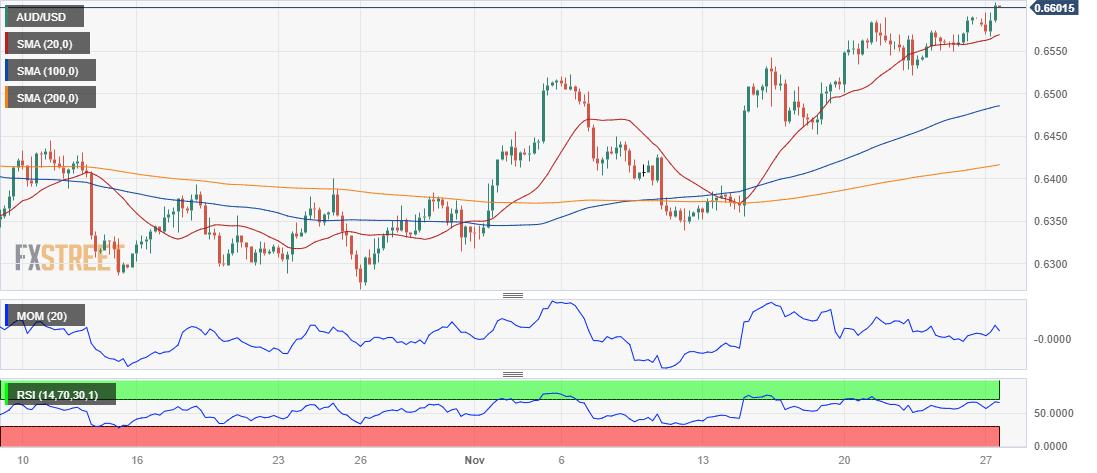
The AUD/USD pair heads into the announcement on a strong note, as the US Dollar remains under selling pressure. The pair trades around the 0.6600 level, its highest since early August.
The immediate reaction will be directly correlated to the report’s outcome. Better-than-anticipated Retail Sales can boost the AUD, while poor figures will likely trigger a pullback in AUD/USD. However, as demand for the Greenback remains subdued, a potential decline will probably be quickly reversed.
Financial markets started the week cautiously, with stock markets trading tepidly. That usually undermines demand for AUD, although it is not the case at the time of writing. If stocks maintain the sour tone, the bullish potential of AUD/USD will probably be limited.
The pair faces resistance at 0.6630, with gains above the area favoring an extension towards 0.6670, en route to 0.6710.
A strong support region stands around 0.6560, where the first line of buyers should appear. If the level gives up, AUD/USD could extend its near-term slide towards the 0.6520 region.
Premium
You have reached your limit of 3 free articles for this month.
Start your subscription and get access to all our original articles.
Author
Valeria Bednarik
FXStreet
Valeria Bednarik was born and lives in Buenos Aires, Argentina. Her passion for math and numbers pushed her into studying economics in her younger years.