Aussie dollar up more than a percent from yesterday’s dip

Right, but also wrong.
That's the way I feel about the note on the AUDUSD I wrote yesterday. Lower levels did beckon as I suggested but I failed to realise that the stuff I wrote about yesterday that some of the protagonists in the Italian political saga had already started to walk back their positions wasn't wildly appreciated by traders.
So, the Aussie’s dip into the 0.7470/75 support zone was short lived and once the news broke that Italian President Mattarella didn't want a summer election and other news about the protagonists walk back hit the headlines again the Aussie went along with the rally in the Euro and risk assets.
And this morning it is up more than a per cent on the day from this time yesterday at 0.7575.
So, to know where the Aussie might head it's worth rehashing where it has been recently.
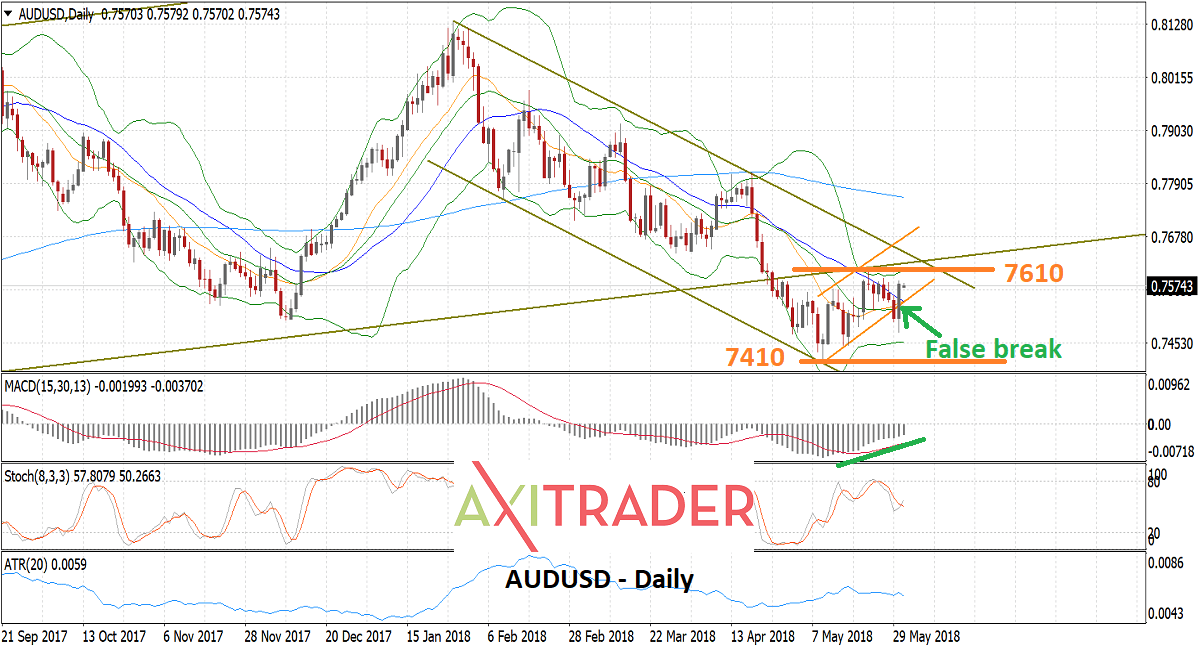
Two days ago, the Aussie looked like it might challenge the top of this 2-cent range between 74.10 and 76.10 cents. Yesterday the chances where it would approach the bottom of the range with the concerns over Italy and the risk off tone. Today it looks again like it might test the top of the range.
You can see in those few sentences that the Aussie dollar remains hostage to movements offshore and is ebbing and flowing with the moves in overseas markets or more correctly the appetite for risk from global investors as it ebbs and flows with the risks that have arisen and seemingly faded again. But it hasn’t broken the range yet.
Today could be the day local data comes back to the fore though. There is plenty of global data but of most import is the local CapEx number for Q1 which will feed into GDP. It’s a complex number to evaluate though because we get the number that feeds into GDP – expected to be +0.7% the Reuters poll says – and we also get forecasts for future investment. So watch that space at 11.30am and then the NBS PMI’s for China a little later this morning.
It might also be worth keeping an eye on Chinese stocks - the Shanghai composite is at a very important juncture.
Key levels on the day are 0.7600/10 then 0.7630 and 0.7660. Support is 0.7545, 25, 00 and 0.7470/75.
Author

Gregory McKenna
GO Markets
Greg McKenna has been working in and around financial markets since 1988.
















