|

AUD/USD stays in one piece after flash crash

  • AUDUSD bounces back from its lowest point in nine months.

  • Short-term risk skewed to the upside; close above 0.6500 needed.

  • RBA maintains steady policy; pushes back rate cut timing.

Chart

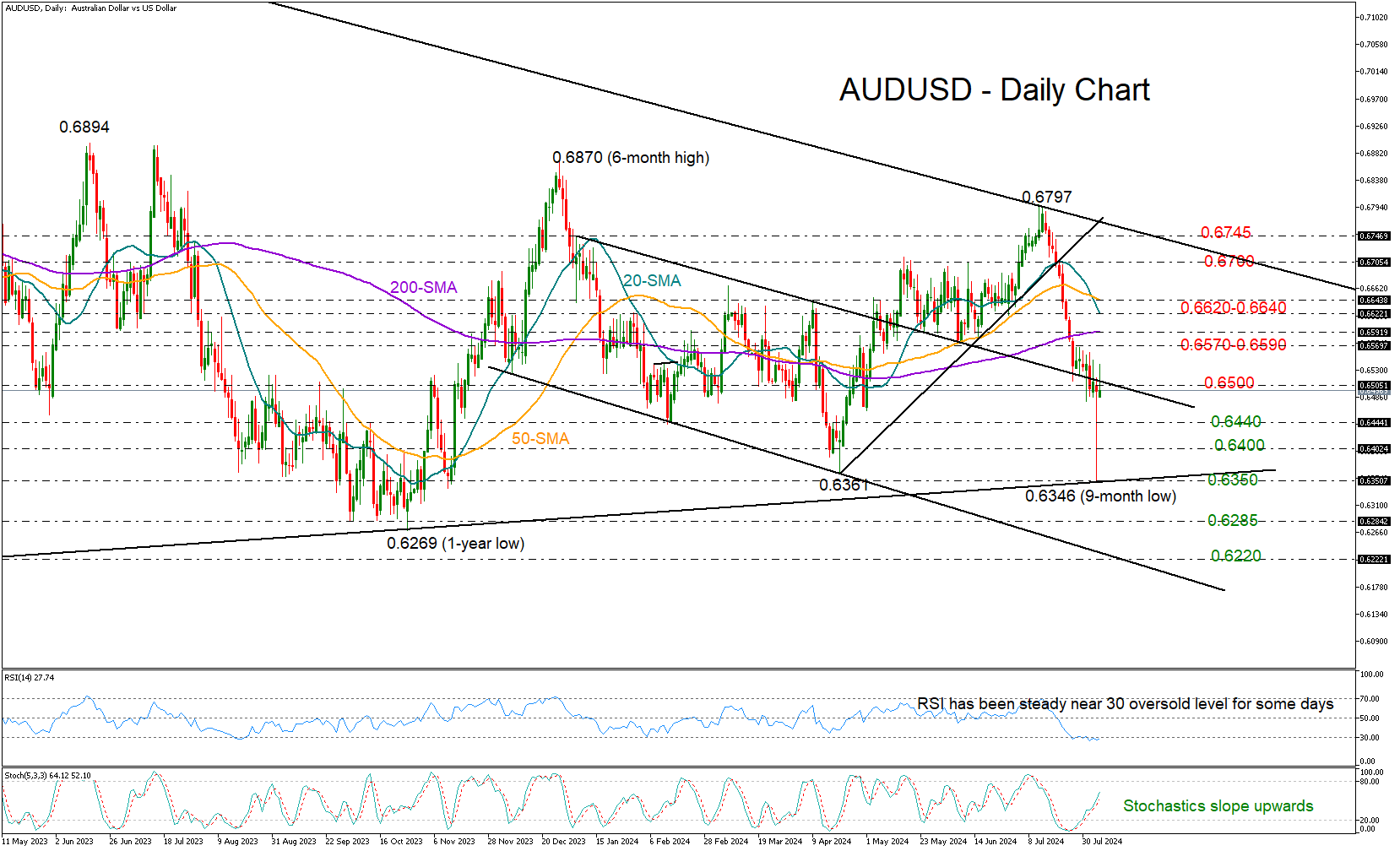
AUDUSD encountered a significant drop to a nine-month low of 0.6346 on Monday, marking its worst daily performance since the pandemic, but it quickly found fresh buying near the trendline, which connects the 2022 and 2023 lows, and managed to recover most of its losses by the end of the day.

The Reserve Bank of Australia (RBA) provided a helping hand to the pair on Tuesday after it played down any hopes for a rate cut soon, boosting the price as high as 0.6539. However, the pair could not sustain its gains, returning below the 0.6500 number again and beneath the falling constraining line from January which has been limiting upside movements over the past three trading days.

With the RSI remaining flat near the oversold level of 30 for a few days and the stochastic oscillator showing an upward trend, it seems like the bulls may have some luck in their favor in the upcoming sessions. A clear close above 0.6500 could last until the 0.6570-0.6590 zone, where the 200-day SMA is positioned. If the 20- and 50-day SMAs at 0.6620 and 0.6640 give way as well, the bullish wave could pick up pace towards the 0.6700 number and the broken ascending trendline seen near 0.6745.

In the opposite scenario, if the price holds below 0.6500, there could be stronger selling interest towards the range of 0.6400-0.6440. If the bears breach that base too, the 0.6285 floor from October 2023 could be the next destination.

To summarize, AUDUSD has laid the foundation for its next recovery phase, but buyers might not step in if the price fails to break above 0.6500.

Author

Christina Parthenidou

Christina joined the XM investment research department in May 2017. She holds a master degree in Economics and Business from the Erasmus University Rotterdam with a specialization in International economics.


More from Christina Parthenidou
Share:

Markets move fast. We move first.

Orange Juice Newsletter brings you expert driven insights - not headlines. Every day on your inbox.

By subscribing you agree to our Terms and conditions.

Editor's Picks

EUR/USD retreats below 1.1750 on modest USD recovery

EUR/USD stays under modest bearish pressure and trades below 1.1750 on Friday. Although trading conditions remain thin following the New Year holiday and ahead of the weekend, the modest recovery seen in the US Dollar causes the pair to edge lower. The economic calendar will not feature any high-impact data releases.

GBP/USD struggles to gain traction, stabilizes above 1.3450

After testing 1.3400 on the last day of 2025, GBP/USD managed to stage a rebound. Nevertheless, the pair finds it difficult to gather momentum and moves sideways above 1.3450 as market participants remain in holiday mood.

Gold climbs toward $4,400 following deep correction

Gold reverses its direction and advances toward $4,400 after suffering heavy losses amid profit-taking before the New Year holiday. Growing expectations for a dovish Fed policy and persistent geopolitical risks seem to be helping XAU/USD stretch higher.

Cardano gains early New Year momentum, bulls target falling wedge breakout

Cardano kicks off the New Year on a positive note and is extending gains, trading above $0.36 at the time of writing on Friday. Improving on-chain and derivatives data point to growing bullish interest, while the technical outlook keeps an upside breakout in focus.

Economic outlook 2026-2027 in advanced countries: Solidity test

After a year marked by global economic resilience and ending on a note of optimism, 2026 looks promising and could be a year of solid economic performance. In our baseline scenario, we expect most of the supportive factors at work in 2025 to continue to play a role in 2026.

Crypto market outlook for 2026

Year 2025 was volatile, as crypto often is.  Among positive catalysts were favourable regulatory changes in the U.S., rise of Digital Asset Treasuries (DAT), adoption of AI and tokenization of Real-World-Assets (RWA).