|

AUD/USD Showing Signs of a Potential Near-Term Top

As my colleague Fawad Razaqzada noted earlier today, the US dollar has caught a bid today after traders reevaluated yesterday’s FOMC meeting and deemed it moderately hawkish. Though the central bank removed the phrasing about monetary policy remaining accommodative from its statement, Fed Chair Powell was at pains to emphasize that that change was more procedural than anything. At the end of the day, the Federal Reserve is the only major central bank engaging in sustained interest rate increases, and until that dynamic starts to change, the greenback could maintain its recent strength.

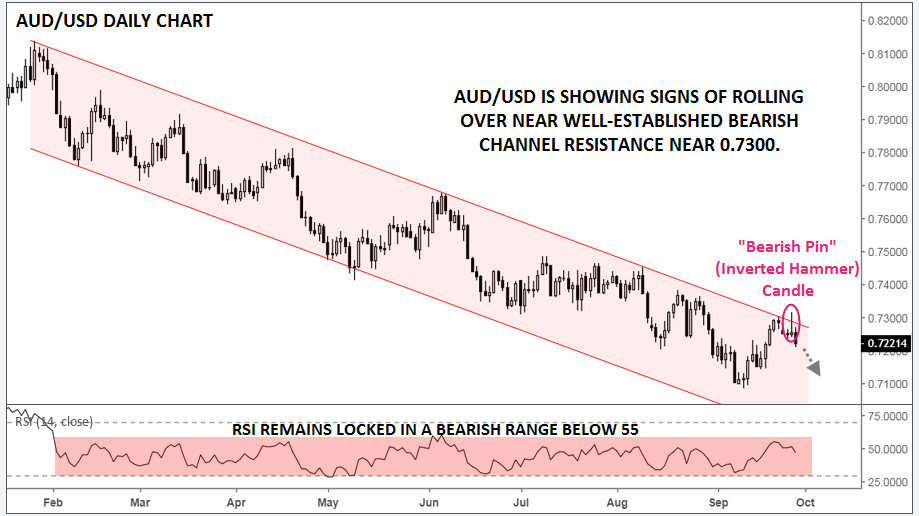
Heading into this week, the textbook bearish channel in AUD/USD was under threat, boosted by hopes of a thaw in US-China trade relations. However, President Trump’s aggressive rhetoric toward China at the UN Security Council earlier this week has dashed those hopes, making it more likely that the budding trade war gets worse before it gets better.

The Aussie formed a textbook “bearish pin,” or inverted hammer, candle in the wake of yesterday’s FOMC statement and press conference. This pattern shows an intraday shift from buying to selling pressure in the market and is often seen at near-term tops. At the same time, the RSI indicator appears to be rolling over from the top of its bearish range between 30 and 55, signaling that the longer-term bearish trend remains intact.

With this price action pattern forming at a logical resistance level from the established bearish channel, bears may look to drive the pair back toward the lows from earlier this month around 0.7100 next. A break below that low, toward the bottom of the channel around the psychologically-significant 0.7000 handle, could come into play if we see an escalation of trade war fears. Only a break above this week’s high around 0.7300 would erase the near-term bearish bias.
Author

Matt Weller, CFA, CMT

Matt Weller, CFA, CMT

Faraday Research

Matthew is a former Senior Market Analyst at Forex.com whose research is regularly quoted in The Wall Street Journal, Bloomberg and Reuters. Based in the US, Matthew provides live trading recommendations during US market hours, c


More from Matt Weller, CFA, CMT
Share:

Editor's Picks

AUD/USD meets support near 0.7150

AUD/USD comes under renewed and quite strong selling pressure ahead of the Asia opening bell on Friday, drifting back toward multi-day troughs near 0.7150, where it seems to have met some decent contention for now. The Aussie’s decline follows the inflation-reignited uptick in the Greenback in response to robust US factory-gate prices in August.


USD/JPY consolidates around 153.50 as bears turn cautious ahead of US inflation

USD/JPY stabilizes above 153.50 during the Asian session on Thursday, but remains near a seven-month low set earlier this week as hawkish BoJ repricing continues to underpin the Japanese Yen. Meanwhile, rising September Fed rate-hike bets and escalating US-Iran tensions help ease US Dollar selling pressure, offering some support to the currency pair ahead of US inflation figures.

Gold remains weak, retargets $4,350

Gold keeps the choppy price action on Thursday, now slipping back toward the $4,350 region per troy ounce amid the robust bounce in the US Dollar as well as rising US Treasury yields across the curve, particularly following US Producer Prices and ahead of Friday’s more relevant US CPI data.

Bitcoin and Gold Outlook: BTC and XAU drop as US PPI broadens rate-hike bets
Cryptocurrency prices are broadly correcting, led by Bitcoin (BTC), which is trading around $77,000 on Thursday, marking four consecutive days of declines. Meanwhile, Gold (XAU) remains sideways, hovering around $4,365, with upside capped below $4,400.
ECB recap: A hawkish hike despite downside growth risks
The European Central Bank (ECB) increased the Deposit Facility Rate to 2.50%, the Refinancing Rate to 2.65% and the Marginal Lending Facility to 2.90%, effective from September 16. The decision was accompanied by a clear warning that the outlook remains highly uncertain, with risks tilted to the upside for inflation and to the downside for growth.
Venezuela’s 65-billion-barrel Oil deal could reshape America’s inflation fight
The United States (US) has secured unprecedented access to part of Venezuela’s vast Oil reserves. The timing is particularly significant as the war with Iran is disrupting Middle Eastern supplies, keeping energy prices elevated and reviving concerns about inflation.