AUD/USD Price Forecast: Up, up, up you go
- AUD/USD advanced to multi-week highs near 0.6750.
- The Dollar’s sell-off underpinned the move higher in the pair.
- The RBA Minutes discussed an interest rate hike.

On Tuesday, AUD/USD continued its bullish momentum for the fourth consecutive day, successfully extending the recent breakout of the key 0.6700 level for the first time since mid-July.
After breaking through the critical 200-day SMA at 0.6603, the outlook for AUD/USD is expected to gradually improve, potentially supporting the continuation of the uptrend in the short term.
The extension of the monthly bounce was driven by a further decline in the US Dollar (USD) and a broad recovery in the risk complex, despite some corrective moves in commodity prices, where copper edged a tad lower vs. a slight rebound in iron ore prices.
On the monetary policy front, the Australian dollar has recently benefited from the Reserve Bank of Australia's (RBA) decision to keep the official cash rate (OCR) steady at 4.35%. The RBA has adopted a cautious approach, indicating no immediate plans to ease policy due to persistent domestic inflation. Both trimmed-mean and headline CPI inflation are now projected to reach the midpoint of the 2-3% range by late 2026, later than previously anticipated.
In a subsequent speech, Governor Michelle Bullock reaffirmed the RBA's readiness to raise interest rates if necessary to control inflation, maintaining a hawkish stance in light of high underlying inflation. She emphasized the bank's vigilance regarding inflation risks following the decision to keep rates unchanged. Core inflation, which stood at 3.9% last quarter, is expected to fall within the 2-3% target range by late 2025.
Still around the RBA, the bank released its Minutes early on Tuesday. The Minutes indicated that members debated whether to increase the cash rate target or keep it the same. The argument for raising the rate was bolstered by ongoing underlying inflation and to counteract market expectations of multiple rate cuts later in 2024. However, members ultimately concluded that maintaining the current cash rate target was the stronger position. They also concurred that it was improbable for the cash rate target to be reduced in the near term, but it was not feasible to definitively predict future changes to the rate target.
Overall, the RBA is anticipated to be the last among the G10 central banks to begin reducing interest rates. The potential for Federal Reserve easing in the medium term, contrasted with the RBA's expected prolonged restrictive stance, could support AUD/USD in the coming months. So far, the swaps markets see the central bank cutting its rates by 25 bps at some point towards year-end.
However, a slow recovery in the Chinese economy might limit the Australian dollar's rebound. China continues to grapple with post-pandemic challenges, such as deflation and inadequate stimulus. Concerns about demand from China, the world's second-largest economy, were also heightened after the Politburo meeting, which, despite promises of support, did not introduce specific new stimulus measures.
Meanwhile, non-commercial traders (speculators) remain largely net-short on the AUD, according to the latest CFTC report for the week ending August 13, mainly due to the lack of positive developments from China. Net shorts have dominated since Q2 2021, with only a brief two-week interruption.
AUD/USD daily chart
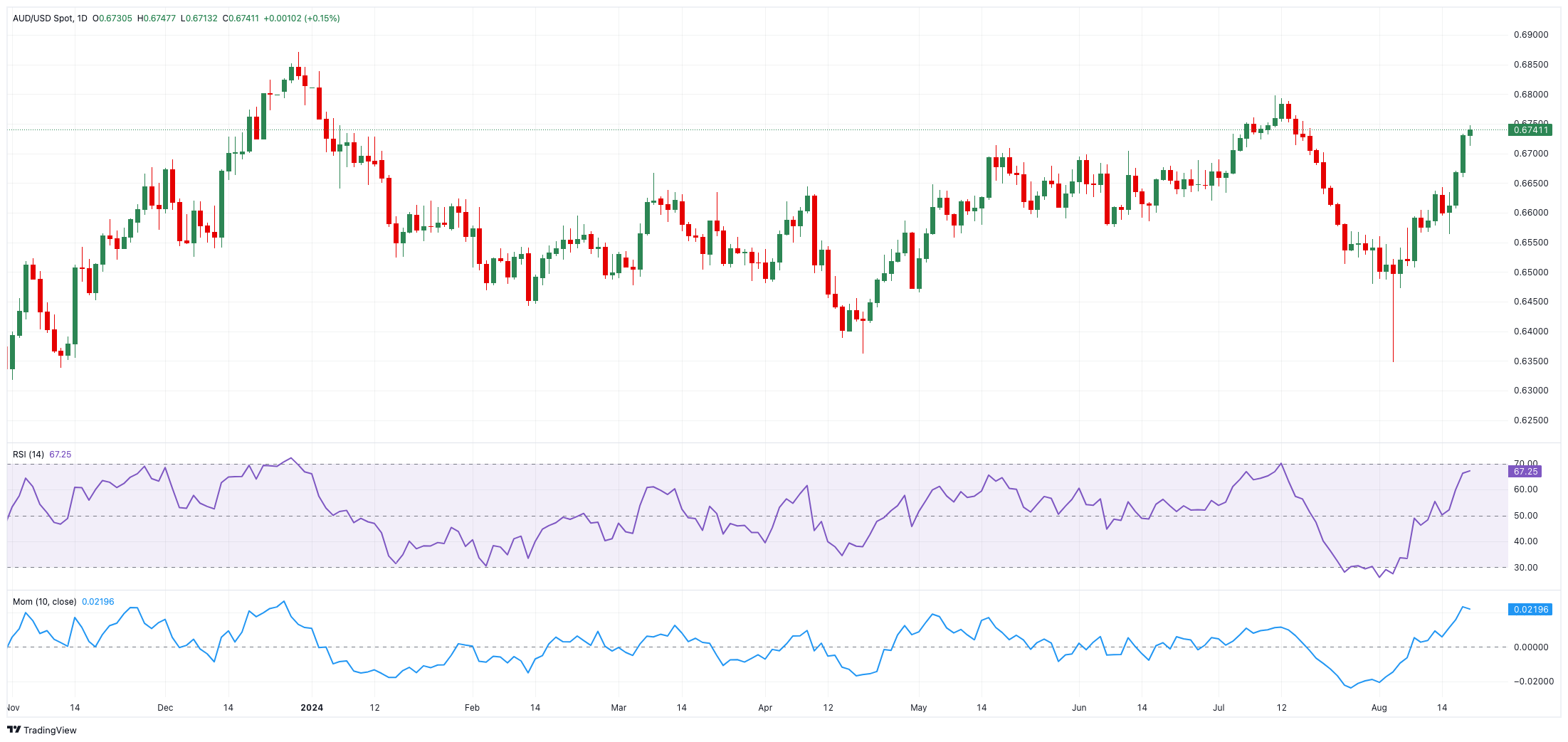
AUD/USD short-term technical outlook
Further gains should propel the AUD/USD to its August high of 0.6747 (August 20), ahead of the July high of 0.6798 (July 8) and the December peak of 0.6871.
On the other side, bearish swings may trigger an initial drop to the key 200-day SMA of 0.6603 prior to the 2024 bottom of 0.6347 (August 5), and the 2023 low of 0.6270 (October 26).
The four-hour chart suggests an increase in increasing momentum for the time being. However, the immediate obstacle is at 0.6747, just ahead of 0.6754 and then 0.6798. On the other hand, the 200-SMA around 0.6635 provides early support, followed by 0.6560. The RSI climbed to around 77.
Author

Pablo Piovano
FXStreet
Born and bred in Argentina, Pablo has been carrying on with his passion for FX markets and trading since his first college years.

















