AUD/USD Price Forecast: Trade jitters should keep the Aussie under pressure
- AUD/USD plummeted to multi-year lows in the sub-0.6000 zone.
- The US Dollar advanced marginally following Friday’s sharp bounce.
- Stock markets worldwide tumbled as they assessed Trump’s tariffs


The Australian Dollar (AUD) managed to regain a small smile on Monday following Friday’s striking decline following news of Chinese retaliation to tariffs announced by President Trump’s “Liberation Day”.
That said. AUD/USD extended that drop to levels last seen in March 2020 around 0.5930 earlier on Monday, although it recouped part of that move and regained the 0.6000 barrier and beyond as the day progressed.
Rising global trade war fears
Trade tensions are ratcheting up fast. President Trump’s newly imposed tariffs—ranging from 10% to 50% on multiple trading partners—have already provoked sp,e retaliatory measures and fanned the flames of a full-blown global trade war.
Such an escalation would threaten economic activity, consumer prices, and central bank policies around the globe. Given Australia’s close ties to China and its commodity exports, the Aussie remains especially sensitive to any slowdown in Chinese demand or broader fallout from US tariffs.
Indeed, that tension came to a head when China unveiled its own set of tariffs in the latter part of last week, sending AUD/USD into a nosedive. In addition, robust US jobs data (+228K) and hawkish commentary from Fed Chair Jerome Powell only added to the downward pressure. That steep pullback in just 24 hours underscores the extreme volatility the Aussie faces amid intensifying trade disputes and domestic economic headwinds.
The delicate balance of the Fed
Across the Pacific, the Federal Reserve (Fed) faces a delicate balancing act. Escalating trade conflicts could stoke inflation, justifying further rate hikes. At the same time, signs of a cooling US economy argue for caution—despite a still-solid labour market. In its March 19 meeting, the Fed held rates steady at 4.25–4.50% and reiterated a “wait-and-see” approach. Chair Jerome Powell highlighted forecasts for slower growth and slightly higher inflation, both of which could be exacerbated by looming tariffs.
On Friday, Chief Powell argued that, while uncertainty remained elevated, it was becoming evident that the tariff increases would be significantly larger than expected. He further mentioned that the economic effects were likely to mirror this trend, including higher inflation and slower growth.
RBA Holds Steady Amid Uncertainty
Meanwhile, the Reserve Bank of Australia (RBA) kept its Official Cash Rate (OCR) at 4.10% on Tuesday, as expected. In a notable shift, policymakers dropped their previous caution about “further policy easing” and instead emphasized risks on both sides of the economic outlook. RBA Governor Michele Bullock acknowledged uncertainty over how quickly inflation will return to the 2–3% target range and revealed that the decision to hold rates was unanimous. Following the meeting, markets trimmed the odds of a 25-basis-point cut at the May 20 meeting to 70%, down from 80%.
Bears Bet on the Aussie
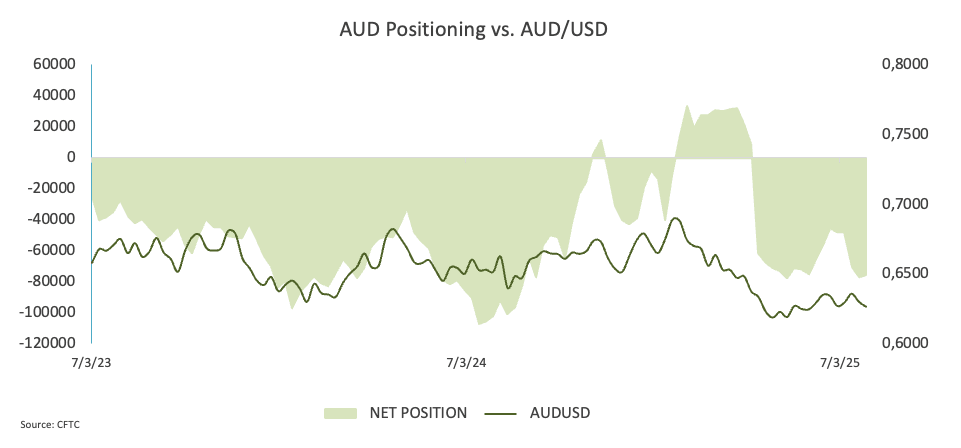
According to the latest CFTC report, non-commercial players remained bearish on the Aussie. Despite net shorts shrinking slightly to around 76K contracts in the week ending April 1, the readings remain near the upper end of the range, as they have been steadily rising since mid-December, reflecting growing tariff concerns.
Technical signals for AUD/USD
Risks of extra weakness are expected to remain well in place as long as AUD/USD navigates the area below its key 200-day SMA around 0.6500.
Extra bouts of selling pressure could prompt the pair to retest its 2025 bottom of 0.5930 (April 7), ahead of the 2020 trough at 0.5506 (March 19).
On the upside, if spot can definitively break above the 2025 high at 0.6408 (February 21), the path may open toward the 200-day SMA at 0.6496, with the November 2024 top of 0.6687 as the next key hurdle.
Although the Relative Strength Index (RSI) bouncing towards the 37 level shows some recovery, an Average Directional Index (ADX) near 15 signals that the broader trend remains relatively weak, although off recent lows.
AUD/USD daily chart

What’s next for AUD?
Next on tap in Oz will come the Consumer Confidence gauge tracked by Westpac and the NAB’s Business Confidence reading, all on April 8. Later in the week will come Building Permits and Private House Approvals on April 9, while the Melbourne Institute will release its Inflation Expectations on April 10.
Bottom Line
The Australian Dollar’s immediate direction will hinge on how trade tensions evolve, China’s economic performance, and the careful policy moves of central banks on both sides of the Pacific.
Premium
You have reached your limit of 3 free articles for this month.
Start your subscription and get access to all our original articles.
Author
Pablo Piovano
FXStreet
Born and bred in Argentina, Pablo has been carrying on with his passion for FX markets and trading since his first college years.