AUD/USD Price Forecast: The 200-day SMA holds the downside so far
- AUD/USD partially faded Monday’s auspicious advance to the 0.6500 region.
- The US Dollar made a comeback after bottoming in multi-week lows.
- The RBA Minutes came in on the dovish side, also weighing on the Aussie.


The Australian Dollar (AUD) suffered the strong rebound of the US Dollar (USD) on Tuesday, with AUD/USD coming under pressure and eroding part of Monday’s promising session.
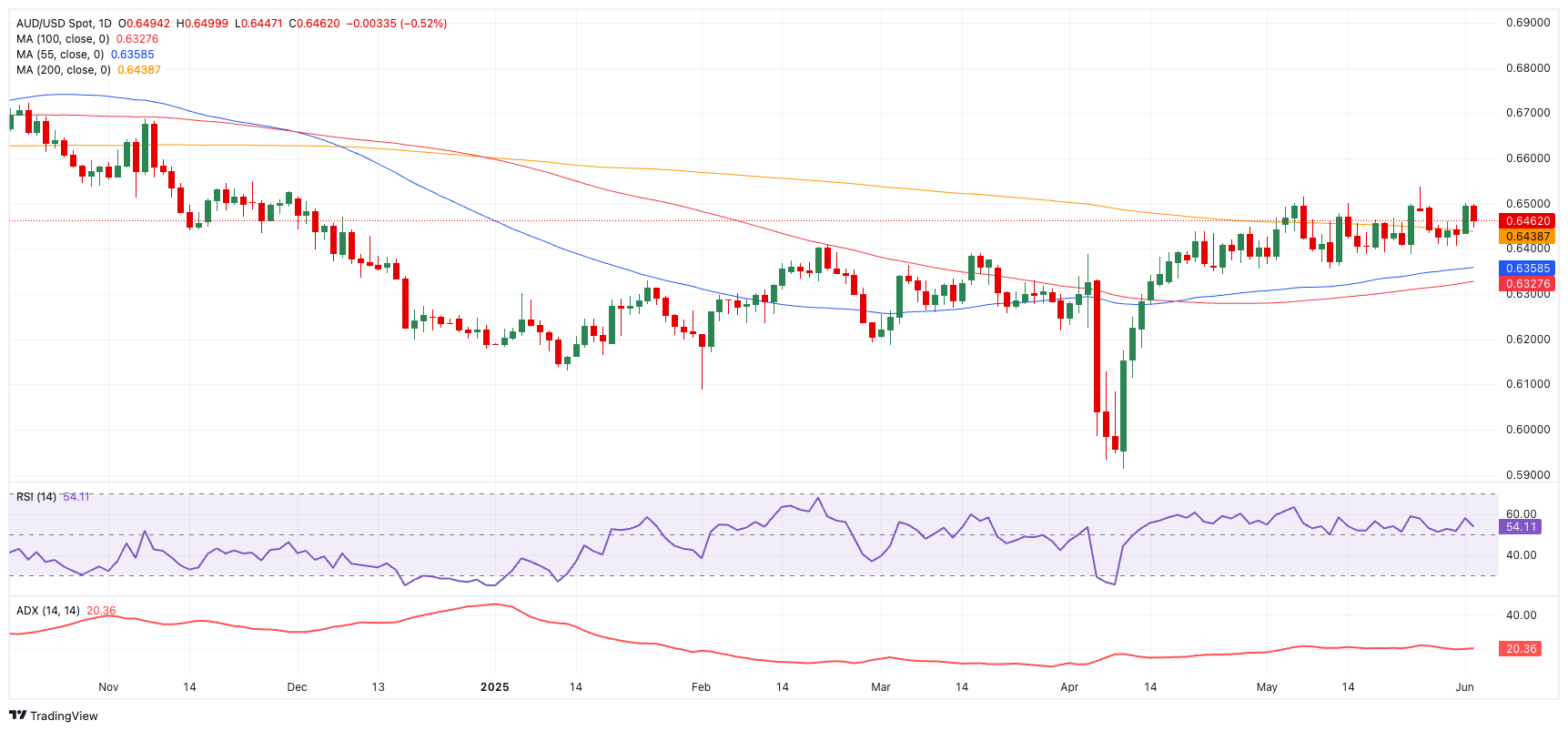
That said, the AUD briefly managed to test the 0.6500 zone before retreating to the mid-0.6000s, which coincides with the key 200-day SMA.
Central banks in focus
Meanwhile, the FX space continued to look for central bank signals when it came to price direction. Against that, the Federal Reserve (Fed) kept rates unchanged during its May meeting, and Chair Jerome Powell underlined a wary, data-dependent posture. Since softer April inflation estimates have then caused markets to price in a probable rate decrease by September more and more.
On May 20, the Reserve Bank of Australia became more dovish, lowering its benchmark rate by 25 basis points to 3.85%. The RBA expected the cash rate to drop to 3.2% by 2027, therefore projecting a slow lowering cycle in its Monetary Policy Report. With inflation now expected to ease to 2.6%, the bank highlighted residual uncertainty in local demand and global supply chains, hence lowering its 2025 GDP growth estimate to 2.1%.
Earlier on Tuesday, the RBA Minutes noted that the decision to lower the OCR to 3.85% was aimed at maintaining monetary policy predictability amid increased uncertainty. The bank said that a bigger decrease of 50 basis points would be needed if household spending didn't pick up as expected or if wage growth slowed down more than expected together with a weak job market. It was also said that there may be times when a more forceful action could be needed because of the unexpected effects of global policy uncertainty.
Additionally, futures markets are indicating nearly 80% odds of a quarter-point rate cut at the July gathering, with expectations of nearly 100 basis points of easing over the next 12 months.
China’s mixed signals weigh on outlook
For Australia's biggest trade partner, China's most recent GDP figures presented a dubious image. Although Q1 industrial production shocked everyone with an increase, sluggish retail sales and little investment highlighted ongoing fragilities.
The People's Bank of China (PboC) responded by cutting its 1- and 5-year Loan Prime Rates by 10 basis points to 3.00% and 3.50%, respectively. The regional picture is nevertheless long shadowed by structural issues like unstable property markets and erratic US-China trade dynamics.
However, earlier results from the Caixin Manufacturing PMI in May (48.3) failed to reignite optimism among market participants, let alone hopes of a solid recovery in the economy.
Speculators turn bearish again
The Aussie seems to be attracting a bearish attitude. Even while open interest rose, CFTC data as of May 27 revealed net short positions climbing to 61.2K contracts, the largest since early April, that reflect cautious posture across more general markets.
Technical views and key levels
Should the AUD/USD surpass its 2025 peak of 0.6537 (May 26), it may aim for the November 2024 high at 0.6687, subsequently leading to the 2024 peak at 0.6942.
On the other hand, first support is around 0.6356 (May 12 low), a region underpinned by the interim 55-day SMA. Down from here comes the transitory 100-day SMA at 0.6326 prior to the psychological support at 0.6000. A deeper pullback could put the 2025 bottom at 0.5913 (April 9) on the radar.
Momentum indicators lean constructive so far: The Average Directional Index (ADX) swings around 22, indicating trend persistence but with little conviction; the Relative Strength Index (RSI) has weakened to around 54, still suggesting a positive scenario in the short-term horizon.
AUD/USD daily chart
Looking ahead
Next on tap on the Australian docket come the Q1 GDP Growth Rate, final S&P Global Services PMI, and the Ai Group survey on June 4, while Trade Balance numbers are expected on June 5 and Private House Approvals and Building Permits complete the week on June 6.
Author
Pablo Piovano
FXStreet
Born and bred in Argentina, Pablo has been carrying on with his passion for FX markets and trading since his first college years.