AUD/USD Price Forecast: Stuck in a range as trade uncertainties overshadow strong Aussie CPI
- AUD/USD gains positive traction as strong Australian CPI tempers oversized RBA rate cut bets.
- Mixed US-China trade talk signals and a modest USD uptick caps any further gains for the pair.
- Traders now look forward to the key US macro releases to grab some short-term opportunities.

The AUD/USD pair attracts fresh buyers in reaction to stronger-than-expected Australian consumer inflation figures released earlier this Wednesday and reverses a part of the previous day's retracement slide from the year-to-date top. The Australian Bureau of Statistics reported that the headline Consumer Price Index (CPI) rose 0.9% in the first quarter of 2025 compared to the 0.2% increase seen in the previous quarter and 0.8% anticipated. Meanwhile, the annual CPI rate held steady at 2.4%, topping expectations of 2.2%. That said, the Reserve Bank of Australia's (RBA) Trimmed Mean core inflation fell back into the central bank's 2% to 3% target band for the first time since late 2021 and slowed to 2.9% from 3.3%. The data reaffirms bets for a 25 basis points (bps) interest rate cut at the next RBA policy meeting on May 20, though tempers expectations of an outsized rate cut and provides a modest lift to the Australian Dollar (AUD).
Apart from this, hopes for the de-escalation of the US-China trade standoff, to a larger extent, overshadow disappointing Chinese data and turn out to be another factor underpinning the China-proxy Aussie. According to the National Bureau of Statistics, China’s factory activity contracted at the fastest pace in 16 months in April and the official Manufacturing Purchasing Managers' Index (PMI) fell to 49 from 50.5 in March. Adding to this the NBS Non-Manufacturing PMI eased more than expected, to 50.4 from 50.8 in the previous month. Moreover, a separate private sector survey revealed that manufacturing activity slowed at the start of the second quarter and a sharp fall in new export orders. In fact, China's Caixin Manufacturing PMI fell from 51.2 to 50.4 in April. The reading, however, was better than the market forecast. Nevertheless, the data keeps alive calls for further stimulus from China, which lends additional support to the Aussie.
Meanwhile, US President Donald Trump announced a rollback of tariffs on car components, giving US car makers a two-year window to ramp up domestic production of parts. This further boosts investors' confidence, which is evident from a generally positive tone around the equity markets and contributes to driving flows towards perceived riskier assets, including the AUD. However, Trump's rapidly shifting stance on trade policies and mixed US-China trade talks signals continue to fuel global uncertainty. In fact, Trump claimed that he had spoken directly with President Xi Jinping on the trade issue. Chinese officials responded to this by categorically saying that “China and the US have not held consultations or negotiations on the issue of tariffs”. This keeps market participants on the edge and should keep a lid on the optimism, which, along with a modest US Dollar (USD) uptick, should contribute to capping any meaningful upside for the AUD/USD pair.
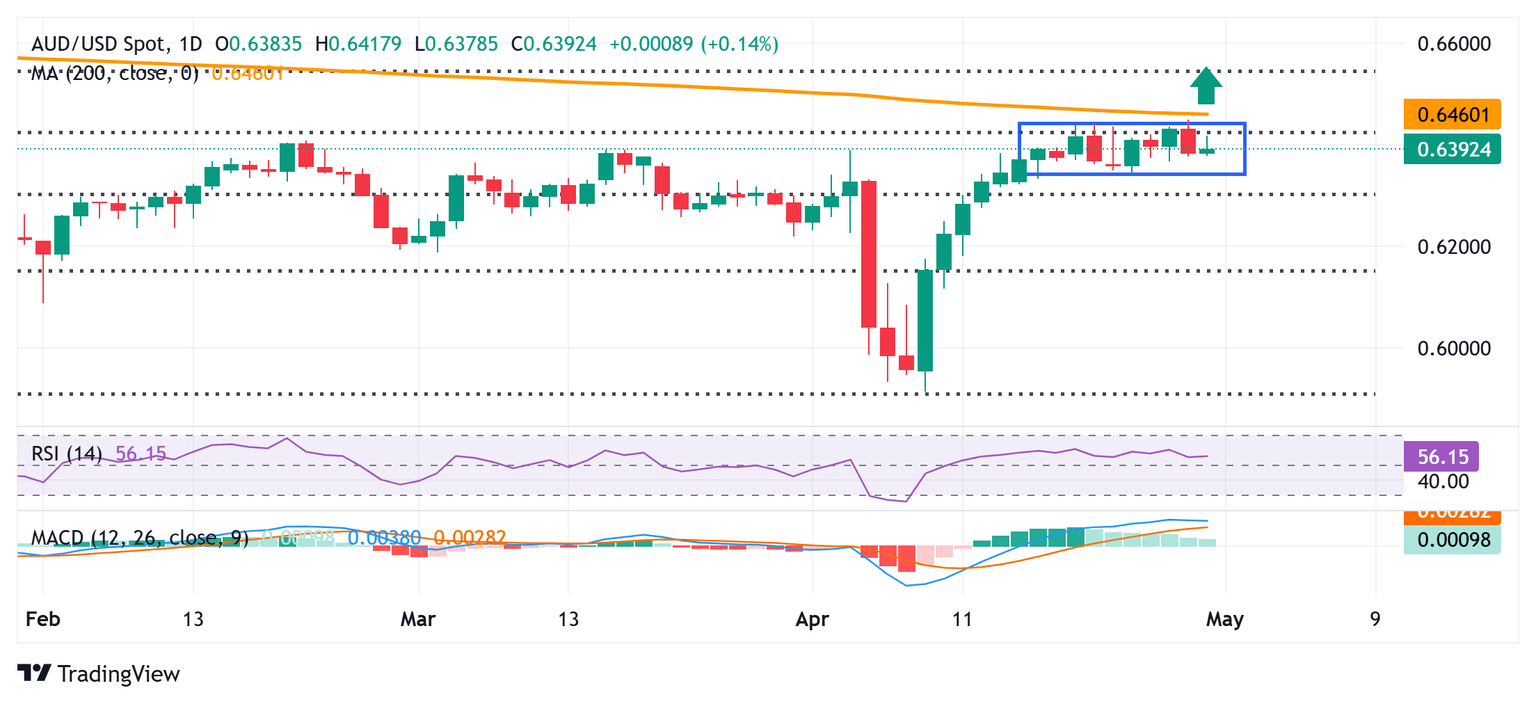
The USD uptick, however, lacks any obvious catalyst and could be attributed to some repositioning trade ahead of the key US macro data and month-end flow. Wednesday's US economic docket features the ADP report on private-sector employment, the Advance Q1 GDP print, and the Personal Consumption and Expenditure (PCE) Price Index. Apart from this, the crucial US Nonfarm Payrolls (NFP) report on Friday might provide a fresh insight into the Federal Reserve's (Fed) policy outlook, which, in turn, will drive the buck and provide some meaningful impetus to the AUD/USD pair. In the meantime, rising bets that the US central bank will resume its rate-cutting cycle in June, and deliver up to 100 bps in cuts by the year-end, might hold back the USD bulls from positioning for any further gains. This suggests that the path of least resistance for the currency pair is to the upside and supports prospects for an eventual breakout through over a one-week-old range.
AUD/USD daily chart
Technical Outlook
The range-bound price action might be categorized as a bullish consolidation phase against the backdrop of the AUD/USD pair's recent sharp recovery from the 0.5900 neighborhood, or a five-year low touched earlier last week. Moreover, the recent breakout above the 100-day Simple Moving Average (SMA) – for the first time since October 2024 – and positive oscillators on the daily chart validate the positive outlook. That said, repeated failures near the 50% Fibonacci retracement level of the September 2024-April 2025 downfall make it prudent for bulls to wait for some follow-through buying beyond the overnight swing high, around mid-0.6400s, before placing fresh bets.
The AUD/USD pair might then surpass the 200-day SMA hurdle near the 0.6465 region and reclaim the 0.6500 psychological mark. The momentum could extend further towards the 61.8% Fibo. level, around the 0.6545 region en route to the 0.6600 mark and the next relevant resistance near the 0.6650 area. Spot prices might eventually aim to challenge the November 2024 swing high, around the 0.6700 neighborhood.
On the flip side, the lower boundary of the short-term trading range, around the 0.6350-0.6345 region, might offer immediate support ahead of the 0.6300 mark (38.2% Fibo. level). This is closely followed by the 100-day SMA, currently around the 0.6280 region, which if decisively might prompt some technical selling. The AUD/USD pair might then accelerate the corrective slide to the 0.6220 intermediate support en route to sub-0.6200 levels and the next relevant support is pegged near the 0.6130 area. Failure to defend the said support levels will negate any near-term positive outlook and shift the bias in favor of bearish traders.
Premium
You have reached your limit of 3 free articles for this month.
Start your subscription and get access to all our original articles.
Author
Haresh Menghani
FXStreet
Haresh Menghani is a detail-oriented professional with 10+ years of extensive experience in analysing the global financial markets.