AUD/USD Price Forecast: Remains at the mercy of USD price dynamics after RBA’s 25 bps rate cut
- AUD/USD ticks higher in reaction to the RBA’s widely expected 25 bps rate cut on Tuesday.
- Rebounding US bond yields revive the USD demand and cap the pair amid trade war fears.
- The technical setup favors bullish traders and supports prospects for further appreciation.

The AUD/USD pair attracts some intraday buyers after the Reserve Bank of Australia's (RBA) widely expected rate cut earlier this Tuesday, though it lacks follow-through. The RBA board members decided to lower the Official Cash Rate for the first time since November 2020, by 25 basis points (bps) from 4.35% to 4.1% following the conclusion of the February policy meeting. In its quarterly Statement on Monetary Policy, the Australian central bank noted that the cash rate was above its estimates of the neutral rate, and also lowered its inflation forecast. The bearish outlook, however, was largely offset by RBA Governor Michele Bullock's hawkish remarks, which provided a modest lift to the Australian Dollar (AUD).
Speaking at the press conference, Bullock said that the Board is alert to upside risks to inflation and that market pricing for two more quarter-point cuts this year was ambitious. The AUD/USD pair, however, struggles to capitalize on the uptick and remains below a two-month high touched on Monday amid a modest US Dollar (USD) strength. Investors remain worried about a potential escalation in global trade tensions on the back of US President Donald Trump's trade policies. This, along with a goodish pickup in the US Treasury bond yields, assists the USD Index (DXY) in staging a recovery from its lowest since December 17 touched in reaction to the disappointing release of the US Retail Sales figures last Friday.
Meanwhile, a delay in the implementation of Trump's reciprocal tariffs and the optimism over talks aimed at ending the Russia-Ukraine war remain supportive of a positive risk tone. Furthermore, bets that the Federal Reserve (Fed) might cut interest rates further this year, bolstered by the drop in US Retail Sales and mixed signals on inflation, cap gains for the buck. Apart from this, China's continuous efforts to boost the domestic economy act as a tailwind for the Aussie. This, in turn, supports prospects for a further near-term appreciating move for the AUD/USD pair. That said, the lack of any meaningful buying interest warrants some caution for bullish traders amid the uncertainty surrounding Trump's tariff plans.
Market participants now look to the release of the Empire State Manufacturing Index from the US, due later during the North American session. Furthermore, speeches by influential FOMC members would be looked upon for cues about the interest rate outlook. This, along with the US bond yields and the broader risk sentiment, will drive demand for the safe-haven Greenback and provide some impetus to the AUD/USD pair.
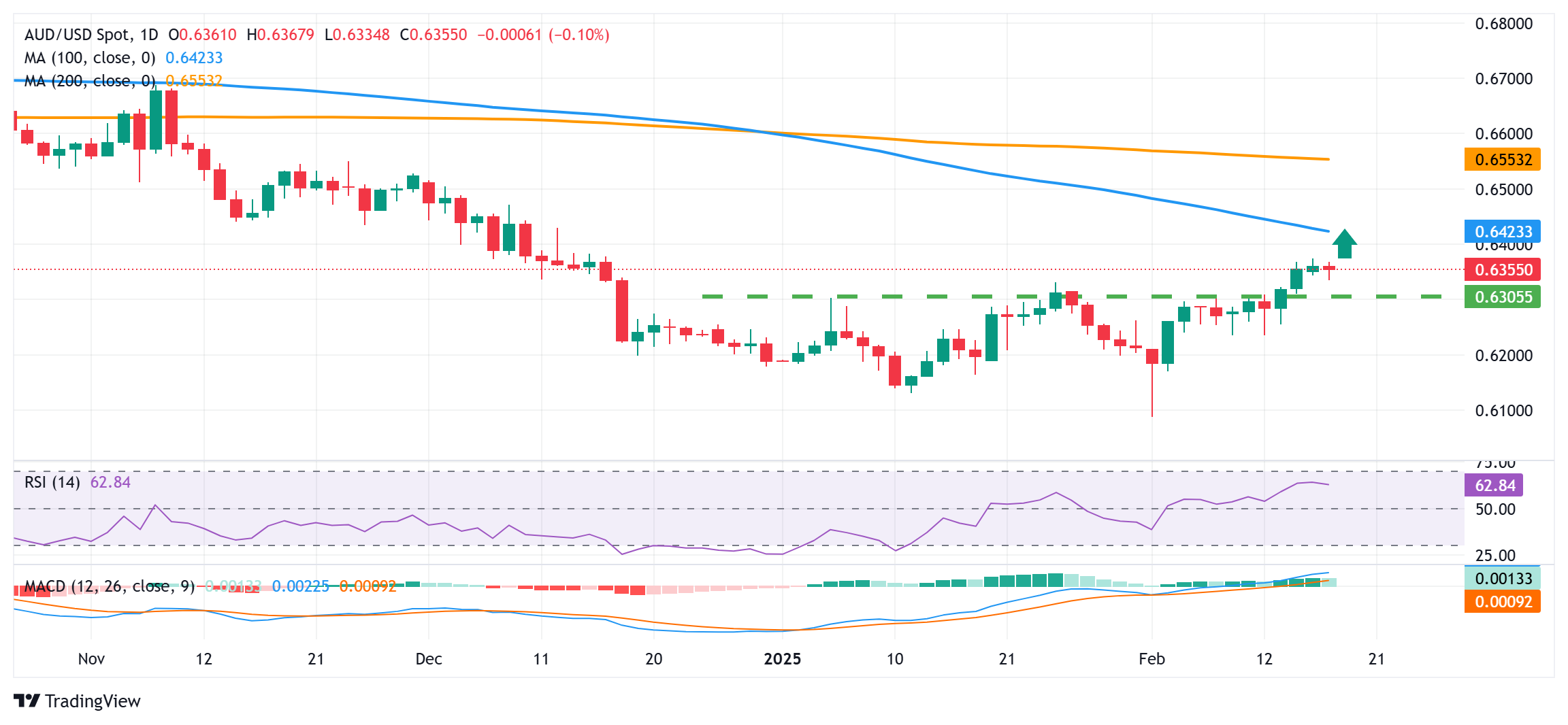
AUD/USD daily chart
Technical Outlook
From a technical perspective, sustained strength beyond the 0.6365-0.6375 region has the potential to lift the AUD/USD pair beyond the 0.6400 mark, towards the 100-day Simple Moving Average (SMA), currently egged near the 0.6440 area. Some follow-through buying will be seen as a fresh trigger for bullish traders and pave the way for a move towards reclaiming the 0.6500 psychological mark for the first time since early December. The positive momentum could extend further towards testing the very important 200-day SMA, around the 0.6555-0.6560 zone.
On the flip side, the 0.6330 area now seems to have emerged as an immediate support. This is closely followed by the 0.6300 mark, which if broken could drag the AUD/USD pair further towards an intermediate support near the 0.6265 region en route to the 0.6240-0.6235 zone. Some follow-through selling might shift the near-term bias back in favor of bearish traders. Spot prices might then weaken further below the 0.6200 mark, towards the 0.6145 support before eventually dropping to the sub-0.6100 levels, or the year-to-date low touched earlier this month.
Author

Haresh Menghani
FXStreet
Haresh Menghani is a detail-oriented professional with 10+ years of extensive experience in analysing the global financial markets.